%20%20--%3E%0A%3Csvg%20version%3D%221.1%22%20id%3D%22Layer_1%22%20xmlns%3D%22http%3A%2F%2Fwww.w3.org%2F2000%2Fsvg%22%20xmlns%3Axlink%3D%22http%3A%2F%2Fwww.w3.org%2F1999%2Fxlink%22%20x%3D%220px%22%20y%3D%220px%22%0A%09%20width%3D%2239px%22%20height%3D%2240px%22%20viewBox%3D%220%200%2039%2040%22%20enable-background%3D%22new%200%200%2039%2040%22%20xml%3Aspace%3D%22preserve%22%3E%0A%3Cpath%20fill%3D%22%23FFFFFF%22%20d%3D%22M38.5%2C7H28.2v26h10.3V7z%22%2F%3E%0A%3Cpath%20fill-rule%3D%22evenodd%22%20clip-rule%3D%22evenodd%22%20fill%3D%22%23FFFFFF%22%20d%3D%22M26.1%2C25.5c0%2C5.8-4.1%2C7.5-12.9%2C7.5C3.9%2C33%2C0%2C31.2%2C0%2C25.2v-1.1h11.6%0A%09v2.4c0%2C0.7%2C0.1%2C1.4%2C1.2%2C1.4c1%2C0%2C1.2-0.4%2C1.2-1.3v-0.9c0-1.6-0.9-1.6-3.5-2.2C2.2%2C21.7%2C0%2C19.7%2C0%2C15.3v-0.9C0%2C9.3%2C5.5%2C7%2C12.9%2C7%0A%09c10.2%2C0%2C12.8%2C2.6%2C12.8%2C7.4v1.8h-11v-2.9c0-0.6-0.4-1.1-1.2-1.1c-0.6%2C0-1.2%2C0.4-1.2%2C1.1v0.9c0%2C1.5%2C0.9%2C2%2C3.3%2C2.5%0A%09c8%2C1.6%2C10.5%2C3.3%2C10.5%2C7.5V25.5z%22%2F%3E%0A%3C%2Fsvg%3E%0A)
How Scoring Works in Olympic Moguls
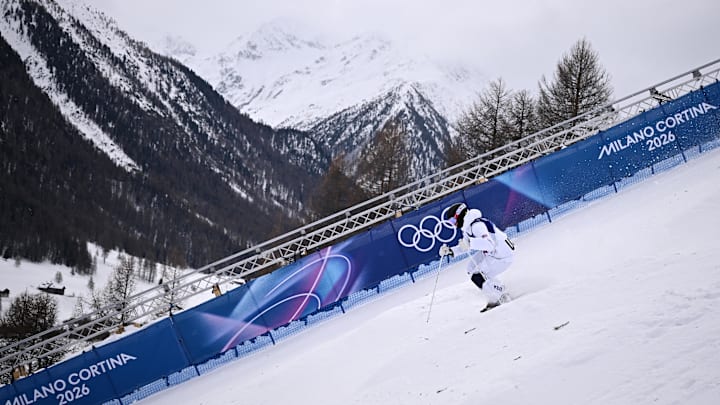
Team USA was out in full force on Wednesday morning when athletes Elizabeth Lemley (82.30) and Jaelin Kauf (80.77) took gold and silver, respectively, in freestyle skiing women's moguls.
Both Americans beat out Bronze medalist Perrine Laffont of France, who scored a 78.00, as well as defending champion Jakara Anthony of Australia (60.81), who shockingly fell to the bottom of the pack after a rocky first jump in the second final.
In the interest of better understanding the numbers attached to each of the aforementioned athletes, as well as in preparation for the men's finals on Thursday, let's take a quick look at how scoring works in Olympic moguls.
What is moguls skiing?
Anyone who has skied knows how hard a mountain can be on your knees. Now, imagine the mountain you are hurtling down is covered in bumps, and your knees are working overtime to help carve around said bumps, lest you violently crash into the ground.
That's moguls skiing.
A subsection of freestyle skiing, this fast-paced winter sport also requires a combination of "technical turns, jumps, aerial maneuvers and speed," per the Olympics website, both to avoid those run-ending bumps and to increase an athlete's overall score.
Liz Lemley is as GOOD AS GOLD in her #WinterOlympics debut. 💪 pic.twitter.com/vTKIwtAsfW
— NBC Olympics & Paralympics (@NBCOlympics) February 11, 2026
How are moguls runs scored?
A skier's score on a mogul run comes down to three different pillars: technique, aerial maneuvers and speed. Each of these pillars holds a different weight in the overall score.
Technique, which counts for 60% of a skier's score, is the key piece of the equation. Here, judges look at the "fluidity" and "precision" of the athlete as they carve down the mountain. A strong technique score means the skier remained "stable while skiing over the irregularities of the course" and executed "symmetrical and controlled turns," as outlined on the Olympics website.
Aerial maneuvers, meanwhile, account of 20% of the score. Each skier must perform two jumps during their run, which are rated according to the following criteria:
- The difficulty of the trick
- The height of the jump
- The quality of execution
- The landing (Was it stable? Were there any mistakes/errors?)
Athletes can maximize their score here by adding accoutrements like rotations, flips, and grabs.
And finally, there's speed, which accounts for 20% of an athlete's score. The time it takes a skier to reach the finish line is compared to a reference time; the faster the faster a skier's run, the more points they can earn.
That said, the maximum possible score for speed is 20 points. If a skier goes too fast, it could affect their control and therefore their technical score and their jumps; going too slow, meanwhile, will hurt their speed score.
What if there is a tie?
In the event of a tie, wherein multiple athletes earn the same total score, judges prioritize the technical score. If that's not enough, they look at the individual aerial maneuvers scores. And if that's still not enough, the speed score is used to break the tie.
What is dual moguls skiing?
Dual mogals skiing, making its debut at the 2026 Winter Olympics, is a variation of moguls skiing in which two athletes compete against one another on the same course.
When are the moguls events at the 2026 Winter Olympics?
The women's moguls finals were held on Wednesday, Feb. 11. Team USA's Elizabeth Lemley and Jaelin Kauf won gold and silver, respectively, while Perrine Laffont of France won Bronze.
Women's dual moguls, however, are slated for Saturday, Feb. 14.
On the men's side, moguls finals will be held on Thursday, February 12, starting at 6:15 a.m. ET. Dual moguls are that Sunday, Feb. 15, starting at 4:30 a.m. ET.
For a full look at the Winter Olympics TV schedule, with all times listed in ET, click here.
More Winter Olympics on Sports Illustrated
 Add us as a preferred source on Google
Brigid Kennedy is a writer for the Features and Franchises team at Sports Illustrated. Before joining SI in November 2024, she covered political news, sporting news and culture at TheWeek.com before moving to Livingetc, an interior design magazine. She is a graduate of Syracuse University, dual majoring in television, radio and film (from the Newhouse School of Public Communications) and marketing managment (from the Whitman School of Management). Offline, she enjoys going to the movies, reading and watching the Steelers.