%20%20--%3E%0A%3Csvg%20version%3D%221.1%22%20id%3D%22Layer_1%22%20xmlns%3D%22http%3A%2F%2Fwww.w3.org%2F2000%2Fsvg%22%20xmlns%3Axlink%3D%22http%3A%2F%2Fwww.w3.org%2F1999%2Fxlink%22%20x%3D%220px%22%20y%3D%220px%22%0A%09%20width%3D%2239px%22%20height%3D%2240px%22%20viewBox%3D%220%200%2039%2040%22%20enable-background%3D%22new%200%200%2039%2040%22%20xml%3Aspace%3D%22preserve%22%3E%0A%3Cpath%20fill%3D%22%23FFFFFF%22%20d%3D%22M38.5%2C7H28.2v26h10.3V7z%22%2F%3E%0A%3Cpath%20fill-rule%3D%22evenodd%22%20clip-rule%3D%22evenodd%22%20fill%3D%22%23FFFFFF%22%20d%3D%22M26.1%2C25.5c0%2C5.8-4.1%2C7.5-12.9%2C7.5C3.9%2C33%2C0%2C31.2%2C0%2C25.2v-1.1h11.6%0A%09v2.4c0%2C0.7%2C0.1%2C1.4%2C1.2%2C1.4c1%2C0%2C1.2-0.4%2C1.2-1.3v-0.9c0-1.6-0.9-1.6-3.5-2.2C2.2%2C21.7%2C0%2C19.7%2C0%2C15.3v-0.9C0%2C9.3%2C5.5%2C7%2C12.9%2C7%0A%09c10.2%2C0%2C12.8%2C2.6%2C12.8%2C7.4v1.8h-11v-2.9c0-0.6-0.4-1.1-1.2-1.1c-0.6%2C0-1.2%2C0.4-1.2%2C1.1v0.9c0%2C1.5%2C0.9%2C2%2C3.3%2C2.5%0A%09c8%2C1.6%2C10.5%2C3.3%2C10.5%2C7.5V25.5z%22%2F%3E%0A%3C%2Fsvg%3E%0A)
The American Breaststroke Revolution Is Fueled by Accidental Stars
IRVINE, Calif. — If you want to fully appreciate the beguiling beauty of breaststroke, the quirkiest of swimming disciplines, consider where the fastest American man and woman were four years ago.
McKenzie Siroky, who Thursday night won the gold medal in the women’s 100 breast at the Pan Pacific Championships, was a hockey player who had committed to play collegiately at Minnesota-Duluth—a serious hockey school. Her swimming career consisted of summer club and high school teams. She had never been a year-round swimmer to that point and never competed in a long-course pool (50 meters).
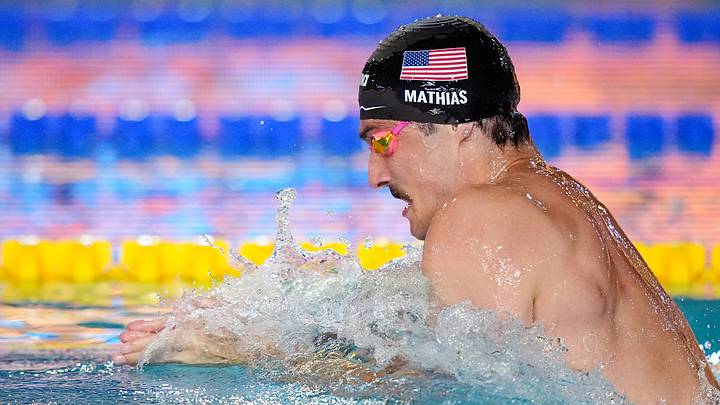
Van Mathias, who Thursday night won gold in the men’s 100 breast, giving him the four fastest times in the world this year in that event, was a distance butterflyer of modest renown. He wouldn’t become a sprint breaststroker until the following season, his fifth at Indiana, and then quit the sport for two years before making a comeback as a part-time competitor and full-time director of operations for IU’s swimming program.
Both went from complete nonfactors to prime 2028 Olympic threats and major cogs in USA Swimming’s plans for those Los Angeles Games.
This is the nature of breaststroke, and breaststrokers. They can arrive from parts unknown, not necessarily beholden to a traditional path through a powerhouse club or college team. They can come and go with jarring suddenness, comets streaking through the water and then disappearing just as fast.
And they’re born as much as made, requiring an ankle pronation that not everyone possesses. (Just look at their feet. For many breaststrokers, they naturally splay out when standing still, as opposed to pointing inward. If you’re pigeon-toed, it is likely not the stroke for you.)
“I don’t have many givens in breaststroke,” says Indiana coach Ray Looze, who mentors Mathias and has multiple Olympic medalist breaststrokers. “It’s a stroke that can literally break your heart because it can come and go for no reason. So we just try to keep an open mind to how we train it, what we do with technique. And we’re always on the lookout for somebody that’s under the radar.”
Nobody has come farther from off the radar than Siroky, who finally gave up the hockey dream for swimming in 2023. She took a gap year before enrolling at Tennessee in ’23–24, opting to train at home in Michigan for the Olympic Trials and shockingly making the eight-woman final. (She finished seventh.) Last summer she swam fast enough to make the USA Pan-Pacs squad, another big step forward, and Thursday night Siroky took it to the next level by holding off China’s Tan Qianting, silver medalist in the event at the Paris Olympics; Japan’s Satomi Suzuki, who won three medals at the 2012 Olympics; and her superstar American teammate, Kate Douglass, winner of five Olympic medals.

When Siroky saw that she won the event at Woollett Aquatic Center in a time of 1:05.32, her lifetime best and the second-fastest in the world this year, she celebrated with gusto. The 21-year-old slapped her hand down on the water, beckoned the fans to cheer louder and looked ready to headbutt someone.
“I wanted to get out [of the pool] and rip a little hockey celly, but I don’t have a stick or something,” she said. “I would love to get out and just go jump in the crowd if we were closer to the [bleachers].”
Siroky followed that triumph with a silver medal Friday night in the 50 breaststroke. When coming out for that race, she looked like a boxer bouncing on her toes, then slapping hands with fans behind the blocks.
“I need to get some of my power and energy out,” she said. “I want to walk out in a robe and gloves. I feel like it’s just energy. That brings me joy to see people enjoying the sport. And I think you need to have fun. You need to have energy.”
The 25-year-old Mathias wasn’t quite as emotive when he won in a time of 58.02, but he did climb up on the lane line and encouraged the crowd to cheer a little louder. He missed breaking his own American record by .01, but it continued a dazzling performance here in his first major international meet. Forget the Pan-Pacs, he’s made it the Van-Pacs, as one sign in the stands read Thursday.
Mathias also took a silver in the men’s 50 breast, which was a tremendous swim considering he was laid low by back spasms after the prelims Friday. He said it wasn’t until 90 minutes before his event at night that he knew he could go.
“I felt pretty good in the water [in warmups], so might as well just send it,” he said. “I’m so happy with that because I couldn’t walk maybe six hours ago. So I’ll take that all day.”
Mathias previously took a silver medal in the 50 butterfly and swam the breaststroke leg on the U.S.’s gold medal–winning mixed medley relay that broke the world record. Fake mustaches have begun popping up on fans as well, an homage to Mathias’s ’stache of rapidly growing renown. In a sport that abhors body hair, he’s not shaving it.

The turnaround from that relay world record Wednesday night to swimming again Thursday was a tough one. The race didn’t end until nearly 10 p.m. PT, and after a medal ceremony, interviews and drug testing, the American quartet didn’t leave the pool for their hotel until after midnight. The toll showed a bit on freestyler Douglass and butterflyer Gretchen Walsh, who finished fourth and second, respectively, in the 100 breast and 100 freestyle Thursday night.
But Mathias powered through, showing a staying power beyond 50-meter sprint events. His 2026 season has been on an inexorable trajectory of improvement and achievement.
“I mean, this wasn’t a priority, maybe at the beginning of the year and it’s kind of turned into one,” Mathias said of the 100 breast. “So we’re still figuring out how we can race that well and still be good at the other events. But I think it’s a good step, and hopefully I just keep getting better and better.”

One thing the accidental American breaststroke stars have in common: incredible strength. Siroky is built like a former hockey player, with powerful arms and legs. Mathias is a ripped 200 pounds, big across his upper body and possessing huge quadriceps.
“If he’s not the strongest guy in USA Swimming, I would be surprised,” Looze says. “He is a monster.”
Back willing, Mathias and Siroky will be chasing more medals on Saturday night in the medley relays. (Mathias is also entered in the 50 free Saturday.) They’re on the leading edge of a USA Swimming program in transition in that area, after the retirements of Lilly King and Nic Fink.
Their ascendance is a welcome development pointing toward L.A. in 2028. They are two more examples of the unforeseeable magic that can happen in the strangest stroke.
 Add us as a preferred source on Google
Pat Forde is a senior writer for Sports Illustrated who covers college football and college basketball as well as the Olympics and horse racing. He cohosts the Others Receiving Votes podcast for SI and is a regular contributor to the Tony Kornheiser Show podcast. He previously worked for Yahoo Sports, ESPN and The (Louisville) Courier-Journal. Forde has won 28 Associated Press Sports Editors writing contest awards, has been published three times in the Best American Sports Writing book series, and was nominated for the 1990 Pulitzer Prize. A past president of the U.S. Basketball Writers Association and member of the Football Writers Association of America, he lives in Louisville with his wife. They have three children, all of whom were collegiate swimmers.
Follow ByPatForde