%20%20--%3E%0A%3Csvg%20version%3D%221.1%22%20id%3D%22Layer_1%22%20xmlns%3D%22http%3A%2F%2Fwww.w3.org%2F2000%2Fsvg%22%20xmlns%3Axlink%3D%22http%3A%2F%2Fwww.w3.org%2F1999%2Fxlink%22%20x%3D%220px%22%20y%3D%220px%22%0A%09%20width%3D%2239px%22%20height%3D%2240px%22%20viewBox%3D%220%200%2039%2040%22%20enable-background%3D%22new%200%200%2039%2040%22%20xml%3Aspace%3D%22preserve%22%3E%0A%3Cpath%20fill%3D%22%23FFFFFF%22%20d%3D%22M38.5%2C7H28.2v26h10.3V7z%22%2F%3E%0A%3Cpath%20fill-rule%3D%22evenodd%22%20clip-rule%3D%22evenodd%22%20fill%3D%22%23FFFFFF%22%20d%3D%22M26.1%2C25.5c0%2C5.8-4.1%2C7.5-12.9%2C7.5C3.9%2C33%2C0%2C31.2%2C0%2C25.2v-1.1h11.6%0A%09v2.4c0%2C0.7%2C0.1%2C1.4%2C1.2%2C1.4c1%2C0%2C1.2-0.4%2C1.2-1.3v-0.9c0-1.6-0.9-1.6-3.5-2.2C2.2%2C21.7%2C0%2C19.7%2C0%2C15.3v-0.9C0%2C9.3%2C5.5%2C7%2C12.9%2C7%0A%09c10.2%2C0%2C12.8%2C2.6%2C12.8%2C7.4v1.8h-11v-2.9c0-0.6-0.4-1.1-1.2-1.1c-0.6%2C0-1.2%2C0.4-1.2%2C1.1v0.9c0%2C1.5%2C0.9%2C2%2C3.3%2C2.5%0A%09c8%2C1.6%2C10.5%2C3.3%2C10.5%2C7.5V25.5z%22%2F%3E%0A%3C%2Fsvg%3E%0A)
The Most Interesting Man in Swimming Is Doing Less, But Setting Records
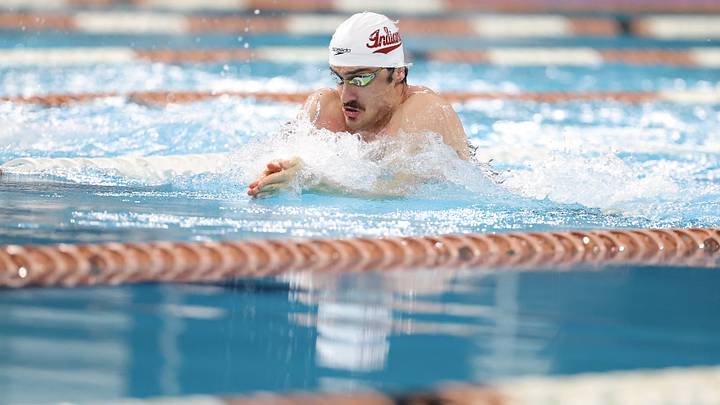
BLOOMINGTON, Ind. — It’s 7:30 a.m. on a cloudless August day in the heartland, the sun just cresting the limestone hills that surround Indiana University. School is not in session, and the campus is still. As classic rock quietly plays on the loudspeakers at the IU outdoor pool, two members of the U.S. national swim team barely disturb the 10-lane, 50-meter expanse of water.
As his swimmers softly splash through the early stages of their workout, Hoosiers coach Ray Looze holds two pieces of paper. The one in his right hand is an 8-by-11 printout of the 5,000-meter practice plan for freestyler and Olympic silver medalist Anna Peplowski. The paper in his left hand, the size of a Post-it note, is the practice plan for the most interesting man in swimming, Van Mathias. Total distance of that one: 1,400 meters, a spa treatment of a workout.
“This,” Looze says of the small scrap of paper, “is the future.”
In a sport built on the daily grind of grueling distance, hour upon hour spent straining lungs while staring at a black line on the bottom of a pool, Mathias could be an avatar of change. He’s in and out of the water in 38 minutes on this day, not even long enough to prune the fingers, while Peplowski plowed on much longer.
Short, fast, focused workouts in the water, buttressed by intense power-building sessions in the weight room are having a transformative impact on the swimming world. So-called “race-pace training,” which leans on less heavy yardage, has been around and increasingly in vogue for a while, but this is next-level stuff.
It’s not necessarily for everyone. The current best swimmers in the world, Léon Marchand of France and Summer McIntosh of Canada, didn’t get that way by babying themselves, and they’re currently coached by the guru of the grind, Bob Bowman. But sprinters—especially male sprinters—are seeing the benefits of the kind of training Mathias is doing. Australian Cameron McEvoy, at age 31, took down the 17-year-old world record in the 50 freestyle in the spring, declaring that “more yardage isn’t the answer.”
Mathias is an adherent to what has been called the “McEvoy Method.” Indiana sprint coach John Long Jr. writes the splash-and-dash workouts for Mathias—and Looze, a hard-charging, high-yardage member of the coaching old guard, has seen the light.
“I’m the last person on the face of the coaching earth that people would’ve thought would sign off on this,” says the 59-year-old Looze, now in his 24th year as the coach at Indiana. “But this is perfect for him. He keeps getting better.”
How much better is the 25-year-old? Mathias has rocketed from retirement and relative obscurity to the American record holder in both the 50-meter and 100-meter breaststroke. Heading into the Pan Pacific Championships this week in Irvine, Calif., where the top U.S. swimmers will take on rivals from Australia, Japan, China, Canada, Brazil and elsewhere, Mathias has the three fastest times in the world this year in the 100 breast and is also No. 1 internationally in the 50.
If anyone is going to set fire to conventional thinking in the sport, it might as well be Van Mathias—a part-time swimmer with a full-time day job as Indiana’s director of swimming operations. Might as well be someone who did not compete from April 2023 through June 2025, then metamorphosed from a distance butterflyer into a sprint breaststroker. Might as well be a guy who shuns the traditional full shave, even for the biggest meets, competing with a mustache that Indiana icon Mark Spitz would admire.
“I’m scared that if I shave it, I might lose all my powers,” Mathias says with a laugh while toweling off at poolside. “And my thinking is that confidence is key. Look good, feel good. So for now it’s going to stay.”

For now, midway through the olympiad between Paris in 2024 and Los Angeles in ’28. Mathias is the male breaststroker USA Swimming desperately needs. America had fallen behind in that stroke, and part of the penalty for that was a historic defeat.
The U.S. had never lost a 400 medley relay in the Olympics, the country’s most enduring point of swimming pride. That changed in Paris, when the Yanks were dethroned by China. Blame did not all land at the feet of breaststroker Nic Fink—this was an aging relay lineup trying to rekindle past glory—but he was fourth fastest of the eight finalists in a race the U.S. lost by half a second. Fink won silver in the individual 100 breast, but the Americans missed the podium in the 200.
It got worse last year, after Fink retired. At the 2025 world championships, Americans were shut out of the eight-man final in the 50 breast, recorded a fifth-place finish in the 200 and a seventh in the 100.
At Indiana, these shortcomings carried greater gravity. Looze has long been America’s foremost breaststroke builder, guiding the legendary Lilly King to world records and gold medals and coaching 2016 Olympic relay gold medalist Cody Miller, among others. Then the rest of the world surged past the Stars and Stripes.
“We were terrible as a country in breaststroke and I was contributing to that,” Looze says. “I wasn’t doing anything to help.”
Enter Van Mathias. Through the back door.
The Portland product had been a good swimmer at Indiana for four seasons from 2018 to ’22, qualifying for NCAA championships in butterfly and individual medley races, plus relays, but never cracking the top eight in an individual event. With a fifth year of eligibility available after the pandemic, Mathias and his coaches tinkered with a lineup change. Before the Big Ten championships, they decided to “throw me in some breaststroke and see how it goes,” he says.
It wasn’t a complete reinvention. Mathias credits his youth coach at Multnomah Athletic Club, Alex Nikitin, with instilling quality technique in all four strokes. But changing training from preparing for the perseverance of a 200-yard butterfly (roughly 100 to 105 seconds of pain management) to the urgency of a 100 breaststroke (50 seconds of fury) was an adjustment.
Mathias made it look easy, finishing second at both Big Ten and NCAA championships to Minnesota’s Max McHugh. It looked like the fitting cap to his swimming career.
He moved back home to Portland, working odd jobs and coaching a high school team while trying to figure out what he wanted to do with the rest of his life. Mathias also started lifting weights with an uncle and his mom, Nancy Maxwell, who was a competitive bodybuilder.
“I was not touching the water at all,” Mathias says. “Only the weights.”
About a year after leaving Indiana, Looze called him and offered his director of operations position. Mathias came back to Bloomington for an office job, not a swimming renaissance. But after being around the program and on the pool deck, he decided in the summer of 2025 to get back in and see what he could do as a wholly dedicated sprinter.
For the first time at the Olympic level, swimming will add the 50-meter stroke events other than freestyle in Los Angeles. That has opened up a whole new vista of opportunities. Having packed on muscle in his time away from swimming, Mathias brought a new level of power back to the pool. (He was up to 235 pounds at one point but now is around 220, thickly muscled in the chest, arms and quadriceps.)
“If he’s not the strongest guy in USA Swimming, I would be surprised,” Looze says. “He is a monster.”
Muscles aside, Mathias’s comeback was built as much on curiosity as steadfast belief. Nobody was sure what to expect.
“It was an experiment, that’s it,” Looze says. “A short-term experiment. There was no long-term thought.”
The results came together quickly. Mathias surprisingly made the Pan Pac team at U.S. nationals last summer, earning his first spot on a senior national roster. Then the 2026 season has just been a cascading effect of success, with one great performance after another.
In 33 swims at official competitions this year, Mathias has posted 21 lifetime-best times. Mathias set the American record in the 50 breast for the first time in a meet in Norway in April, then broke it again in Indianapolis in June at 26.30 seconds. At the same meet in Indy, he set the national record in the 100 at 58.01.
After breaking the record in the 50 in Indy, Mathias slung both arms over the lane line and stared into the NBC camera for several seconds. His face was an emotionless mask.
“I was screaming on the inside,” he assures.
Mathias has become a shooting star in a notoriously fickle stroke. It’s a quirky motion, often mastered by quirky people. Breaststrokers can come from just about anywhere, born as much as made, a raw talent rising up and then sometimes just as quickly receding. (The most prominent recent example: Lydia Jacoby, who came out of obscurity in Alaska with scant experience and won a stunning Olympic gold medal in the 100 breast at the Tokyo Olympics, and has not been back on a prominent international level since.)
The stroke itself is unlike freestyle, backstroke or butterfly, much more reliant on timing and rhythm. Like a golf swing, it’s beautiful when it’s on. And if it’s off by a little, it can quickly become off by a lot. Then the mind games set in.
“I don’t have many givens in breaststroke,” Looze says. “It’s a stroke that can literally break your heart because it can come and go for no reason. So we just try to keep an open mind to how we train it, what we do with technique. And we’re always on the lookout for somebody that’s under the radar.”
Mathias is under the radar no more. The success has been sudden enough and new enough that the distraction of a day job has helped Mathias deal with it. The director of ops workload is considerable, with much of the top-five national program’s daily logistics running through him. Mathias plans and books all IU swim team travel and has a major hand in recruiting, both scheduling coaches’ trips to see prospects and every element of campus visits. (The Hoosiers’ remarkable football rise has made tickets for recruits and their families on official visits a bit harder to come by.)
“I’ve tried to distract myself with work and other things to not let that feeling set in,” he says. “I think that’s when I swim my best is when there’s none of that kind of stuff floating around.”
He’ll be concentrating on his side gig this week in Irvine, trying to win medals in the 50 and 100 breast, the 50 fly and 50 free. There will also be medley relay duties. Mathias could have as many as 10 swims at Pan Pacs. If they go well, he should be a cornerstone of the U.S. men’s Olympic plans for 2028.
If the less-is-more approach continues to work for Van Mathias and others, a segment of the sport could have a training revolution on its hands. Garbage yardage out, splash-and-dash workouts in. Waterlogged swimmers everywhere could end up thanking them for the extra rest.
 Add us as a preferred source on Google
Pat Forde is a senior writer for Sports Illustrated who covers college football and college basketball as well as the Olympics and horse racing. He cohosts the Others Receiving Votes podcast for SI and is a regular contributor to the Tony Kornheiser Show podcast. He previously worked for Yahoo Sports, ESPN and The (Louisville) Courier-Journal. Forde has won 28 Associated Press Sports Editors writing contest awards, has been published three times in the Best American Sports Writing book series, and was nominated for the 1990 Pulitzer Prize. A past president of the U.S. Basketball Writers Association and member of the Football Writers Association of America, he lives in Louisville with his wife. They have three children, all of whom were collegiate swimmers.
Follow ByPatForde