%20%20--%3E%0A%3Csvg%20version%3D%221.1%22%20id%3D%22Layer_1%22%20xmlns%3D%22http%3A%2F%2Fwww.w3.org%2F2000%2Fsvg%22%20xmlns%3Axlink%3D%22http%3A%2F%2Fwww.w3.org%2F1999%2Fxlink%22%20x%3D%220px%22%20y%3D%220px%22%0A%09%20width%3D%2239px%22%20height%3D%2240px%22%20viewBox%3D%220%200%2039%2040%22%20enable-background%3D%22new%200%200%2039%2040%22%20xml%3Aspace%3D%22preserve%22%3E%0A%3Cpath%20fill%3D%22%23FFFFFF%22%20d%3D%22M38.5%2C7H28.2v26h10.3V7z%22%2F%3E%0A%3Cpath%20fill-rule%3D%22evenodd%22%20clip-rule%3D%22evenodd%22%20fill%3D%22%23FFFFFF%22%20d%3D%22M26.1%2C25.5c0%2C5.8-4.1%2C7.5-12.9%2C7.5C3.9%2C33%2C0%2C31.2%2C0%2C25.2v-1.1h11.6%0A%09v2.4c0%2C0.7%2C0.1%2C1.4%2C1.2%2C1.4c1%2C0%2C1.2-0.4%2C1.2-1.3v-0.9c0-1.6-0.9-1.6-3.5-2.2C2.2%2C21.7%2C0%2C19.7%2C0%2C15.3v-0.9C0%2C9.3%2C5.5%2C7%2C12.9%2C7%0A%09c10.2%2C0%2C12.8%2C2.6%2C12.8%2C7.4v1.8h-11v-2.9c0-0.6-0.4-1.1-1.2-1.1c-0.6%2C0-1.2%2C0.4-1.2%2C1.1v0.9c0%2C1.5%2C0.9%2C2%2C3.3%2C2.5%0A%09c8%2C1.6%2C10.5%2C3.3%2C10.5%2C7.5V25.5z%22%2F%3E%0A%3C%2Fsvg%3E%0A)
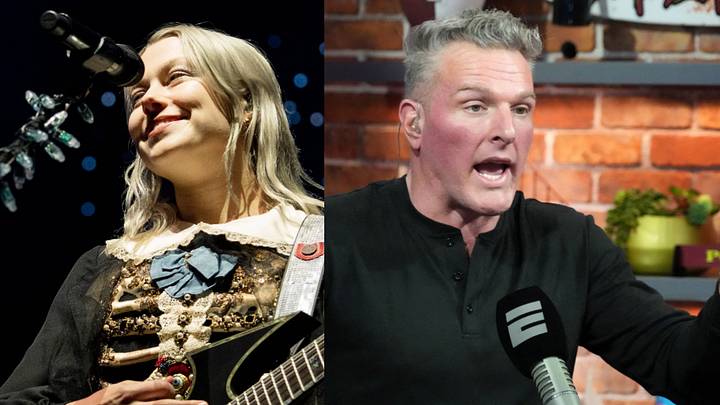
Pat McAfee vs. Phoebe Bridgers: Who Dropped the Better Album Friday?
In this story:
There are certain days in the history of popular music that fans will remember forever. Sept. 24, 1991—Nirvana’s Nevermind, A Tribe Called Quest’s The Low End Theory and the Red Hot Chili Peppers’ Blood Sugar Sex Magik. The Kanye West vs. 50 Cent chart battle of 2007. More indie-oriented fans can point to March 22, 2024, when Waxahatchee’s Tigers Blood and Adrianne Lenker’s Bright Future both lit up Pitchfork’s scoreboard.
Friday was just a such a day. On the one hand, indie-turned-mainstream icon Phoebe Bridgers released her third solo album—the searching, overwhelming Lost Weekend. On the other hand, College GameDay’s Pat McAfee dropped his solo debut—the, well, polarizing The Diary of a Polarizing Figure.
Leaving aside the fact that you could switch the two titles without anyone batting an eye, no publication to date has dared to compare the two projects. No one has dared to put “Oops” and “Rich as S---” up against “As Above” and “I Can’t Wait.” No one has dared to probe whether ERNEST makes a more artistically engaging collaborator than Alex G. No one has dared to heal America’s big city-small town divide, of which Bridgers is an unintentional and McAfee a comically-intentional avatar.
Until now.
Without further ado, let Sports Illustrated be the first to bring you the tale of the tape between two records that rocked the summer and will soon soundtrack college campuses everywhere (in all likelihood two very different corners of campus, mind you, but that’s what college is for). In the immortal words of Funkmaster Flex: if you're on the fence about [releasing] your album, push it back.
Credentials
Bridgers: Four Grammys from 11 nominations, all four won at the 2024 ceremony where she was the most decorated artist of the evening. Two classic solo albums—the folky Stranger in the Alps (2017) and expansive Punisher (2020)—as well as a giant library of collaborations, led by two supergroup albums (2019’s Better Oblivion Community Center and 2023’s The Record) and an EP (2018’s Boygenius EP).
McAfee: In music, one single entitled “Dookie.” In football, two Pro Bowl appearances. In life, quite a bit of money (more on that in a minute), thanks to a sequence of wildly successful shows at Barstool Sports, as an independent (indie, even) creator and ESPN.
Advantage: The arena is music and not field-goal kicking, so we’re going to have to give this one to Bridgers.

Supporting casts
Bridgers: Practically any indie musician of any modern relevance is on Lost Weekend, from Geese’s Cameron Winter (“Kill Me,” the mesmerizing “I Can’t Wait”) to Alex G (anywhere there is uncanny-valley elevator music, which is eveywhere) to Black Country, New Road expat Isaac Wood (bonus track “Best Dressed”). Readers in the Bridgers-McAfee demographic overlap may recognize the presence of bluegrass workhorses Nickel Creek. And then there are her Boygenius bandmates Julien Baker and Lucy Dacus on “Lost Boys” and “Haunted.”
McAfee: From Nilaav Ranjan Gogoi of EssentiallySports: “Country music star Jelly Roll connected Pat McAfee with Nashville singer-songwriter and producer ERNEST, who helped the former NFL player record his debut album with professional studio musicians.” Even acknowledging McAfee and Jelly Roll run in similar WWE circles—and that McAfee wasn’t going to sit down and pound out American Heartbreak—a truly terrifying sentence.
Advantage: If the College GameDay crew were going up against the Bridgers-verse, it’d be a fairer fight—both have good dogs to spare. Unfortunately, McAfee might as well be on his own here. Another point for Bridgers.
Thematic heft
Bridgers: Much of Bridgers’s work probes the nature of grief, the ephemeral nature of love and the trappings of fame. On Lost Weekend, these themes are found in abundance from the get-go, as opening track “The Outside” sees Bridgers seemingly cracking uncomfortable jokes about her father’s funeral.
McAfee: Much of McAfee’s work probes the nature of receiving mind-numbingly large paychecks from the Walt Disney Company, and using said paychecks to stick it to the haters. On “Blue Collar Symphony” he threatens self-awareness by alluding to his Western Pennsylvania upbringing, but don’t worry, he’s insisting (in what he claims is the oldest song in his bag) he wants to be “rich as s--t before I die” soon enough.
Advantage: We’ll bust the myth that indie rock is above materialism—much of Alex G’s last album, Headlights, covers this topic in a song ironically about punting. However, it’s hard to believe that even an admitted hobbyist can’t do better than “I wanna be rich as s---.” Point Bridgers.
Disses
Bridgers: “The Governor’s Waltz” certainly reads like a searing diss of Gracie Abrams, the Candlebox to Bridgers’s Nirvana and girlfriend of Bridgers’s ex, Oscar nominee Paul Mescal. Elliott Smith, a Bridgers idol with a famously acidic pen, might’ve influenced this line of thinking.
McAfee: Anyone and everyone. “Lame bros” and “Aunt Karens” (“Pitbull and a Mugshot”). “Folks considered trustable” (“Polarizing Figure”). “Bunch of puppets with some pens” (“Outlaws”—wait a minute, is this f---ing play about us?). Hard to say who might’ve influenced this line of thinking.
Advantage: Smith, and therefore Bridgers.

Trend chasing
Bridgers: There are hints of the musical trends that have arisen since 2020 on Lost Weekend—a little Dijon-inflected stop-and-start alt-R&B here, a little Mustafa-flavored electro-folk-into-roots music there—but the record’s real miracle is the extent to which it does not chase trends. Credit Bridgers for avoiding falling back on her sound, which has become in indie rock what “Drake featuring Drake” was to early-2010s radio rap.
McAfee: Go to Morgan Wallen’s discography on Wikipedia, click under “singles,” and behold those sweet, sweet certifications.
Advantage: Bridgers.
Fandoms
Bridgers: Please don’t accost me for putting Bridgers and McAfee in the same sentences.
McAfee: Please don’t accost me for putting Bridgers and McAfee in the same sentences.
Advantage: Tie, because I want to live.
Use of electronics
Bridgers: Critics have been comparing this album to Kid A for a reason. It’s a lofty comparison, but the last blockbuster guitar-first album to use electronic music this creatively might be ... Frank Ocean’s Blonde?
McAfee: Really? Really? You, Mr. McAfee, really “started plugging [your] lyrics in and chanting it into [AI music generator] Suno and getting Suno demos of [your] songs,” per ERNEST on the Whiskey Riff Raff podcast? You don’t have the means to fly down and snag a couple hours with Nashville’s enormous songwriting ecosystem, and do this the old-fashioned way? From one Patrick to another, have some respect for your fans! Have some respect for yourself!
Advantage: Bridgers, and she gets one million points for this one.

Money quote from critics
Bridgers: “For all the time that’s passed, and all the ways her sound has been cemented in both pop and indie music around her, the greatest achievement of Lost Weekend is how it presents Bridgers as an object in motion, in a world of her own”—Sam Sodomsky, Pitchfork.
McAfee: “‘They say the good die young and I’m scared im great’ What a line”—Dan Orlovsky, ESPN.
Advantage: Bridgers.
Live performance aspect
Bridgers: Touring North American and European arenas from September to December in a series of no-phone shows.
McAfee: Kirk Herbstreit is threatening to have McAfee perform on College GameDay.
Advantage: Bridgers, because you can choose not to spend money on concert tickets, but if you’re a college football fan you can’t in your heart of hearts opt out of College GameDay.
Final verdict
First things first: Lost Weekend is a classic, superior to both Stranger in the Alps and Punisher—you heard me—and one of the 2020s’ signature releases. Saturday Night Live, the Grammys, your cousin at Amherst or Oberlin’s stocking—this record likely has a long life ahead it. Bridgers is our winner.
As for McAfee? The former West Virginia kicker’s schtick is not for everyone—he knows it, he internalizes it, and he luxuriates in the fact both on the album and off it. In focusing on his haters, however, McAfee has forgotten a key element of his appeal (a polarizing figure has to have two poles, after all). You can accuse him of being loud, vacuous and shallow—you’d be broadly correct—but you cannot accuse him, at least onscreen, of hovering above the masses.
On The Diary of a Polarizing Figure, he does just that, making for an irritable listen even by novelty-music standards. McAfee would be wise to heed the words of Pulp frontman Jarvis Cocker—words that could be flipped into a motto for College GameDay, and words that sum up that show’s enduring appeal.
Listen to SI’s college sports podcast, Others Receiving Votes, below or on Apple and Spotify. Watch the show on SI’s College YouTube channel.
 Add us as a preferred source on Google
Patrick Andres is a staff writer on the Breaking and Trending News team at Sports Illustrated. He joined SI in December 2022, having worked for The Blade, Athlon Sports, Fear the Sword and Diamond Digest. Andres has covered everything from zero-attendance Big Ten basketball to a seven-overtime college football game. He is a graduate of Northwestern University's Medill School of Journalism with a double major in history .
Follow PAndres2001