%20%20--%3E%0A%3Csvg%20version%3D%221.1%22%20id%3D%22Layer_1%22%20xmlns%3D%22http%3A%2F%2Fwww.w3.org%2F2000%2Fsvg%22%20xmlns%3Axlink%3D%22http%3A%2F%2Fwww.w3.org%2F1999%2Fxlink%22%20x%3D%220px%22%20y%3D%220px%22%0A%09%20width%3D%2239px%22%20height%3D%2240px%22%20viewBox%3D%220%200%2039%2040%22%20enable-background%3D%22new%200%200%2039%2040%22%20xml%3Aspace%3D%22preserve%22%3E%0A%3Cpath%20fill%3D%22%23FFFFFF%22%20d%3D%22M38.5%2C7H28.2v26h10.3V7z%22%2F%3E%0A%3Cpath%20fill-rule%3D%22evenodd%22%20clip-rule%3D%22evenodd%22%20fill%3D%22%23FFFFFF%22%20d%3D%22M26.1%2C25.5c0%2C5.8-4.1%2C7.5-12.9%2C7.5C3.9%2C33%2C0%2C31.2%2C0%2C25.2v-1.1h11.6%0A%09v2.4c0%2C0.7%2C0.1%2C1.4%2C1.2%2C1.4c1%2C0%2C1.2-0.4%2C1.2-1.3v-0.9c0-1.6-0.9-1.6-3.5-2.2C2.2%2C21.7%2C0%2C19.7%2C0%2C15.3v-0.9C0%2C9.3%2C5.5%2C7%2C12.9%2C7%0A%09c10.2%2C0%2C12.8%2C2.6%2C12.8%2C7.4v1.8h-11v-2.9c0-0.6-0.4-1.1-1.2-1.1c-0.6%2C0-1.2%2C0.4-1.2%2C1.1v0.9c0%2C1.5%2C0.9%2C2%2C3.3%2C2.5%0A%09c8%2C1.6%2C10.5%2C3.3%2C10.5%2C7.5V25.5z%22%2F%3E%0A%3C%2Fsvg%3E%0A)
The 10 Best World Cup Teams of All Time—Ranked
Every four years, the FIFA World Cup produces a different story.
Some nations quietly fade away, others fail to live up to expectations, while a few capture the imagination—like Cabo Verde in 2026, which defied the odds to reach the knockout stages and came within touching distance of eliminating Argentina.
Then there are the teams that do far more than enjoy a memorable tournament—they leave a lasting mark on soccer history.
Whether by dominating the competition, overcoming seemingly impossible odds or introducing a revolutionary style of play to the global stage, these sides have become benchmarks for greatness.
With that in mind, Sports Illustrated has ranked the 10 greatest World Cup teams of all time.
10. Argentina (1986)

Though the 1986 World Cup is rightly remembered as Diego Maradona’s tournament—where he dribbled, dazzled and duped his way past defenders to carry Argentina to glory—it would be a mistake to see it as a one-man show.
With the hard-working and dynamic Jorge Burruchaga controlling the midfield, Maradona had the freedom to operate at his full brilliance. Oscar Ruggeri was the combative central defender who helped keep three clean sheets and stifled some of the world’s best attacks. And let’s not forget strike partner Jorge Valdano, who netted four goals—including one in the final—just one fewer than Maradona himself.
Yes, Maradona was the star and often the decisive factor, but Carlos Bilardo’s rugged, fiercely competitive squad, operating in a revolutionary 3–5–2 formation, provided the perfect balance of steel, work ethic and tactical intelligence.
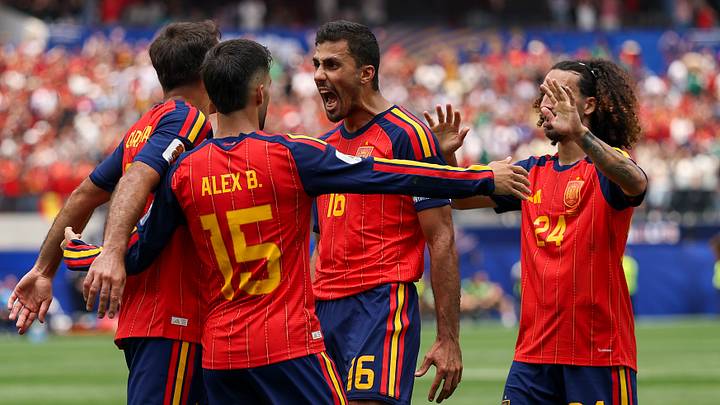
9. Spain (2026)

Spain arrived at the 2026 World Cup as reigning European champion and among the favorites, but many believed France, England, or defending champion Argentina had a better chance of lifting the trophy, with all three boasting greater depth and, especially in France’s case, more proven star power.
Those doubts only intensified after La Roja was held to a surprise draw by Cabo Verde in its opening group match.
However, Spain quickly silenced the critics. It stormed through the rest of the tournament, becoming the first team in World Cup history to win the title while conceding just one goal—a remarkable achievement that highlighted the evolution of its traditional style.
As expected, Rodri and Pedri controlled matches from midfield with their trademark composure, but this Spain side was built on far more than possession. Marc Cucurella provided relentless energy at left back, keeping the likes of France’s Michael Olise and Argentina’s Lionel Messi quiet in the semifinal and final, while Pau Cubarsí and Aymeric Laporte formed a commanding central defensive partnership reminiscent of Carles Puyol and Gerard Piqué. Behind them, Unai Simón offered experience and reliability between the sticks, finishing the tournament with seven clean sheets.
Where France looked to overwhelm opponents with attacking firepower and Argentina relied on physicality and moments of Messi brilliance, Spain found the perfect balance. It stayed true to its tiki-taka identity but combined it with a newfound defensive resilience, creating a side that controlled matches with the ball while proving extremely difficult to break down without it.
It was a triumph of teamwork, tactical intelligence, and composure—a complete World Cup-winning side that showed Spain could evolve its identity without losing what made it special.
8. Netherlands (1974)

Led by head coach Rinus Michels and star man Johan Cruyff—the on-field conductor of his manager’s Total Football vision—the Netherlands introduced a fluid, positionally interchangeable system built on movement, passing and technical brilliance unlike anything the world had seen before. It made them overwhelming favorites to win the 1974 World Cup, but they ultimately fell short.
After sweeping aside some of the world’s best teams—including Argentina and Brazil—on their way to the final, the Dutch were stopped at the last hurdle, as West Germany produced a masterclass in discipline and man-marking to shut them down.
Even in defeat, though, they were a joy to watch. This Netherlands side laid the tactical blueprint for many of the greatest teams that followed, including Spain’s dominant sides of the late 2000s and early 2010s, as well as Pep Guardiola’s all-conquering Barcelona and Manchester City sides.
7. Brazil (2002)

The sheer star power Brazil had at their disposal was truly frightening. From the flying full backs Cafu and Roberto Carlos, to defensive rock Lúcio at the back, midfield dynamo Kaká, the flair and skill of Ronaldinho, the acrobatics of Rivaldo and the ruthless finishing of Ronaldo Nazário—this was a team overflowing with world-class talent. It always felt like only one outcome was possible.
While the team’s path was eased somewhat by early exits from other heavyweights like France, Portugal and Argentina, Brazil still had to deliver—and they did so in style. The Seleção were driven by moments of individual brilliance—Ronaldinho’s unforgettable free kick against England and Ronaldo’s masterclass in the final—but also by a collective strength and balance.
An irresistible force going forward and a disciplined unit at the back, Brazil swept aside opponents with ease, scoring freely while barely conceding (just once in the knockout stages). This wasn’t just a team of superstars—it was a complete, dominant machine.
6. Brazil (1958)

The 1958 World Cup marked the birth of a true soccer icon: Pelé.
Just 17 at the time, the young Santos star took the tournament by storm, scoring six goals—three in the semifinal against France and two in the final against Sweden—showcasing a level of skill and flair the game had rarely seen before.
Brazil became the first South American team to win the World Cup on European soil, but this was far from a one-man show. Alongside Pelé were legends such as Garrincha, Didi, Nilton Santos, Djalma Santos, Vavá and future manager Mário Zagallo—a golden generation that announced Brazil’s arrival as a global soccer powerhouse.
5. Hungary (1954)

Hungary’s 1954 side is the greatest team never to win the World Cup.
Having claimed Olympic gold in 1952 and gone 28 games unbeaten heading into the tournament, the “Mighty Magyars” arrived in Switzerland as overwhelming favorites. Led by some of the game’s greatest players—Ferenc Puskás, Sándor Kocsis, Nándor Hidegkuti and József Bozsik—they were simply unstoppable.
And for much of the tournament, that dominance held. Hungary thrashed South Korea 9–0, West Germany 8–3, Brazil 4–2 and Uruguay 4–2 on their way to the final, where they would once again face West Germany.
But then came one of the greatest upsets in soccer history. The Germans stunned Hungary 3–2 in what became known as the “Miracle of Bern,” breaking Hungarian hearts and denying them immortality.
Remarkably, it was Hungary’s only defeat in a 50-match stretch from 1950–56.
4. Spain (2010)

Probably the greatest World Cup side of the modern era, Spain’s 2010 team added a world title to the European crown from two years earlier by triumphing in South Africa.
La Roja didn’t overwhelm opponents with goals, but the side built largely around Barcelona and Real Madrid stars—or their academy graduates—controlled games through a trademark tiki-taka style. The possession-heavy, fluid approach suffocated opponents, passing them into submission much like Khabib Nurmagomedov in the Octagon—relentless, suffocating, and inescapable—before delivering the decisive blow.
At the heart of it all was a midfield trio of Sergio Busquets, Xavi and Andrés Iniesta—who scored the winner in the final against the Netherlands—a unit that remains the gold standard in world soccer.
3. France (1998)

As hosts in 1998, France made the rest of the world look second-rate on their way to a first-ever World Cup title.
Les Bleus were imperious throughout, overcoming the likes of Denmark, Italy and surprise package Croatia before dismantling Brazil 3–0 in the final—a statement victory over the pre-tournament favorites.
While Zinedine Zidane—who scored twice in the final—was the standout star, France’s success was built on defensive excellence. With Didier Deschamps acting as the so-called “water carrier” in midfield, shielding a back line of Lilian Thuram, Marcel Desailly, Laurent Blanc (suspended for the final) and Bixente Lizarazu, Aimé Jacquet’s side conceded just two goals all tournament—a foundation as solid as it was decisive.
2. West Germany (1974)

Aside from a shock defeat to East Germany in the final game of the first group stage, West Germany enjoyed an otherwise flawless 1974 World Cup, lifting the trophy for the second time in their history.
Helmut Schön’s side overcame the likes of Yugoslavia, Sweden and Poland en route to the final, where they defeated the Netherlands—another of the greatest teams in World Cup history. Despite being widely regarded as underdogs against Johan Cruyff’s side, then at the peak of its Total Football revolution, West Germany rose to the occasion.
In many ways, the Germans were just as revolutionary as their Dutch counterparts. Franz Beckenbauer redefined the role of the defender as a modern sweeper, orchestrating play from deep, while Schön’s disciplined, man-marking system proved the perfect antidote to the Netherlands’ more fluid, expressive style.
1. Brazil (1970)

Undoubtedly one of the most frightening teams not just in soccer, but in all of sport, Brazil’s 1970 side in Mexico were utterly dominant. The Seleção swept aside everyone in its path, playing a dazzling, attack-minded style that stood out sharply against the more physical, pragmatic approaches common at the time.
Led by the legendary Pelé and supported by a cast including Jairzinho—who remarkably scored in every game—Rivelino, Tostão, Gérson and Carlos Alberto, Mário Zagallo’s team won all six of their matches on the way to lifting the trophy.
The campaign was capped by a resounding 4–1 victory over Italy in the final, with Alberto’s iconic strike—finishing a breathtaking team move—widely regarded as the greatest goal in soccer history.
READ THE LATEST WORLD CUP NEWS, PREVIEWS AND ANALYSIS HERE
 Add us as a preferred source on Google
Barnaby Lane, better known as Barney, is a soccer writer for SI FC. With nearly a decade of experience in the industry, he has worked for a range of household-name publications in both the United States and the United Kingdom, and has interviewed some of the world’s biggest athletes—from Usain Bolt and Rafael Nadal to Christian Pulisic (though his favorite interview remains Adebayo Akinfenwa). Barney specializes in Premier League soccer, covering everything from the nostalgia of years gone by to the modern, vastly different landscape of today’s game. He also has experience reporting on La Liga and Major League Soccer, the latter of which he developed a particular affinity for during his university days at Virginia Commonwealth University in Richmond.