%20%20--%3E%0A%3Csvg%20version%3D%221.1%22%20id%3D%22Layer_1%22%20xmlns%3D%22http%3A%2F%2Fwww.w3.org%2F2000%2Fsvg%22%20xmlns%3Axlink%3D%22http%3A%2F%2Fwww.w3.org%2F1999%2Fxlink%22%20x%3D%220px%22%20y%3D%220px%22%0A%09%20width%3D%2239px%22%20height%3D%2240px%22%20viewBox%3D%220%200%2039%2040%22%20enable-background%3D%22new%200%200%2039%2040%22%20xml%3Aspace%3D%22preserve%22%3E%0A%3Cpath%20fill%3D%22%23FFFFFF%22%20d%3D%22M38.5%2C7H28.2v26h10.3V7z%22%2F%3E%0A%3Cpath%20fill-rule%3D%22evenodd%22%20clip-rule%3D%22evenodd%22%20fill%3D%22%23FFFFFF%22%20d%3D%22M26.1%2C25.5c0%2C5.8-4.1%2C7.5-12.9%2C7.5C3.9%2C33%2C0%2C31.2%2C0%2C25.2v-1.1h11.6%0A%09v2.4c0%2C0.7%2C0.1%2C1.4%2C1.2%2C1.4c1%2C0%2C1.2-0.4%2C1.2-1.3v-0.9c0-1.6-0.9-1.6-3.5-2.2C2.2%2C21.7%2C0%2C19.7%2C0%2C15.3v-0.9C0%2C9.3%2C5.5%2C7%2C12.9%2C7%0A%09c10.2%2C0%2C12.8%2C2.6%2C12.8%2C7.4v1.8h-11v-2.9c0-0.6-0.4-1.1-1.2-1.1c-0.6%2C0-1.2%2C0.4-1.2%2C1.1v0.9c0%2C1.5%2C0.9%2C2%2C3.3%2C2.5%0A%09c8%2C1.6%2C10.5%2C3.3%2C10.5%2C7.5V25.5z%22%2F%3E%0A%3C%2Fsvg%3E%0A)
Brazil’s 1994 World Cup Winning Squad: Where Are They Now?
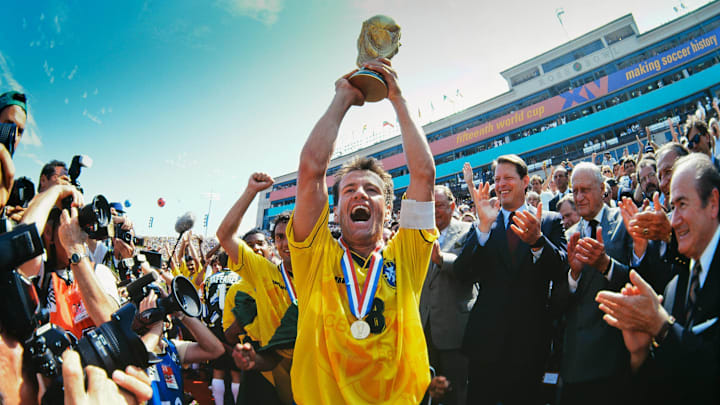
The Brazil side that won the 1994 World Cup was unlike any of the nation’s other four title-winning teams.
Whereas the squads of 1958, 1970 and 2002 were built on flair, attacking intent and the iconic samba style, the 1994 team instead relied mostly on tactical discipline, defensive solidity and sheer grit. There were flashes of the trademark Jogo Bonito in the final third, but overall it was a far more pragmatic approach than what Brazilian fans had come to expect.
Heading into the tournament, there were complaints about the team’s style, but when captain Dunga—the on-field architect of their disciplined system—lifted the trophy after Brazil’s penalty shootout win over Italy in the final, any criticism quickly vanished.
Here, we take a look at where every member of the 1994 squad is today.
Goalkeepers
Cláudio Taffarel

Brazil’s most capped goalkeeper ever, Cláudio Taffarel was the Seleção’s No. 1 at the 1994 World Cup, playing every minute and keeping four clean sheets.
A two-time Copa América winner in 1989 and 1997, he had club stints with Parma, Atlético Mineiro, and Galatasaray before retiring in 2003.
Today, he has returned to the national team as Brazil’s goalkeeping coach, mentoring the next generation of shot-stoppers.
Zetti

An unused substitute at the 1994 World Cup, Zetti earned just 17 caps for Brazil during his career. Domestically, he spent his entire playing days in his home country, most notably with São Paulo, where he won two Copa Libertadores along with multiple other titles.
After retiring in 2001, he moved into management, though he hasn’t held a coaching role since 2009 and now works as a pundit.
Gilmar Rinaldi

Another of Brazil’s unused goalkeepers at the 1994 World Cup, Gilmar Rinaldi was 35 at the time. He earned nine caps for the Seleção and won domestic titles with Internacional, São Paulo and Flamengo before retiring in 1997.
Today, he works as a football agent—most notably having represented Inter Milan legend Adriano—and also previously served as the technical director for the Brazilian Football Confederation (CBF).
Defenders
Jorginho

A star for both Bayer Leverkusen and Bayern Munich in his heyday, right back Jorginho earned 64 caps for Brazil, with his appearances at the 1994 World Cup among his final ones for the national team.
Since retiring for good in 2002, he has moved into management and has taken charge of numerous clubs, including Flamengo, Bahia, Vasco da Gama and Coritiba—managing the latter two clubs on three separate occasions each.
Ricardo Rocha

Thanks to his signature mustache—often paired with a mullet—Ricardo Rocha certainly stood out. The starting center back at the 1994 World Cup, he featured for just 69 minutes in a 2-0 group-stage win over Russia before injury ruled him out for the remainder of the tournament.
He finished his Brazil career with 38 caps, and since retiring in 1999, the former Real Madrid defender has worked in coaching, appeared regularly on television, run a marketing business and founded a soccer school for children in Recife.
Ronaldão

Not to be confused with Ronaldo, “Ronaldão” (meaning “Big Ronaldo”) earned 14 caps for Brazil but was an unused substitute at the 1994 World Cup. He was only called up on the tournament’s opening day, traveling from Japan to the United States as a replacement for the injured Ricardo Gomes.
Before retiring in 2002, he won multiple pieces of silverware with both São Paulo and Flamengo. Since then, he has largely lived a quiet life with his family, though he does still make occasional media appearances.
Branco

Left back Branco started Brazil’s first four games at the 1994 World Cup on the bench, but came into the side in the Round of 16 and made an immediate impact—scoring a stunning free kick and setting up another in a 3-2 win over the Netherlands. He played every minute thereafter.
He made just two more appearances for Brazil after the tournament, finishing his international career with 72 caps and nine goals.
A set-piece specialist who won domestic titles with Internacional, Fluminense, Porto and Grêmio, Branco moved into management after retiring in 1998 and now works as a youth academy coordinator for the CBF.
Aldair

Considered one of Brazil’s greatest defenders ever, Aldair earned 81 caps for his country, playing in all seven games at the 1994 World Cup. Domestically, he spent the majority of his career with Italian side AS Roma, where he also served as captain and won the Serie A title in 2001.
Today, he remains closely associated with Roma, while also appearing in the media and regularly taking part in exhibition matches in both Europe and Brazil.
Márcio Santos

Márcio Santos played every minute of the 1994 World Cup for Brazil as a center back, notably scoring in their 3-0 win over Cameroon in their second group game.
He enjoyed a varied and successful club career, representing the likes of Ajax, Bordeaux, Fiorentina and several clubs in Brazil before retiring in 2006.
Today, he serves as the technical director at, rather aptly, Santos FC.
Cafu

At 24, Cafu was still relatively young in 1994 and played just 121 minutes at the World Cup, the majority of which came in the final after replacing the injured Jorginho early on.
He would, of course, go on to become the most capped player in the history of the Brazil national team, captaining them to World Cup glory in 2002.
A legend at both AS Roma and AC Milan, he retired in 2008 and turned to philanthropy, remaining busy with his foundation, Fundação Cafu, which aims to provide social integration, educational opportunities and sporting activities for underprivileged children, helping steer them away from crime.
Midfielders
Dunga

Dunga drew heavy criticism from none other than Pelé following Brazil’s World Cup exit in 1990 at the hands of Argentina, with the former striker lamenting his “thuggish” style of play. Four years later, however, Dunga silenced Pelé, stepping in as captain partway through the tournament to lead Brazil to glory.
He later went on to manage Brazil across two spells, winning the Copa América in 2007. Today, he remains heavily involved in the media and with world governing body FIFA.
Zinho

Zinho won silverware everywhere he went during his domestic career, spent mostly in Brazil, winning multiple titles with Flamengo, Palmeiras, Grêmio, Cruzeiro and Yokohama Flügels in Japan.
That success also translated to the international stage. The left winger started every match at the 1994 World Cup, providing a crucial assist in the draw with Sweden in Brazil’s final group game.
Since retiring in 2007, he has held various managerial positions, including as head coach of the now-defunct Miami FC.
Rai

One of the most underrated Brazilian players of all time, Raí spent most of his career with São Paulo and Paris Saint-Germain, winning 10 major titles, including league crowns with both clubs.
At the 1994 World Cup, Raí captained Brazil during the group stage and scored a penalty in the opener against Russia. However, he was dropped for the knockout rounds, with Dunga taking over the armband, and only appeared as a substitute against the Netherlands in the quarterfinals and Sweden in the semifinals.
He earned just one more cap after that, in a 1998 friendly against Argentina. Since retiring, Raí has become a social activist, working with philanthropic organisations and appearing on Brazilian television.
Leonardo

Former PSG, AC Milan and Valencia midfielder Leonardo was capped 55 times by Brazil during his career, four of which came at the 1994 World Cup. He played in Brazil’s first four matches but missed the rest of the tournament through suspension after being sent off against the United States for elbowing midfielder Tab Ramos—an incident that caused a skull fracture and left him hospitalized for three and a half months.
Since retiring, Leonardo has worked as an executive at PSG and Milan, had brief spells as a manager at Milan and rivals Inter and has also dedicated himself to social work alongside his friend and former teammate Raí.
Mazinho

Former central midfielder Mazinho earned 35 caps for Brazil, winning the 1989 Copa América and the 1994 FIFA World Cup, where he featured in all but one match.
The father of Thiago Alcântara and Rafinha, he later had a brief spell in management and now supports his family’s charity, the Alcântara Family Foundation, which helps vulnerable people—especially children—through social inclusion and the values of sport.
Forwards
Romário

Romário was Brazil’s top scorer at the 1994 World Cup, netting five goals while also providing three assists. He went on to finish his international career in 2005 with 55 goals in 70 appearances—a strike rate almost unmatched for the Seleção, bettered only by Pelé.
He was just as prolific at club level, officially scoring 756 goals for the likes of PSV, Barcelona, Flamengo and Vasco da Gama (though he famously claims the true figure is over 1,000).
Since retiring, Romário has represented Brazil in beach soccer before moving into politics, notably being elected to the Brazilian Senate in 2014.
Bebeto

Romário’s partner in crime up front in 1994, Bebeto scored three goals and provided two assists, playing a crucial role in Brazil’s World Cup triumph.
A legend at Deportivo La Coruña, he has since moved into politics, serving as a state deputy in Rio de Janeiro, representing the Democratic Labour Party (PDT) and later Solidarity (SD).
Paulo Sérgio

Paulo Sérgio earned 12 caps for Brazil, including two brief substitute appearances at the 1994 World Cup, totaling just 22 minutes.
His club career was far more impressive, representing Bayer Leverkusen, AS Roma, and Bayern Munich, where he won the Champions League in 2001 and two Bundesliga titles.
Since retiring, he has worked as a television host and now leads the Bayer 04 Football Academy in São Paulo.
Müller

Nicknamed Müller, Luís Antônio Corrêa da Costa earned 56 caps for Brazil and scored 12 goals, though he played just nine minutes at the 1994 World Cup.
One of São Paulo’s all-time leading scorers, he has worked as a television commentator since retiring in 2004.
Viola

Viola—nicknamed in his youth after the brand of his first pair of boots—made just one appearance at the 1994 World Cup, coming on as a late substitute in the final, one of only eight caps he earned for Brazil.
He spent most of his domestic career in Brazil with Corinthians, Santos and Vasco da Gama, winning silverware with all three, and now lives a quiet life in his home country with his family.
Ronaldo

Ronaldo Nazário was just 17 at the time of the 1994 World Cup, earning his call-up after two stellar seasons with Cruzeiro in which he scored 44 goals. He did not feature at the tournament, but would go on to make 98 appearances and score 62 goals for the Seleção, including eight at the 2002 World Cup as he finished as top scorer and fired Brazil to the title.
Widely regarded as one of the greatest strikers of all time, he played for the likes of PSV, Barcelona, Inter Milan, Real Madrid and AC Milan, finishing his career in 2011 with 352 club goals—a total that would no doubt have been even higher had he not struggled so much with injuries and fitness.
Since retiring, ‘R9’ has remained a prominent figure in the media and commercial world, while also moving into club ownership. His takeover of Spanish side Real Valladolid proved deeply unpopular, however, and he sold his stake in May 2025 after seven years at the helm.
Manager: Carlos Alberto Parreira

Carlos Alberto Parreira coached Brazil on three separate occasions—first in 1983, then from 1991 to 1994, stepping down shortly after World Cup glory, and again between 2003 and 2006, leading the Seleção to another tournament.
Remarkably, he also managed four other nations at World Cups: Kuwait (1982), the United Arab Emirates (1990), Saudi Arabia (1998) and South Africa (2010).
A title winner with Fluminense, Fenerbahçe and Corinthians, he retired from coaching in 2010 and is now enjoying life in his mid-eighties.
READ THE LATEST WORLD CUP NEWS, PREVIEWS & ANALYSIS HERE
 Add us as a preferred source on Google
Barnaby Lane, better known as Barney, is a soccer writer for SI FC. With nearly a decade of experience in the industry, he has worked for a range of household-name publications in both the United States and the United Kingdom, and has interviewed some of the world’s biggest athletes—from Usain Bolt and Rafael Nadal to Christian Pulisic (though his favorite interview remains Adebayo Akinfenwa). Barney specializes in Premier League soccer, covering everything from the nostalgia of years gone by to the modern, vastly different landscape of today’s game. He also has experience reporting on La Liga and Major League Soccer, the latter of which he developed a particular affinity for during his university days at Virginia Commonwealth University in Richmond.