%20%20--%3E%0A%3Csvg%20version%3D%221.1%22%20id%3D%22Layer_1%22%20xmlns%3D%22http%3A%2F%2Fwww.w3.org%2F2000%2Fsvg%22%20xmlns%3Axlink%3D%22http%3A%2F%2Fwww.w3.org%2F1999%2Fxlink%22%20x%3D%220px%22%20y%3D%220px%22%0A%09%20width%3D%2239px%22%20height%3D%2240px%22%20viewBox%3D%220%200%2039%2040%22%20enable-background%3D%22new%200%200%2039%2040%22%20xml%3Aspace%3D%22preserve%22%3E%0A%3Cpath%20fill%3D%22%23FFFFFF%22%20d%3D%22M38.5%2C7H28.2v26h10.3V7z%22%2F%3E%0A%3Cpath%20fill-rule%3D%22evenodd%22%20clip-rule%3D%22evenodd%22%20fill%3D%22%23FFFFFF%22%20d%3D%22M26.1%2C25.5c0%2C5.8-4.1%2C7.5-12.9%2C7.5C3.9%2C33%2C0%2C31.2%2C0%2C25.2v-1.1h11.6%0A%09v2.4c0%2C0.7%2C0.1%2C1.4%2C1.2%2C1.4c1%2C0%2C1.2-0.4%2C1.2-1.3v-0.9c0-1.6-0.9-1.6-3.5-2.2C2.2%2C21.7%2C0%2C19.7%2C0%2C15.3v-0.9C0%2C9.3%2C5.5%2C7%2C12.9%2C7%0A%09c10.2%2C0%2C12.8%2C2.6%2C12.8%2C7.4v1.8h-11v-2.9c0-0.6-0.4-1.1-1.2-1.1c-0.6%2C0-1.2%2C0.4-1.2%2C1.1v0.9c0%2C1.5%2C0.9%2C2%2C3.3%2C2.5%0A%09c8%2C1.6%2C10.5%2C3.3%2C10.5%2C7.5V25.5z%22%2F%3E%0A%3C%2Fsvg%3E%0A)
FIFA President Ridicules 2026 World Cup Ticket Price Backlash With Hot Dog Promise
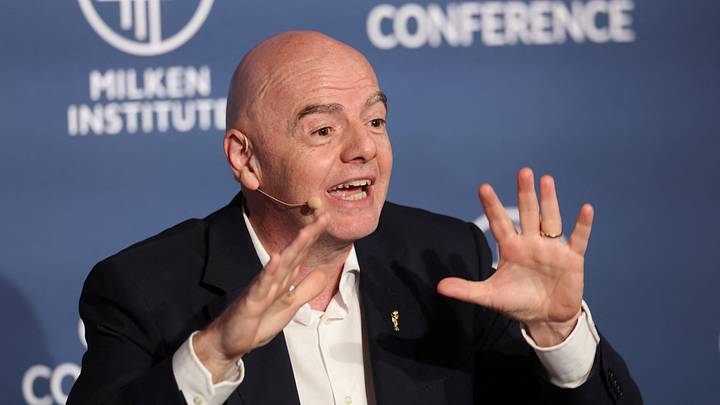
FIFA president Gianni Infantino laughed off the vicious backlash to reports of a single ticket for the 2026 World Cup final costing in excess of $2 million. Should anyone actually pay that price, the Swiss executive promised to personally deliver them a hot dog.
Controversy has dogged FIFA’s ticket prices for months. The use of a dynamic pricing model—adjusting the cost to match demand—has prompted widespread outcry, while the implementation of an official resale market is perhaps the hottest topic.
Fans can sell tickets they’ve already bought at face value for any price they deem fit per laws in the U.S. and Canada. Mexico operates under different regulations. FIFA bank 30% of every transaction on their resale site.
Consternation peaked once again recently when four tickets for the World Cup final were listed at almost $2.3 million each. Infantino dismissed this swollen figure out of hand at the Milken Institute Global Conference in Beverly Hills this week.
“If some people put on the resale market, some tickets for the final at $2 million, number one, it doesn’t mean that the tickets cost $2 million,” Infantino explained. “And number two, it doesn’t mean that somebody will buy these tickets.
“If somebody buys a ticket for the final for $2 million, I will personally bring him a hot dog and a Coke to make sure that he has a great experience.”
Infantino is objectively correct in his assertion that no one has to buy a ticket listed at $2.3 million to get a seat at the World Cup final. There are several options a matter of yards away from those extravagant prices listed in the region of $16,000—which, lest it be forgotten, is still a large sum.
‘We Have to’—Gianni Infantino Blames the U.S.

Most tickets are less than seven digits, and a proportion of seats for every fixture have been listed at $60, yet some sums bandied around are still enough to inspire global fury. Compared to the average price on offer at the five tournaments between 2006–22, this year’s cheapest seats have increased by around six times, per analysis by The Guardian.
Infantino’s defense is one of circumstance. If the opportunity is there thanks to established practice in two of the co-hosts, why not take it? “We have to look at the market,” he reasoned, “we are in the market in which entertainment is the most developed in the world. So we have to apply market rates.
“In the U.S., it is permitted to resell tickets as well. So if you were to sell tickets at the price which is too low, these tickets will be resold at a much higher price.
“And as a matter of fact, even though some people are saying that the ticket prices we have are high, they still end up on the resale market at an even higher price, more than double our price.”
This argument hasn’t gone down well with everyone. “Before I remember the World Cup—years, years, years ago—was like a celebration of the joy of football for the nations going there,” Manchester City’s manager Pep Guardiola recently reflected.
“Everyone traveled all around the globe, from the other continents, to see your country, to play there. And it was affordable. Now, [it’s] modern times, right? It’s so expensive.”
That warm-hearted sentiment was not enough to move Infantino. “You cannot go to watch in the U.S. a college game, not even speaking about a top professional game of a certain level, for less than $300,” he argued. “And this is the World Cup.”
FIFA’s messaging on ticketing stresses that the prices are not a quest for profit. “Unlike the entities behind profit-driven third-party ticket marketplaces, FIFA is a not-for-profit organization. Revenue generated from the FIFA World Cup every four years is reinvested to support the development of men’s, women’s and youth football across all FIFA 211 member associations, every day of the year.”
READ THE LATEST WORLD CUP NEWS, ANALYSIS AND INSIGHT FROM SI FC
 Add us as a preferred source on Google
Grey Whitebloom is an Associate Editor for SI FC. He has more than half a decade of experience in sports media across all its various guises, from the fast-paced demands of news articles and match reports to in-depth research required for features. Whitebloom graduated with a First Class Honours from University College London and found himself named on the Dean’s List—which, despite his initial fears, was a form of praise rather than a punishment. He specialises in the Premier League and Champions League, while also boasting an extensive track record of La Liga coverage.