%20%20--%3E%0A%3Csvg%20version%3D%221.1%22%20id%3D%22Layer_1%22%20xmlns%3D%22http%3A%2F%2Fwww.w3.org%2F2000%2Fsvg%22%20xmlns%3Axlink%3D%22http%3A%2F%2Fwww.w3.org%2F1999%2Fxlink%22%20x%3D%220px%22%20y%3D%220px%22%0A%09%20width%3D%2239px%22%20height%3D%2240px%22%20viewBox%3D%220%200%2039%2040%22%20enable-background%3D%22new%200%200%2039%2040%22%20xml%3Aspace%3D%22preserve%22%3E%0A%3Cpath%20fill%3D%22%23FFFFFF%22%20d%3D%22M38.5%2C7H28.2v26h10.3V7z%22%2F%3E%0A%3Cpath%20fill-rule%3D%22evenodd%22%20clip-rule%3D%22evenodd%22%20fill%3D%22%23FFFFFF%22%20d%3D%22M26.1%2C25.5c0%2C5.8-4.1%2C7.5-12.9%2C7.5C3.9%2C33%2C0%2C31.2%2C0%2C25.2v-1.1h11.6%0A%09v2.4c0%2C0.7%2C0.1%2C1.4%2C1.2%2C1.4c1%2C0%2C1.2-0.4%2C1.2-1.3v-0.9c0-1.6-0.9-1.6-3.5-2.2C2.2%2C21.7%2C0%2C19.7%2C0%2C15.3v-0.9C0%2C9.3%2C5.5%2C7%2C12.9%2C7%0A%09c10.2%2C0%2C12.8%2C2.6%2C12.8%2C7.4v1.8h-11v-2.9c0-0.6-0.4-1.1-1.2-1.1c-0.6%2C0-1.2%2C0.4-1.2%2C1.1v0.9c0%2C1.5%2C0.9%2C2%2C3.3%2C2.5%0A%09c8%2C1.6%2C10.5%2C3.3%2C10.5%2C7.5V25.5z%22%2F%3E%0A%3C%2Fsvg%3E%0A)
Four Things We Learned From Arsenal’s Spectacular Collapse Against Wolves
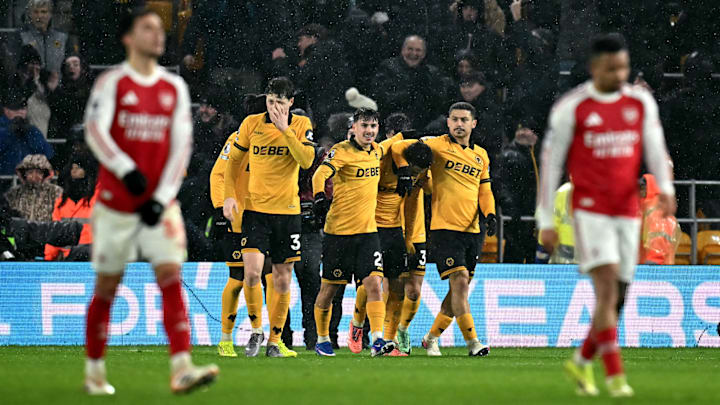
By the end, it was all too much for Mikel Arteta. Arsenal’s sodden manager was as frosty as the temperature at Molineux after watching his side bungle a 2–0 lead against the Premier League’s worst team on Wednesday evening.
Arteta had been gripped by a red mist long before Riccardo Calafiori chaotically, objectively comedically, diverted the ball off the post and into his own net to give Wolverhampton Wanderers a much-deserved point. By the time he had towelled off to come into the post-match press conference, he was in no mood to defend his players.
“Any question, any criticism, any opinion, you have to take it on the chin today,” he seethed. “Any hit, any bullet, take it, because we didn’t perform at the level that is required. Anything that anybody says can be right because we didn’t do what we had to do.”
Taking full advantage of that carte blanche, here’s a closer look at what went wrong in midweek and what it may mean in a title race that Arsenal have welcomed Manchester City back into.
The Pressure Is Real

“If you are at the top, and you have to win, you have to win and win and win,” Arteta fretted after the 2–2 draw. The pressure which comes with that mentality has clearly seeped into his squad.
Arsenal have finished the past three seasons as Premier League runners-up and earned the tag of “bottle-jobs” on each occasion. That distinction has largely been unfair—plenty of factors outside their mentality contributed to those second-place finishes—but the current bag of nerves lining up in red and white each week are doing their best to prove the critics correct this time around.
As has so often been the case this term, the Gunners started strongly and took a first-half lead—although Bukayo Saka heading the ball in after darting into the box from a No. 10 position was a new wrinkle. Wolves didn’t have a whisper of chance before the two sides were spared from the elements at the half-time interval. Regrettably, Arsenal didn’t bother coming out for the second 45 minutes.
During Liverpool’s trophy-laden domination in the 1970s and ’80s, the club’s revered assistant coach Joe Fagan was constantly guarding against a sense of complacency, the fire burning inside fading, which he summed up with the phrase “easy-osey.”
Arsenal’s Premier League Record in 2026
Statistic | Arsenal Value |
|---|---|
Games | 8 |
Wins | 3 |
Draws | 4 |
Losses | 1 |
Goals For | 15 |
Goals Against | 8 |
Goal Difference | +7 |
Points | 13 |
Arsenal came out with that lacklustre attitude at the restart and couldn’t even be shaken awake by Piero Hincapié’s goal which put them 2–0 up. Once Hugo Bueno bent the ball into the top corner on the hour mark to halve the deficit, enjoying a pocket of space afforded to him in the second phase of a set piece—a time when heightened focus is paramount—that nonchalance gave way to blind panic.
Across the final 15 minutes of Wednesday’s fixture, Arsenal’s pass completion rate plummeted to just 61%. Their average for the season is 85%. Nothing would stick and Wolves eventually accepted the invitation their visitors were so intent of thrusting into their hands.
When nerves become frayed wires get crossed; Gabriel and David Raya looked as though they were playing for different teams when they conspired to present the ball to the feet of Tom Edozie, whose goal-bound effort couldn’t be turned away by a luckless Calafiori in stoppage time.
Gabriel Jesus exposed the tensions of these dropped points and the recent underwhelming run (Arsenal have won just two of their last six in the league) by needlessly shoving Yerson Mosquera to the turf at the final whistle. For a squad of players as chronically online as this modern generation, the next few days will be spent being bombarded by a wave of bottle-job barbs on social media. This time, they don’t have a great deal to say in their defence.
David Raya’s Glaring Weakness

Wolves’ 23-year-old left back Hugo Bueno was lining up for his 105th senior appearance on Wednesday night. The previous 104 outings had seen him score just once, from 10 yards out. Yet, up against the Premier League’s reigning Golden Glove holder, he managed to pick out the top corner from the edge of the box. If only it came as a surprise.
Raya has many qualities—his immaculate distribution, surprising command at aerial deliveries and a preternatural ability to anticipate where and when someone is going to pull the trigger from close range. However, his weakness from distance has become an issue.
There are some goals which you can’t do anything about—two-time Premier League-winning goalkeeper Joe Hart was at the front of queue to defend Raya for not saving Dominik Szoboszlai’s stunning free kick in August—yet, Bueno’s bending effort is not a freak occurrence.
Arsenal’s keeper has only faced 13 shots on target from outside the box this season, but six have found the back of his net. When analysing the speed, trajectory and positioning of these efforts compared to thousands of previous attempts, Opta can provide an estimate for the likelihood of that shot becoming a goal. Based on the shots Raya has faced, he would have been expected to only concede one or, at most two.
Statistic (Premier League 2025–26) | Outside the Box | Inside the Box |
|---|---|---|
Shots on Target Faced | 13 | 45 |
Goals Conceded | 6 | 14 |
Expected Goals Conceded | 1.25 | 15.67 |
Goals Prevented | -4.75 | +1.67 |
Stats via FotMob.
More Options Don’t Mean the Right Options

Arsenal were without Martin Ødegaard, Kai Havertz and Mikel Merino for the trip to a sleet-riddled Molineux, but Arteta still had several midfield options at his disposal. Intriguingly, he turned back to the experiment of Saka as a No. 10, leaving a fully fit Eberechi Eze on the bench to stew on his best performance in months.
It’s increasingly clear that Arteta has almost zero faith in the £67.5 million ($91.1 million) summer recruit. Considering his last goal or assist against top-flight opposition was back in November, that stance is perhaps justified.
However, Eze is a perfect example of a player suffering from the choice of teammates around him. It’s been repeatedly said that Arteta has more weapons at his disposal than ever before, but it’s unhelpful to think of each player as an individual piece of artillery, rather than sections of one hulking bazooka. Football is a team game. If you stick the trigger too far away from the butt of the gun, you’re never going to fire off any shots.
The ultimate example of Arsenal cohesion came in the form of the flexible triangle formed by Saka, Ødegaard and Ben White. This triumvirate has effectively disappeared due to injuries and fluctuations of form, forcing Arteta to search for new combinations. The painful lack of fluency which still exists in possession against teams with any vague semblance of organisation proves that search is still ongoing.
Viktor Gyökeres Shows How to React to This Result

Viktor Gyökeres’s last four Premier League appearances for Arsenal capture the pitfalls of how we consume modern football. After scoring three goals across back-to-back appearances against Leeds United and Sunderland, the summer signing had been transformed from misfit to messiah by the media.
Suddenly, the scrappy nature of his finishes was an example of his quality—rather than a worrying lack of balance. His bumbling trot a powerful stride, the misplaced aggression a show of great passion. When Arteta was quizzed on the secrets behind Gyökeres’s uptick in form he couldn’t hide the puzzled look which washed across his face.
Nothing had changed. He was simply playing two newly promoted teams and taking advantage of the space afforded to him by the opposition chasing a goal.
Over his last two Premier League appearances, Gyökeres hasn’t taken a single shot, let alone scored.
This is not to say that Arsenal’s No. 14 is a lumbering fraud destined for the scrapheap—that would be the same overreaction just in the opposite direction. But it does point towards the sense of context required during the chaotic nature of Arsenal’s title quest.
Wednesday’s result now means that Manchester City can lift the Premier League if they win all their remaining matches—yet, the same is true for Arsenal, who still, lest it be forgotten, sit five points clear of Pep Guardiola’s side after playing just one game more.
Arteta hailed the upcoming north London derby away to Tottenham Hotspur on Sunday as “a great opportunity” to reset the narrative. Manchester City are at home to Newcastle United the day before, giving Arsenal the chance to “respond” to whatever result they cook up—which, unlike in years gone by, is no longer guaranteed to be a win.
“Anything that we say from here today is fine,” Arteta bitterly concluded in the bowels of Molineux, “but we need to keep all that in our tummies to show it on Sunday.”
READ THE LATEST ARSENAL NEWS, TRANSFER RUMOURS AND MORE
 Add us as a preferred source on Google
Grey Whitebloom is an Associate Editor for SI FC. He has more than half a decade of experience in sports media across all its various guises, from the fast-paced demands of news articles and match reports to in-depth research required for features. Whitebloom graduated with a First Class Honours from University College London and found himself named on the Dean’s List—which, despite his initial fears, was a form of praise rather than a punishment. He specialises in the Premier League and Champions League, while also boasting an extensive track record of La Liga coverage.