%20%20--%3E%0A%3Csvg%20version%3D%221.1%22%20id%3D%22Layer_1%22%20xmlns%3D%22http%3A%2F%2Fwww.w3.org%2F2000%2Fsvg%22%20xmlns%3Axlink%3D%22http%3A%2F%2Fwww.w3.org%2F1999%2Fxlink%22%20x%3D%220px%22%20y%3D%220px%22%0A%09%20width%3D%2239px%22%20height%3D%2240px%22%20viewBox%3D%220%200%2039%2040%22%20enable-background%3D%22new%200%200%2039%2040%22%20xml%3Aspace%3D%22preserve%22%3E%0A%3Cpath%20fill%3D%22%23FFFFFF%22%20d%3D%22M38.5%2C7H28.2v26h10.3V7z%22%2F%3E%0A%3Cpath%20fill-rule%3D%22evenodd%22%20clip-rule%3D%22evenodd%22%20fill%3D%22%23FFFFFF%22%20d%3D%22M26.1%2C25.5c0%2C5.8-4.1%2C7.5-12.9%2C7.5C3.9%2C33%2C0%2C31.2%2C0%2C25.2v-1.1h11.6%0A%09v2.4c0%2C0.7%2C0.1%2C1.4%2C1.2%2C1.4c1%2C0%2C1.2-0.4%2C1.2-1.3v-0.9c0-1.6-0.9-1.6-3.5-2.2C2.2%2C21.7%2C0%2C19.7%2C0%2C15.3v-0.9C0%2C9.3%2C5.5%2C7%2C12.9%2C7%0A%09c10.2%2C0%2C12.8%2C2.6%2C12.8%2C7.4v1.8h-11v-2.9c0-0.6-0.4-1.1-1.2-1.1c-0.6%2C0-1.2%2C0.4-1.2%2C1.1v0.9c0%2C1.5%2C0.9%2C2%2C3.3%2C2.5%0A%09c8%2C1.6%2C10.5%2C3.3%2C10.5%2C7.5V25.5z%22%2F%3E%0A%3C%2Fsvg%3E%0A)
‘The Pitch!’—France Critical of MetLife Stadium Surface a Year After Concerns First Raised
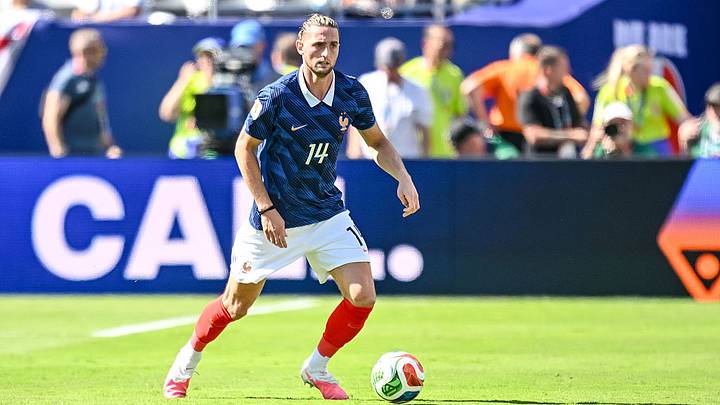
After France’s win against Senegal at MetLife Stadium, midfielder Adrien Rabiot wasn’t happy.
“The pitch ... I don’t even know if you can call it that,” the AC Milan player said. “It felt more like an artificial surface—quite hard and quite rigid.”
France manager Didier Deschamps echoed his player, calling it a “special surface.” He said: “I think there’s probably concrete underneath, it’s very short fibers.”
France isn’t the only team to raise concerns. When Brazil opened its 2026 tournament against Morocco at the same venue, Vinicius Junior commented how the heat “dries out” the pitch, consequently affecting the team’s ability to “get into our rhythm.”
Pitches have been routinely watered at halftime to combat any dryness, although one malfunctioning sprinkler at Gillette Stadium for Norway’s win against Iraq later on Tuesday meant they all had to be turned off during the halftime spritz to prevent damage. Ground staff then had to disperse the excess water from the affected area before the match restarted.
Moisture is measured daily at MetLife Stadium, along with surface firmness and ball roll, part of FIFA’s efforts to ensure playing surfaces are both consistent across the tournament and up to code.
After last summer’s Club World Cup—playing the final at MetLife Stadium—Chelsea captain Reece James said the pitches he’d experienced in the United States during that tournament were “not so good” compared to what he is used to in Europe. “There’s astro underneath and maybe grass on top. It’s not the best for the body, for the joints, for the muscles.”
Why MetLife Stadium’s Pitch Needed to be Changed

The current MetLife Stadium playing surface has been installed specifically for the World Cup. In a stadium that usually has a synthetic surface, a temporary grass pitch has been laid on top—with far greater technological detail than it reads—to meet FIFA’s requirements for the tournament.
All 11 of the stadiums in the United States being used for the World Cup primarily house NFL teams, and seven—including MetLife Stadium—have synthetic turf. Back in 2015, when the Women’s World Cup was held in Canada, a group of almost 50 players filed a gender discrimination lawsuit against FIFA over being made to play on artificial surfaces.
It was defended by then secretary general Jérôme Valcke on the basis that “sooner rather than later the men’s World Cup will also be played on artificial pitches.” But FIFA outlined to prospective hosts bidding for the 2023 Women’s World Cup not to include synthetic turf pitches and, contrary to Valcke’s prediction more than a decade ago, there hasn’t been a shift in the men’s equivalent—even in a co-hosting country where the majority of surfaces are ordinarily artificial.
Now, FIFA mandates that World Cup fixtures—for both genders—must be played exclusively on natural grass.
European Teams More Sensitive to Climate, Pitch Differences

European teams don’t always travel that well. It was 2010—in South Africa—before any European nation won a World Cup outside its home continent. Spain was the victor on that occasion, with Germany then emerging victorious in Brazil four years later.
In every other World Cup held outside Europe, whether it be played somewhere in the Americas or Asia, a South American team has triumphed.
Both Uruguay’s World Cup wins (1930, 1950) were achieved in South America. Brazil got four (1962, 1970, 1994, 2002) of its five World Cups outside Europe—1958 in Sweden is the only exception—while Argentina won all three of its in South America (1978), Central America (1986) or Asia (2022).
READ THE LATEST WORLD CUP NEWS, ANALYSIS AND INSIGHT FROM SI FC
 Add us as a preferred source on Google
Jamie Spencer is a writer and editor for SI FC. Jamie grew up in Manchester, England, in the 1990s and fell in love with the game at the same time as the Premier League was taking off. With more than a decade of experience behind him in sports media, he specializes in Manchester United and the overall Premier League, still living in England’s north-west soccer hotbed. Jamie is also an expert on the women’s game and enjoys old school nostalgia, telling stories from soccer’s rich history and culture.