%20%20--%3E%0A%3Csvg%20version%3D%221.1%22%20id%3D%22Layer_1%22%20xmlns%3D%22http%3A%2F%2Fwww.w3.org%2F2000%2Fsvg%22%20xmlns%3Axlink%3D%22http%3A%2F%2Fwww.w3.org%2F1999%2Fxlink%22%20x%3D%220px%22%20y%3D%220px%22%0A%09%20width%3D%2239px%22%20height%3D%2240px%22%20viewBox%3D%220%200%2039%2040%22%20enable-background%3D%22new%200%200%2039%2040%22%20xml%3Aspace%3D%22preserve%22%3E%0A%3Cpath%20fill%3D%22%23FFFFFF%22%20d%3D%22M38.5%2C7H28.2v26h10.3V7z%22%2F%3E%0A%3Cpath%20fill-rule%3D%22evenodd%22%20clip-rule%3D%22evenodd%22%20fill%3D%22%23FFFFFF%22%20d%3D%22M26.1%2C25.5c0%2C5.8-4.1%2C7.5-12.9%2C7.5C3.9%2C33%2C0%2C31.2%2C0%2C25.2v-1.1h11.6%0A%09v2.4c0%2C0.7%2C0.1%2C1.4%2C1.2%2C1.4c1%2C0%2C1.2-0.4%2C1.2-1.3v-0.9c0-1.6-0.9-1.6-3.5-2.2C2.2%2C21.7%2C0%2C19.7%2C0%2C15.3v-0.9C0%2C9.3%2C5.5%2C7%2C12.9%2C7%0A%09c10.2%2C0%2C12.8%2C2.6%2C12.8%2C7.4v1.8h-11v-2.9c0-0.6-0.4-1.1-1.2-1.1c-0.6%2C0-1.2%2C0.4-1.2%2C1.1v0.9c0%2C1.5%2C0.9%2C2%2C3.3%2C2.5%0A%09c8%2C1.6%2C10.5%2C3.3%2C10.5%2C7.5V25.5z%22%2F%3E%0A%3C%2Fsvg%3E%0A)
How Curacao Achieved the Impossible, Made World Cup History
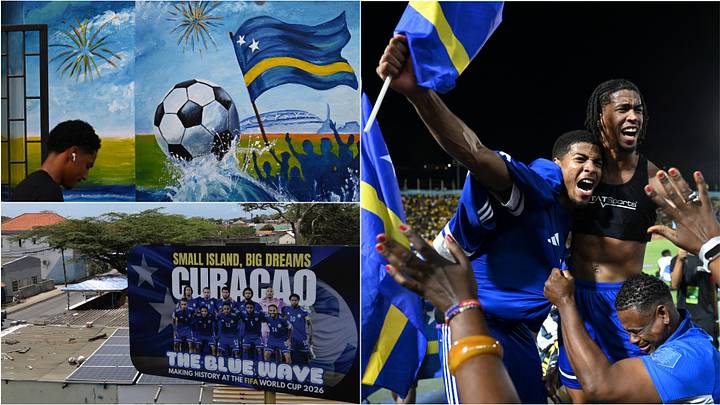
WILLEMSTAD, Curaçao—A group of children saunter their way through physical education class, amid the searing heat of the mid-spring sun in Curaçao. They bounce between Papiamento (the local language), English and Dutch, while Katy Perry songs blare in the background.
It’s all just a few feet away from a place the island couldn’t be more proud of—the national stadium at the Sentro Deportivo Korsou. Through a darkly lit hallway, past the play area, a pool, some rusty scaffolding and a fence on the verge of collapse, sits the Ergilio Hato Stadium, home base to the now World Cup-bound Curaçao team, the “Blue Wave”.
“This island is paradise,” says Federashon Futbòl Kòrsou (FFK) president Gilbert Martina. “The name means the island of healing, the island of paradise and relaxation.”

With an artificial, softer-than-usual surface, the pitch is a sign of how far things have come. It’s no typical rough surface, as often seen in Concacaf, and the lights are brand-new, having been replaced midway through the 2026 World Cup qualifying cycle.
Beyond the touchlines of the cracked track that encircles the pitch, concrete and aluminum bleachers rise. Stand at the top, and you can see the few seated sections have fresh seats, while the disregarded ones nestle behind a trailer in the trees that hug the stadium’s outline, signs of past wild celebrations in this country’s soccer ascendancy.
Unified By Soccer

The island nation has a population of 158,000 and a GDP similar to that of Greenland or Guinea-Bissau. It has endured a challenging past of racial segregation between Black native populations and Dutch immigrants, as well as a 1969 anti-colonial uprising, which burned most of Willemstad, leaving two people dead and hundreds arrested, while the government resigned.
Yet, even with a divided past, it has found a unifying force—soccer, and the pathway to the 2026 FIFA World Cup.
In November, the nation celebrated its first World Cup qualification after playing to a scoreless draw in Jamaica on the final day of qualifying, becoming the smallest country to ever qualify for the sport’s greatest stage.
“I couldn't grasp the feeling. I was totally silent, and then a colleague of mine said, ‘Let’s go to the pitch,’” says Martina, grinning as he sits at a pub near Fort Beekenburg, a Dutch military stronghold from the 18th century. “When I got to the pitch, the tears started, just tears of joy.”
Back in Curaçao, which takes just over an hour to drive across, parties packed the island. Fresh rum, known as Ròm Bèrdè, flowed alongside local beers as the island embraced itself on the global stage, an opportunity rare outside of baseball—where its players suit up for the Netherlands in the World Baseball Classic.

That qualification, in many ways, wasn’t supposed to happen. It was so unlikely that Adidas hadn’t drafted a World Cup edition kit for the team, a process that kicked off the morning after qualification.
Martina hadn’t planned on it either, but through a push to bring in players with Curaçaoan roots from the Netherlands, the shrewd recruitment of commercial partners in Curaçao and the power of community, they managed the improbable.
“The team’s success brings positivity not only to our soccer, but also to sports development,” says Willy Anthony Harms, the facility manager for the national stadium and surrounding areas and a DJ in his spare time.
“The stadium is the final [step]. It’s the schools, the neighborhoods and everything that this World Cup is going to impact positively. It’s a big, big world, but when a kid starts dreaming, and a person becomes a person with discipline, with a regimen that's positive, they can...become somebody better in life.”
Mindfulness Under Pressure

There’s one word that encompasses the entire island: “Vibe.”
It’s the word that demands Island Time, making any scheduling a rough estimate at best. It offers a laid-back approach to much of the community—even the most challenging things, like running the FFK.
For Martina, it’s defining. The 55-year-old has undergone a journey of divine intervention, leaning on mindfulness, meditation and natural medication to rediscover his life’s direction, after his parents’ deaths in 2020. A former fisherman and ex-head of the island's largest hospital, to say Martina knows the island’s heartbeat would be quite literal.
That journey, grounding him in the island’s vibe and spirit, has emanated into the national team, so much so, it led them through the most challenging part of World Cup qualification. Manager Dick Advocaat offered his resignation shortly after the final qualifier, declining an opportunity to coach at the World Cup to focus on his daughter's deteriorating health.
“The doctor called me and said, ‘Gilbert, we have a problem,” says Martina, recalling Advocaat’s resignation. “I said, ‘We don’t have problems, we have a challenge.”
Fred Rutten stepped in as manager for March, before Advocaat’s daughter's health improved, allowing him to take over Curaçao once again. This June, he will become the oldest World Cup manager at 78.
The Dual-National Day

Curaçao is not an independent nation, but part of the Kingdom of the Netherlands, a reality that has shaped everything from migration patterns to the makeup of its national team to daily life.
Aside from his grounded nature, Martina’s ability to aggressively recruit Dutch players with Curaçaoan heritage has been vital. That, however, wasn’t always welcome.
Martina recalled Dutch legend Patrick Kluivert’s time as manager and adviser from 2014–2017, when he opened the door for international recruitment. There was intense resistance, with roster spots taken away from stars in the well-attended domestic professional league.
“Before [Kluivert], it was a selection of mainly local players, and maybe three or four players from the Netherlands, which of course had no chance to succeed because professional football is another level,” Martina says.

While Kluivert and those with footballing experience beyond the shores knew the potential of Dutch recruitment, few locally accepted it. So, in 2016, Kluivert came up with a unique idea: play a match.
Bringing together a team of dual-nationals, all playing professionally, alongside a selection of local stars, a game between the two would prove the better pathway. The dual-nationals throttled the local side, 7–1. Concerns vanished.
Since then, under Martina’s leadership, the focus has been on improving financial situations and organization status to become more attractive to the top eligible players—and this summer, they will have players from first divisions in the Netherlands, Türkiye and Israel, as well as lower-tier players from the U.S.-based USL and the English Football League system.
“It was complicated,” Martina says. “There were times when we were not paying what was promised to the players, and time, travel and logistics were far below [the standard of] what players were used to when they were with the professional team. So why should they come to play for their own country when it's much less organized? That was something that we really emphasized when I came in last year.”
Belief Blossoms

For many on the island, the Curaçao selection had been an afterthought. Why support a team so small that might never make the Concacaf Gold Cup, let alone the World Cup? It meant most soccer fans on the island supported either the Netherlands or Brazil, before now having the opportunity to cheer for their own.
Yet, that was never the case for Brenton Balentien.
A former youth national team player, he has become the face of Curaçao’s soccer renaissance. Dubbed “Captain Blue Face” for his emphatic face paint when supporting the Blue Wave, he has been adamant about supporting the squad since 2016 and was among the passionate few in Jamaica on the qualifying night.
“Soccer is in my veins and in my heart,” he says, outside an official Blue Wave store, where kits have been sold out for weeks. “It was crazy [qualifying]. The whole island was going out. Man, it didn't matter if we're Black, white from Curaçao, Dutch, English, Haitian, Jamaican: it didn't matter. Everybody came out on the streets to celebrate with the guys. And that was the most beautiful thing.”
Having been so committed to the Blue Wave, there was no way he was missing this summer’s games, whatever the cost. He told his wife they would sell the car to go to games. Instead, sponsors stepped up, allowing him to keep the car, even if he still had to shell out a significant amount of cash.
“I hope they're in the semifinals, but that’s delusional,” he adds, with Group E presenting Germany, Ecuador and Ivory Coast as initial opponents, after a send-off friendly in Curaçao against Aruba.
“The most important thing for us now is to play well in a good tournament. It doesn’t matter if we win, lose or draw, because either way we're going to celebrate. ...Whatever happens, we're going to celebrate. If we have a corner, we're going to celebrate. A red card, a yellow card, the first penalty, the offside. We're going to celebrate everything.”
The Future is Bright

While the World Cup provides a pinnacle—a chance to go toe-to-toe with 2014 champion Germany in the opening game—it’s also just the first crescendo for the ever-growing Blue Wave.
On a different pristine turf field, Jong Holland Field, a local youth team, CRKSV Jong Holland, trains. With fizzing passes, quick one- and two-touch play on a stunning evening with cruises, they are just one of many promising signs of the brilliance to come—a sign of soccer’s growth, the game’s culture and the island’s story.
For many in Curaçao, this World Cup is not simply about results. It is about finally seeing themselves reflected in the game they have always loved on the grandest stage, in a story that is just beginning.
Curaçao 2026 World Cup Roster
Goalkeepers
- Tyrick Bodak (Telstar)
- Trevor Doornbusch (VVV-Venlo)
- Eloy Room (Miami FC)
Defenders
- Riechedly Bazoer (Konyaspor)
- Joshua Brenet (Kayserispor)
- Roshon van Eijma (RKC Waalwijk)
- Sherel Floranus (PEC Zwolle)
- Deveron Fonville (NEC Nijmegen)
- Juriën Gaari (Abha Club)
- Armando Obispo (PSV Eindhoven)
- Shurandy Sambo (Sparta Rotterdam)
Midfielders
- Juninho Bacuna (FC Volendam)
- Leandro Bacuna (Iğdır FK)
- Livano Comenencia (FC Zürich)
- Kevin Felida (FC Den Bosch)
- Ar’jany Martha (Rotherham United)
- Tyrese Noslin (Telstar)
- Godfried Roemeratoe (RKC Waalwijk)
Forwards
- Jeremy Antonisse (AE Kifisia)
- Tahith Chong (Sheffield United)
- Kenji Gorré (Maccabi Haifa)
- Sontje Hansen (Middlesbrough)
- Gervane Kastaneer (Terengganu FC)
- Brandley Kuwas (FC Volendam)
- Jürgen Locadia (Miami FC)
- Jearl Margaritha (SK Beveren)
READ THE LATEST WORLD CUP NEWS, ANALYSIS AND INSIGHT FROM SI FC
 Add us as a preferred source on Google
Ben Steiner is an American-Canadian journalist who brings in-depth experience, having covered the North American national teams, MLS, CPL, NWSL, NSL and Liga MX for prominent outlets, including MLSsoccer.com, CBC Sports, and OneSoccer.
Follow BenSteiner00