%20%20--%3E%0A%3Csvg%20version%3D%221.1%22%20id%3D%22Layer_1%22%20xmlns%3D%22http%3A%2F%2Fwww.w3.org%2F2000%2Fsvg%22%20xmlns%3Axlink%3D%22http%3A%2F%2Fwww.w3.org%2F1999%2Fxlink%22%20x%3D%220px%22%20y%3D%220px%22%0A%09%20width%3D%2239px%22%20height%3D%2240px%22%20viewBox%3D%220%200%2039%2040%22%20enable-background%3D%22new%200%200%2039%2040%22%20xml%3Aspace%3D%22preserve%22%3E%0A%3Cpath%20fill%3D%22%23FFFFFF%22%20d%3D%22M38.5%2C7H28.2v26h10.3V7z%22%2F%3E%0A%3Cpath%20fill-rule%3D%22evenodd%22%20clip-rule%3D%22evenodd%22%20fill%3D%22%23FFFFFF%22%20d%3D%22M26.1%2C25.5c0%2C5.8-4.1%2C7.5-12.9%2C7.5C3.9%2C33%2C0%2C31.2%2C0%2C25.2v-1.1h11.6%0A%09v2.4c0%2C0.7%2C0.1%2C1.4%2C1.2%2C1.4c1%2C0%2C1.2-0.4%2C1.2-1.3v-0.9c0-1.6-0.9-1.6-3.5-2.2C2.2%2C21.7%2C0%2C19.7%2C0%2C15.3v-0.9C0%2C9.3%2C5.5%2C7%2C12.9%2C7%0A%09c10.2%2C0%2C12.8%2C2.6%2C12.8%2C7.4v1.8h-11v-2.9c0-0.6-0.4-1.1-1.2-1.1c-0.6%2C0-1.2%2C0.4-1.2%2C1.1v0.9c0%2C1.5%2C0.9%2C2%2C3.3%2C2.5%0A%09c8%2C1.6%2C10.5%2C3.3%2C10.5%2C7.5V25.5z%22%2F%3E%0A%3C%2Fsvg%3E%0A)
Is USMNT Ready for the 2026 World Cup?
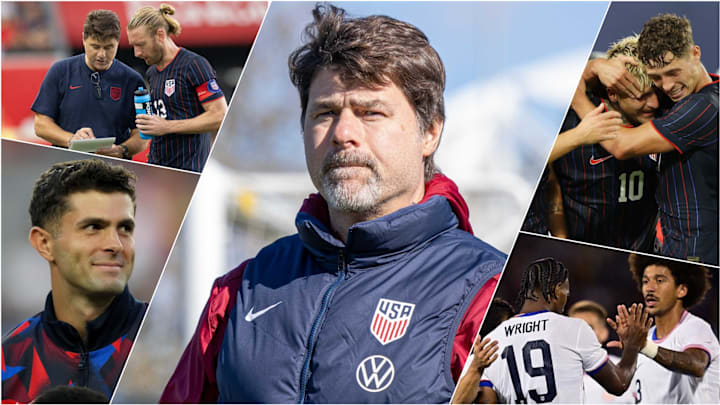
Mauricio Pochettino has done many things in his career, but he has never done this.
The Argentine manager and his staff must prepare the U.S. men’s national team for the World Cup. That’s a big enough job, but the pressure is ratcheted up considerably because of the expectations attached to host teams of the 2026 tournament.
This is the tournament that is supposed to catapult the sport to mainstream status in the U.S., the one supporters and business executives alike hope will win over casual fans and convince them to turn the channel from baseball or American football to soccer—at least now and then. There are plenty of ideas about how to boost the popularity of soccer in the country, but everyone agrees a deep run from the U.S. men’s national team this summer would help.
“We can understand what they’re going through as far as the pressure in 2026 because you want to have success in front of your fans,” Cobi Jones, a former U.S. international who played in three World Cups, including the 1994 tournament on home soil, told Sports Illustrated. “You know what it means. You know that if you have a successful World Cup, it allows for exponential growth of the game within your country.”
So, is the U.S. ready for the World Cup?
One More Camp to Finalize Plans

The team will come together once more before Pochettino and his staff decide on the final roster, playing a pair of friendly matches in March. After that, the final squad will play another pair of friendly games before June 12’s opening match against Paraguay in Southern California.
While the U.S. didn’t win either of the regional competitions it contested in 2025, it ended the year with good momentum and positive vibes from fall friendly matches. The Stars and Stripes were undefeated in their last five games and won their final three, capped by a 5-1 thrashing of Uruguay, the same team that bounced the U.S. from the Copa América in the summer of 2024.
With things feeling like they were going right, Pochettino said he suffered not having more hands-on time with the group during the winter.
“How we finished 2025, you want to play the next week again, to take advantage of the form and the belief and the energy from the group and the team,” he told reporters last week. “Being very honest, it’s tough, really tough to spend all this time watching football, assessing players, having meetings, doing different things, but not coaching. That is the most tough situation that we are living because we love to coach.”
His counterparts, regional rivals Mexico and Canada, didn’t have to wait. El Tri manager Javier Aguirre and Canada boss Jesse Marsch both booked January friendly matches to be back with their players to start the World Cup year. While the matches fell outside of a FIFA window, meaning clubs didn’t need to release their players and the rosters were largely made up of domestic-based players, the managers were eager to see what roster hopefuls could do.
Consistency Mode As World Cup Nears

The U.S. opted against conducting a training camp or scheduling games in January, in part because Pochettino seems to have mostly settled on the group he’ll call on in the summer. While no manager would ever shut the door on a player with months still to go, it’s unlikely he’ll bring in new faces for March’s matches against Belgium and Portugal.
Instead, the U.S. wants to simulate the intensity it will feel when the ball is rolling and the eyes of the world are on it in June. To do that, things have to get very serious, very quickly.
“The idea is the World Cup will start in March when we’ll all be together. It’s time to show, like we were showing in the last camps, our identity, our way to play and how we want to perform in the World Cup,” Pochettino said.
A formation switch to a 3-4-2-1 helped springboard the U.S. to wins over Australia and Paraguay in addition to that triumph over Uruguay. The draw in December produced a group with those two teams plus a European playoff winner. That means that the U.S. should have plenty of confidence.
But as well set up as the U.S. seems to be going into the World Cup, it’s impossible to simulate the exact conditions of the sport’s most intense tournament.
“We have an idea of what the bare minimum will be, but really it’s going to take more to get results,” U.S. center back Tim Ream said after the draw. “They were friendlies, while they weren’t very friendly, and now you add in the pressure and the heightened aggression and experience of a World Cup, and they’re all finals. They all mean something now. Everything is going to be ramped up exponentially.”
Times Have Changed Since 1994 World Cup

The U.S. is in a much different situation than it was last time it hosted this tournament. In 1994, the team had a steady diet of friendlies, living and working together under contract with the federation rather than playing with clubs. Fourteen of the 22 players on the final roster worked together in that environment.
“We were basically the equivalent of a club team, but we were a national team," Jones said. “You will never see anything like that again. The game has just progressed too much, and you’re never going to get the opportunity to keep a group of 18-24-year-olds together for a year and a half.”
The Americans were able to use that experience to meet the expectations fans had set for them, getting out of the group to avoid being the first-ever host eliminated at that stage. They lost to Brazil in the first knockout game, but the fuse was lit toward the sport booming in the country with the launch of MLS.
This time around, with an expanded tournament, the standard will be higher than simply reaching the knockout round and losing. While no one thinks captain Christian Pulisic or Tyler Adams will be raising the trophy on July 19, plenty of supporters are hoping for at least a quarterfinal. That would match what the U.S. did in 2002, its best performance in the modern era. The best-ever performance was a third-place finish at the inaugural World Cup nearly a century ago.
Winning Over the Doubters

While Pochettino may have been feeling the pressure after the U.S. failed to lift the Nations League or Gold Cup trophies in 2025, the strong back half to the year has won him plenty of believers.
“Remember he was a club coach, not a national team coach,” said Jones, who played in four matches during the 2002 run to the quarterfinals. “As he starts to understand the game in the United States, he’s starting to develop this process, learn all this stuff, it’s starting to work out.
“It’s about that desire, that passion. You need that on any team that is going to have success at a World Cup. You’ve got to have that passion exuding during the tournament where you want it more than anything else. I think Pochettino has found that right mix of players to motivate everyone at this time.”
Pochettino has never done this before, but he has a plan to get the U.S. as ready as possible for the World Cup. If he gets it right, countries will be lining up asking him to do it again.
READ THE LATEST USMNT NEWS, REACTION AND ANALYSIS
 Add us as a preferred source on Google
Jon Arnold is a journalist who specializes in coverage of soccer in the Concacaf region. He has covered the biggest matches for the U.S. and Mexico national teams in North America but also has reported from places like Paramaribo, Suriname, Santiago, Chile, and Kazan, Russia. His work also appears on ESPN FC, The Athletic, MLSsoccer.com and his own Getting CONCACAFed newsletter. A graduate of Texas Tech, he enjoys supporting the Red Raiders when not watching a soccer match.
Follow ArnoldcommaJon