%20%20--%3E%0A%3Csvg%20version%3D%221.1%22%20id%3D%22Layer_1%22%20xmlns%3D%22http%3A%2F%2Fwww.w3.org%2F2000%2Fsvg%22%20xmlns%3Axlink%3D%22http%3A%2F%2Fwww.w3.org%2F1999%2Fxlink%22%20x%3D%220px%22%20y%3D%220px%22%0A%09%20width%3D%2239px%22%20height%3D%2240px%22%20viewBox%3D%220%200%2039%2040%22%20enable-background%3D%22new%200%200%2039%2040%22%20xml%3Aspace%3D%22preserve%22%3E%0A%3Cpath%20fill%3D%22%23FFFFFF%22%20d%3D%22M38.5%2C7H28.2v26h10.3V7z%22%2F%3E%0A%3Cpath%20fill-rule%3D%22evenodd%22%20clip-rule%3D%22evenodd%22%20fill%3D%22%23FFFFFF%22%20d%3D%22M26.1%2C25.5c0%2C5.8-4.1%2C7.5-12.9%2C7.5C3.9%2C33%2C0%2C31.2%2C0%2C25.2v-1.1h11.6%0A%09v2.4c0%2C0.7%2C0.1%2C1.4%2C1.2%2C1.4c1%2C0%2C1.2-0.4%2C1.2-1.3v-0.9c0-1.6-0.9-1.6-3.5-2.2C2.2%2C21.7%2C0%2C19.7%2C0%2C15.3v-0.9C0%2C9.3%2C5.5%2C7%2C12.9%2C7%0A%09c10.2%2C0%2C12.8%2C2.6%2C12.8%2C7.4v1.8h-11v-2.9c0-0.6-0.4-1.1-1.2-1.1c-0.6%2C0-1.2%2C0.4-1.2%2C1.1v0.9c0%2C1.5%2C0.9%2C2%2C3.3%2C2.5%0A%09c8%2C1.6%2C10.5%2C3.3%2C10.5%2C7.5V25.5z%22%2F%3E%0A%3C%2Fsvg%3E%0A)
Man Utd Are So Much Better Under Michael Carrick—But Why?
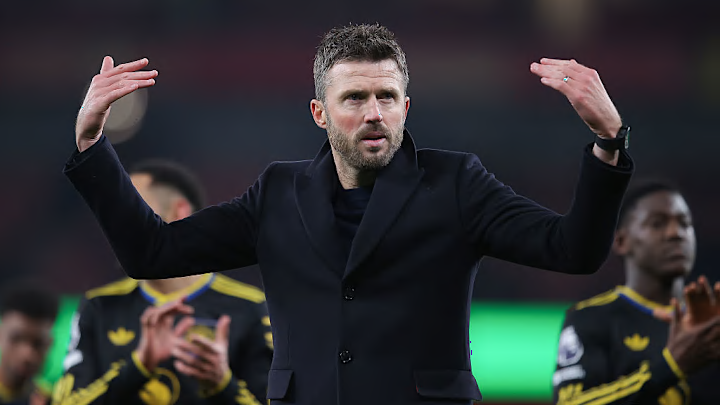
In five games in charge of Manchester United, Michael Carrick has taken on Unai Emery, Thomas Tuchel, Mikel Arteta (twice) and Pep Guardiola. He remains unbeaten.
Within two weeks, United feel like a club transformed after 14 months of dogmatic misery with Ruben Amorim at the helm. "The good times are coming," the Portuguese promised after the club’s worst Premier League season drew to a close last May. Now, supporters finally believe.
Since taking on the job for a second time, Carrick has overseen a 2–0 victory in the Manchester derby and a remarkable 3–2 triumph at league leaders Arsenal, courtesy of a wicked 87th-minute strike from Matheus Cunha that stunned a tense Emirates Stadium.
Rio Ferdinand may soon be pleading with the United hierarchy to get the contract out, let Carrick sign it and allow him to write whatever numbers he wants, but such hasty measures are unlikely to be taken.
Ole Gunnar Solskjær had to win 14 of his first 19 games before he was offered the job permanently, so it’s far from guaranteed that the former Red Devils midfielder will remain in the Old Trafford dugout long-term. Those low blocks are heading their way soon.
Nevertheless, the rapid transition from melancholy to hope has been remarkable. Here are some of the key reasons why United are so improved with Carrick at the helm.
Freedom for Fernandes

Fernandes vs. Arsenal - Stats Snapshot
- Minutes played: 90
- Touches: 65
- Pass accuracy: 41/51 (80%)
- Passes into final third: 7
- Chances created: 2
- Assists: 1
- Expected assists (xA): 0.03
- Shots: 3
- Expected goals (xG): 0.37
Amorim’s 3-4-2-1 sycophancy brought about a myriad of issues, one of which was the tactical dilemma regarding his superstar playmaker, Bruno Fernandes.
His unwillingness to trust Kobbie Mainoo left United with a duo of sub-par technicians when Fernandes wasn’t used in the midfield pivot, so Amorim opted to alleviate his build-up woes by utilising his captain in a deeper role, often alongside Casemiro.
The brilliant Fernandes remained the heartbeat of Amorim’s United, although teams sought to expose his deficiencies out of possession by constantly running off him and overloading the back three. With the ball, the Portuguese was able to ignite transitions via his outstanding passing range, but Amorim’s instructions limited his influence in and around the box.
Unsurprisingly, Carrick has drifted away from Amorim’s underwhelming framework and opted for a common-sense approach. He’s given his best player, Fernandes, the freedom to wreak havoc from the most dangerous zones on the pitch.
Fernandes has operated as a dual false nine with Bryan Mbeumo against Man City and Arsenal. In the derby, United were able to overwhelm Rodri at the base of midfield, and his positioning often outwitted Martín Zubimendi on Sunday afternoon. William Saliba was unsure whether to stay or go when Fernandes was unmarked between the lines, with the Frenchman concerned about the space he’d surrender in behind.
After a slow start, Fernandes got a grip on proceedings and played a key role in United’s triumph. It was his positioning and tidy combination that facilitated Patrick Dorgu’s “goal of a lifetime” to help the away side into a 2–1 lead. He‘s a supreme footballer, and Carrick’s decision to have him work in tandem with Mbeumo has so far proven to be very wise.
Employing United’s DNA

Amorim’s dogmatism and inflexibility meant it was hard for supporters, and perhaps the players, to buy in. While Antonio Conte won the Premier League title using a back three in 2016–17, football has drastically evolved since, and you just don’t see teams at the elite level adopting Amorim-like frameworks.
Even Conte has shifted to a back four since taking the Napoli job.
Formations and configurations tend to be superfluous in the grand scheme of things, though. Principles and intent are what matter. United shifted away from their much-derided ‘DNA’ by appointing Amorim, but Carrick is seemingly helping the club rediscover what made them a dominant force for so long.
The interim manager isn’t reinventing the wheel, but he’s emboldening and platforming players to thrive within a balanced set-up. Positivity is permeating throughout the squad, and the first team suddenly feels more attuned with the all-important academy thanks to Kobbie Mainoo’s reintegration.
Mainoo’s helped elevate the technical level of United’s midfield, supplying the Red Devils with the requisite courage to bypass pressure after weathering storms. The midfielder contributed to Cunha’s sublime winner at the Emirates, having starred in the derby.
While the ‘United DNA’ is a hard-to-explicitly define concept, Carrick seems to be embracing aspects of Sir Alex Ferguson’s great outfits, similar to Solskjær. The Red Devils are playing with courage and positive intent. No challenge appears beyond them thanks to Carrick’s clear vision, and, crucially, player buy-in.
Unleashing Patrick Dorgu

Pat’s been a big player for us... he’s been immense down the side with Luke [Shaw] against two teams that ask a lot of questions.Michael Carrick on Dorgu’s impact.
In the space of 180 minutes, Carrick has done much to further damage Amorim’s slumping reputation. The Portuguese’s inability to maximise an obviously talented squad was one of his major failings, with the players signed for Amorim all playing key roles in their early success under Carrick.
Cunha was Sunday’s match-winner, having recorded an assist off the bench in the derby, while Mbeumo and Patrick Dorgu have scored in back-to-back games.
Mbeumo’s class was on display before the Africa Cup of Nations, but Dorgu had struggled mightily during his first 12 months at the club. The Dane was hardly helped by his former manager, whose curious approach to facing the media was epitomised in late November, when he admitted to feeling anxious every time Dorgu got on the ball. That’s one way to empower a young player.
The shift to a back four left the interim manager with a hole down the left flank. Dorgu’s issues as a wing back under Amorim meant Cunha or Mason Mount seemed like more natural picks to start wide left in the derby, but Carrick opted for Dorgu. So far, his faith in the young Dane has been vindicated.
Dorgu has performed a selfless role out wide, shuttling up and down to ensure his full back isn’t overwhelmed all while providing a source of width when United have possession.
“Pat’s been a big player for us, obviously he’s scored two goals but in terms of the threat and athleticism and quality, he’s been immense down the side with Luke [Shaw] against two teams that ask a lot of questions,” Carrick said after Sunday’s win. Dorgu struck at the back post against Man City, then combined centrally with Fernandes before unleashing a shot that stunned David Raya and satisfyingly kissed the underside of the bar.
That sequence depicted the newfound confidence flowing through the Dane that the interim manager has helped facilitate through a drastic shift in tone and messaging.
There’s been tactical astuteness and greater clarity from the touchline, but player empowerment has been the key to United’s fast start under Carrick.
READ THE LATEST MAN UTD NEWS, TRANSFER RUMORS AND MORE
 Add us as a preferred source on Google
James Cormack is a writer for SI FC. Opting against a football coaching undergraduate degree at the last minute, he instead decided to take on a six-month internship with 90min in 2019 and hasn't looked back. Cormack's current SEO focus means he tends to venture to the land of match previews and predicted lineups, but he also has a wealth of experience in news and feature writing. A passion for soccer's history and the European game often takes his work beyond the familiarity of the Premier League, but it's with Tottenham Hotspur where his strongest allegiance lies.