%20%20--%3E%0A%3Csvg%20version%3D%221.1%22%20id%3D%22Layer_1%22%20xmlns%3D%22http%3A%2F%2Fwww.w3.org%2F2000%2Fsvg%22%20xmlns%3Axlink%3D%22http%3A%2F%2Fwww.w3.org%2F1999%2Fxlink%22%20x%3D%220px%22%20y%3D%220px%22%0A%09%20width%3D%2239px%22%20height%3D%2240px%22%20viewBox%3D%220%200%2039%2040%22%20enable-background%3D%22new%200%200%2039%2040%22%20xml%3Aspace%3D%22preserve%22%3E%0A%3Cpath%20fill%3D%22%23FFFFFF%22%20d%3D%22M38.5%2C7H28.2v26h10.3V7z%22%2F%3E%0A%3Cpath%20fill-rule%3D%22evenodd%22%20clip-rule%3D%22evenodd%22%20fill%3D%22%23FFFFFF%22%20d%3D%22M26.1%2C25.5c0%2C5.8-4.1%2C7.5-12.9%2C7.5C3.9%2C33%2C0%2C31.2%2C0%2C25.2v-1.1h11.6%0A%09v2.4c0%2C0.7%2C0.1%2C1.4%2C1.2%2C1.4c1%2C0%2C1.2-0.4%2C1.2-1.3v-0.9c0-1.6-0.9-1.6-3.5-2.2C2.2%2C21.7%2C0%2C19.7%2C0%2C15.3v-0.9C0%2C9.3%2C5.5%2C7%2C12.9%2C7%0A%09c10.2%2C0%2C12.8%2C2.6%2C12.8%2C7.4v1.8h-11v-2.9c0-0.6-0.4-1.1-1.2-1.1c-0.6%2C0-1.2%2C0.4-1.2%2C1.1v0.9c0%2C1.5%2C0.9%2C2%2C3.3%2C2.5%0A%09c8%2C1.6%2C10.5%2C3.3%2C10.5%2C7.5V25.5z%22%2F%3E%0A%3C%2Fsvg%3E%0A)
The Seven Matches With the Most Red Cards in World Cup History—Ranked
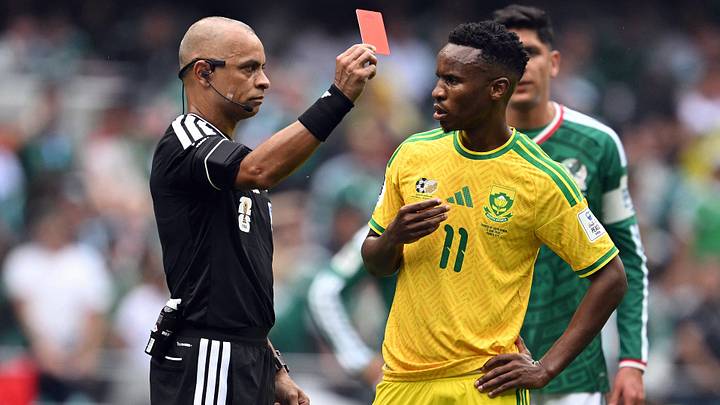
“We kept our cool,” Javier Aguirre said of Mexico’s performance in the opening match of the 2026 World Cup. The same could not be applied to South Africa.
A scatty, error-strewn display saw Hugo Broos’s side concede a pair of goals and as many red cards. A late (and harsh) dismissal for Mexico’s César Montes ensured this contest would be committed to the record books for the wrong reasons.
The first ever World Cup opener to feature three sendings-off immediately ranks among the most red-card heavy fixtures across the competition’s entire 96-year history. However, it wasn’t quite the dirtiest game of all time.
The Dirtiest World Cup Matches of All Time
7. Mexico 2–0 South Africa (2026)

Red cards: Yaya Sithole (49’), Themba Zwane (84’), César Montes (90’+2)
Despite its statistical standing among the World Cup’s most red-tinged contests, the opening game of the 2026 tournament didn’t have the feel of a particularly savage affair. Brazilian official Wilton Sampaio handed out as many yellow cards as reds: three of each.
Yaya Sithole endured a World Cup debut to forget, compounding his first-half concession of possession which led to Julián Quiñones’s opener with two yellow cards. Themba Zwane was befuddled by his dismissal for a handsy tangle with Roberto Alvarado and César Montes could count himself mightily unfortunate to be dismissed for late swipe on Khuliso Mudau.
6. Croatia 2–2 Australia (2006)
This crazy match between 🇭🇷 & 🇦🇺 from 2006 🤯#FIFAWorldCup pic.twitter.com/wHKUab4fkw
— FIFA World Cup (@FIFAWorldCup) October 18, 2022
Red cards: Dario Šimić (85’), Brett Emerton (87’), Josip Šimunić (90’+3)
Despite being one of the few World Cup matches to feature three red cards, it was the number of bookings dished out by referee Graham Poll that mark this game out in the annals of tournament history.
Croatian defender Josip Šimunić was infamously shown three yellow cards before he was eventually dismissed. Thanks to a strong Australian accent for the Canberra-born center back, Poll mistook Šimunić for a Socceroo when noting down his second yellow.
5. Italy 1–1 USMNT (2006)

Red cards: Daniele De Rossi (28’), Pablo Mastroeni (45’), Eddie Pope (47’)
The U.S. may have ended the contest with nine men, but it was the vicious elbow from Italy’s Daniele De Rossi which inspired the most outrage. Had the Roman midfielder not written a letter of apology to FIFA, he would have been banned for the entire tournament, rather than four games.
Thanks to his remorse, De Rossi was available to feature in that year’s World Cup final, coming off the bench to convert his penalty in a triumphant shootout victory over France.
4. South Africa 1–1 Denmark (1998)

Red cards: Miklos Molnar (66’), Alfred Phiri (68’), Morten Wieghorst (85’)
During his time as FIFA president, Sepp Blatter usually got what he wanted (apart from the Nobel Peace Prize, that is). Shortly after demanding the 1998 World Cup’s officials to tighten up, Colombian referee John Jairo Toro met his boss’s brief with three red cards and seven yellows, four of which were for time-wasting. Toro may have taken it too far.
Alfred Phiri was not wise in throwing out an elbow but Miklos Molnar could feel hard done by for his stern punishment after a typical collision. Even South Africa’s Benni McCarthy couldn’t understand why Morten Wieghorst had been sent off for their coming together.
“The guy hardly even touched me,” South Africa’s goalscorer shrugged. “The referee went out of his way to give him a red card and I am sure that was a very silly, a stupid decision from the referee.”
3. Hungary 4–2 Brazil (1954)
Brazil 🇧🇷to face Hungary 🇭🇺in the quarterfinals of World Cup 1954, AKA The Battle of Berne:
— FootballRetroPlus (@robertmdaws) June 9, 2026
Castilho, Djalma Santos, Nílton Santos, Brandãozinho, Pinheiro, Bauer, Julinho, Didi, Baltazar, Maurinho, Humberto pic.twitter.com/kLPBUYImY3
Red cards: József Bozsik (71’), Nilton Santos (71’), Humberto (79’)
Every Brazilian performance at a World Cup is an overreaction to the preceding tournament. After being perceived as weakly melting against Uruguay on home soil in the showpiece fixture of 1950, Brazil would not go down without a fight four years later.
Unfortunately, the Seleção overcorrected, brawling a little too literally with Hungary in the 1954 quarterfinal which would be dubbed ‘The Battle of Berne.’ After a mass brawl involving 20 players broke out, it’s almost impressive only three were sent packing.
2. Brazil 1–1 Czechoslovakia (1938)
#TDIH: 12 June 1938 - Battle of Bordeaux. First time that 3 players were sent off in a #WorldCup match #More2Football pic.twitter.com/oAy4CIopKY
— Sky HISTORY2 (@HISTORY2UK) June 12, 2014
Red cards: Zezé Procópio (14’), Martim (89’), Jan Říha (89’)
This was not a fun game for Czechoslovakia’s wondrous star Oldřich Nejedlý. The playmaker was the subject of a nasty kick from Zezé Procópio which forced the Brazilian’s dismissal inside a quarter-hour.
Martim and Jan Říha’s scrap between themselves reduced the playing staff even further before Nejedlý himself was forced off with a broken bone in his foot. Czech goalkeeper František Plánička would also break his collarbone, but played on for the entirety of the quarterfinal.
1. Portugal 1–0 Netherlands (2006)
4️⃣ red cards. 🟥
— FIFA World Cup (@FIFAWorldCup) June 25, 2024
1️⃣6️⃣ yellow cards. 🟨#OTD in 2006, 'The Battle of Nuremberg' gave us one of the most dramatic #FIFAWorldCup matches of all time. 🇵🇹🇳🇱 pic.twitter.com/5dTNaDnEPA
Red cards: Costinha (45’+1), Khalid Boulahrouz (64’), Deco (78’), Giovanni van Bronckhorst (90’+5)
After four red cards and 16 yellows, then-FIFA president Sepp Blatter still wanted more. “There could have been a yellow card for the referee,” he scoffed. “He was not at the same level as the players.”
READ THE LATEST WORLD CUP NEWS, ANALYSIS AND INSIGHT FROM SI FC
 Add us as a preferred source on Google
Grey Whitebloom is an Associate Editor for SI FC. He has more than half a decade of experience in sports media across all its various guises, from the fast-paced demands of news articles and match reports to in-depth research required for features. Whitebloom graduated with a First Class Honours from University College London and found himself named on the Dean’s List—which, despite his initial fears, was a form of praise rather than a punishment. He specialises in the Premier League and Champions League, while also boasting an extensive track record of La Liga coverage.