%20%20--%3E%0A%3Csvg%20version%3D%221.1%22%20id%3D%22Layer_1%22%20xmlns%3D%22http%3A%2F%2Fwww.w3.org%2F2000%2Fsvg%22%20xmlns%3Axlink%3D%22http%3A%2F%2Fwww.w3.org%2F1999%2Fxlink%22%20x%3D%220px%22%20y%3D%220px%22%0A%09%20width%3D%2239px%22%20height%3D%2240px%22%20viewBox%3D%220%200%2039%2040%22%20enable-background%3D%22new%200%200%2039%2040%22%20xml%3Aspace%3D%22preserve%22%3E%0A%3Cpath%20fill%3D%22%23FFFFFF%22%20d%3D%22M38.5%2C7H28.2v26h10.3V7z%22%2F%3E%0A%3Cpath%20fill-rule%3D%22evenodd%22%20clip-rule%3D%22evenodd%22%20fill%3D%22%23FFFFFF%22%20d%3D%22M26.1%2C25.5c0%2C5.8-4.1%2C7.5-12.9%2C7.5C3.9%2C33%2C0%2C31.2%2C0%2C25.2v-1.1h11.6%0A%09v2.4c0%2C0.7%2C0.1%2C1.4%2C1.2%2C1.4c1%2C0%2C1.2-0.4%2C1.2-1.3v-0.9c0-1.6-0.9-1.6-3.5-2.2C2.2%2C21.7%2C0%2C19.7%2C0%2C15.3v-0.9C0%2C9.3%2C5.5%2C7%2C12.9%2C7%0A%09c10.2%2C0%2C12.8%2C2.6%2C12.8%2C7.4v1.8h-11v-2.9c0-0.6-0.4-1.1-1.2-1.1c-0.6%2C0-1.2%2C0.4-1.2%2C1.1v0.9c0%2C1.5%2C0.9%2C2%2C3.3%2C2.5%0A%09c8%2C1.6%2C10.5%2C3.3%2C10.5%2C7.5V25.5z%22%2F%3E%0A%3C%2Fsvg%3E%0A)
The Uncomfortable Truth: Is Cristiano Ronaldo Holding Portugal Back?
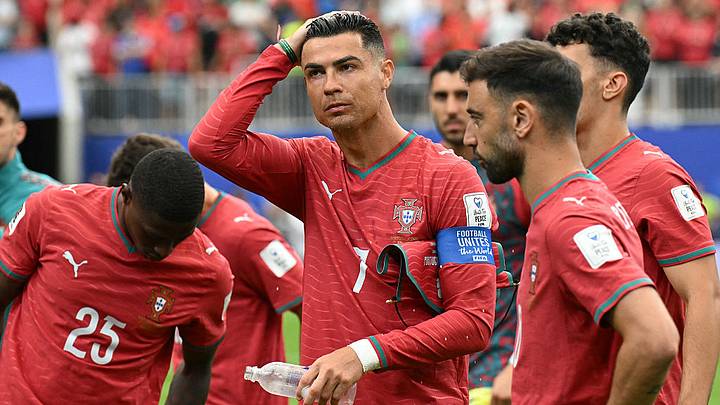
Cristiano Ronaldo said in 2025 that he doesn’t “dream” of winning the World Cup, nor will not winning it “define” his career. The latter is undeniably true.
Ronaldo has changed the course of soccer history since first kicking a ball for Sporting CP in 2002 and were it not for Lionel Messi, his remarkable achievements would stand completely alone—kind of like Roger Federer and Rafael Nadal existing on the tennis court at the same time as Novak Djokovic.
Club accolades and trophies aside, it’s also not like he has never won anything with his national team. Some skeptics might question the legitimacy of the UEFA Nations League as a ‘major’ competition, but the 2016 European Championship was Portugal’s first-ever international triumph and something that two prior golden generations in the 1960s and 2000s never achieved.
But maybe he doesn’t dream of winning the World Cup because he knows deep down that his chance is already long gone. Watching Ronaldo do little more than occupy space in Portugal’s lackluster 2026 group opener against DR Congo was just a little bit sad for one of the all-time greats.
If the World Cup isn’t his dream, why is he still chasing it? Ronaldo is 41, a self-made billionaire, and could have walked into the sunset years ago if he wanted to.
In the 1–1 draw, celebrated like a win by DR Congo, Ronaldo played the full 90 minutes, touched the ball 25 times and didn’t register a shot through the first 67 minutes. All three shots he eventually had were off target, not close to threatening the goal, while he created no chances for others.
Ronaldo’s best opportunity, a scuffed near-post shot after Francisco Conçeicão’s cutback would have been better served left for Bruno Fernandes, positioned a couple of yards further back.
Ronaldo Decline Began Long Ago
0 - Cristiano Ronaldo has now gone 10 consecutive major tournament games without scoring for Portugal (FIFA World Cup/EURO):
— OptaJoe (@OptaJoe) June 17, 2026
33 shots
11 on target
0 goals
Drought. pic.twitter.com/PYQIHPgCkM
This isn’t a new problem. Ronaldo has been over the hill at major tournaments for a while.
Ronaldo’s World Cup record alone has never been outstanding, even through his peak years. Where Messi has scored 16 in goals in 27 appearances on this stage—both debuted at the 2006 tournament—Portugal’s superstar has just eight in 24.
But it’s now 10 major tournament matches at the World Cup or European Championship without a goal. Ronaldo’s last goalscoring appearance in a tournament came against Ghana in Portugal’s first game of the 2022 World Cup. He didn’t find the net again in Qatar as his team exited in the quarterfinals and was even benched for the knockout phase by manager Fernando Santos.
Ronaldo got back in the team and back to scoring ways in the very next match, a Euro 2024 qualifier against Liechtenstein, and that’s kind of been where he’s at for the national team—prolific in qualifiers and the Nations League, but weak in tournaments. He didn’t score at all in Euro 2024 but still played almost every minute. At this stage of his career, if Ronaldo isn’t scoring, he isn’t contributing, no longer the explosive all-action gamechanger he was once.
Saudi Pro League Proves Poor World Cup Preparation

Ronaldo has been playing in Saudi Arabia since the start of 2023. Despite the insistence of the big names who end up there that it’s a strong league, its quality is lacking beyond a small handful of top teams. It has allowed him to extend his career well beyond usual limits, but the numbers Ronaldo puts down in the Gulf arguably inflate the perception of his level well above what it is.
He scored 50 goals across all competitions for Al Nassr in 2023–24 and still managed 28 league goals across 30 appearances in 2025–26 as he finally got his hands on the Saudi Pro League title. But it’s not good practice for facing stronger teams on the biggest international stage.
DR Congo, although competing at the World Cup for the first time since 1974—when it was called Zaïre—is not a team of nobodies. Four of the back five play club soccer in Europe’s ‘Big Five’ leagues. Ronaldo was well marked and the service he wanted from a supporting cast featuring Bruno Fernandes, Bernado Silva, Vitinha and João Neves was all too often just repelled. These days Ronaldo lacks the movement to break free of tight defenses and it makes finding him that bit harder, especially if he remains the ultimate focal point of the team.
Where Does Portugal Go From Here?

It’s obviously a huge call to bench Ronaldo. Santos made it in 2022 and it didn’t last. Sometimes the toughest decision is the most important one, like when Spain ruthlessly dispensed with Real Madrid icon Raúl after one poor tournament too many in 2006. Current manager Roberto Martínez has always defended Ronaldo’s ongoing selection, but with the Spaniard stepping down after this World Cup, he’s now got nothing to lose in pursuit of glory.
Portugal is not blessed with an abundance of other goalscoring strikers. Gonçalo Ramos is the only other natural No. 9 that Martínez chose to bring. The 24-year-old was once considered the next big thing, actually outscoring Ronaldo (three to one) at the last World Cup, but no more than a backup since joining Paris Saint-Germain in 2023 and barely getting on the pitch at Euro 2024.
Where Ramos could thrive is in a more fluid system that plays to his strengths of rotating positions—something Ronaldo cannot do—becoming involved in buildup play and leaving space for wingers and midfields to invade. Portugal could equally go with any number of ‘false nine’ options—Bernardo Silva, João Félix, Rafael Leão or one of several others—for a similar effect.
Portugal faces Uzbekistan next, and an expected win there would all but guarantee progression into the World Cup knockout phase with a final group match against Colombia to spare. But with a cumbersome Ronaldo, would the attacking output be any different than was on display here?
READ THE LATEST WORLD CUP NEWS, ANALYSIS AND INSIGHT FROM SI FC
 Add us as a preferred source on Google
Jamie Spencer is a writer and editor for SI FC. Jamie grew up in Manchester, England, in the 1990s and fell in love with the game at the same time as the Premier League was taking off. With more than a decade of experience behind him in sports media, he specializes in Manchester United and the overall Premier League, still living in England’s north-west soccer hotbed. Jamie is also an expert on the women’s game and enjoys old school nostalgia, telling stories from soccer’s rich history and culture.