%20%20--%3E%0A%3Csvg%20version%3D%221.1%22%20id%3D%22Layer_1%22%20xmlns%3D%22http%3A%2F%2Fwww.w3.org%2F2000%2Fsvg%22%20xmlns%3Axlink%3D%22http%3A%2F%2Fwww.w3.org%2F1999%2Fxlink%22%20x%3D%220px%22%20y%3D%220px%22%0A%09%20width%3D%2239px%22%20height%3D%2240px%22%20viewBox%3D%220%200%2039%2040%22%20enable-background%3D%22new%200%200%2039%2040%22%20xml%3Aspace%3D%22preserve%22%3E%0A%3Cpath%20fill%3D%22%23FFFFFF%22%20d%3D%22M38.5%2C7H28.2v26h10.3V7z%22%2F%3E%0A%3Cpath%20fill-rule%3D%22evenodd%22%20clip-rule%3D%22evenodd%22%20fill%3D%22%23FFFFFF%22%20d%3D%22M26.1%2C25.5c0%2C5.8-4.1%2C7.5-12.9%2C7.5C3.9%2C33%2C0%2C31.2%2C0%2C25.2v-1.1h11.6%0A%09v2.4c0%2C0.7%2C0.1%2C1.4%2C1.2%2C1.4c1%2C0%2C1.2-0.4%2C1.2-1.3v-0.9c0-1.6-0.9-1.6-3.5-2.2C2.2%2C21.7%2C0%2C19.7%2C0%2C15.3v-0.9C0%2C9.3%2C5.5%2C7%2C12.9%2C7%0A%09c10.2%2C0%2C12.8%2C2.6%2C12.8%2C7.4v1.8h-11v-2.9c0-0.6-0.4-1.1-1.2-1.1c-0.6%2C0-1.2%2C0.4-1.2%2C1.1v0.9c0%2C1.5%2C0.9%2C2%2C3.3%2C2.5%0A%09c8%2C1.6%2C10.5%2C3.3%2C10.5%2C7.5V25.5z%22%2F%3E%0A%3C%2Fsvg%3E%0A)
USWNT Takeaways: Experimental Lineup Proves Costly in Japan Defeat
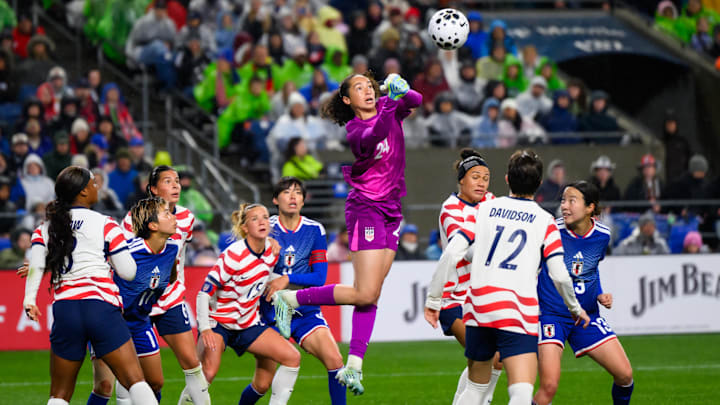
The U.S. women’s national team fell to Japan, 1–0, at Lumen Field in Seattle on Tuesday night as the biggest women’s sports crowd in Seattle history (36,128) watched on during a soggy night in the Pacific Northwest.
Tottenham’s Maika Hamano scored the only goal of the game in the 27th minute. The 21-year-old attacker won the ball off Ally Sentnor in the midfield and then, after some swift passing from Japan, deftly cut inside and curled the ball into the top of the goal.
The defeat evens up the April friendly series between these nations after the USWNT beat Japan, 2-1, three days earlier in San Jose.
It is just the fourth defeat for the USWNT under manager Emma Hayes, who took over in June 2024. Two of those defeats have come at the hands of Japan. Hayes record as USWNT coach now stands at 31-4-2.
The USWNT will close out this trio of friendlies against Japan in the April FIFA window at Dick’s Sporting Goods Park in Commerce City, Colo., on Friday. Here are the takeaways from Tuesday night.
A brand new USWNT XI
With three consecutive friendlies against the same opposition, this window was always going to be about seeing different lineup rotations and relationships tested on the pitch. Hayes opted to change her entire starting XI from Saturday’s win over Japan. While still a very talented group, this was not the first-string USWNT by any means, and it was hard for them to find chemistry.
Outside of centerback Emily Sonnett, who would have started in San Jose were it not for a late knock she picked up in training, this was a young and experimental lineup. Sonnett earned her 116th cap on the night. The other 10 players combined had just 158.
The USWNT’s midfield core was tremendously young. Claire Hutton, 20, was wearing the captain’s armband, with 19-year-old Lily Yohannes and 21-year-old Jaedyn Shaw ahead of her in midfield. Starting as the USWNT’s lone central forward,22-year-old Ally Sentnor looked overwhelmed giving up possession 10 times and going 5-for-10 in duels.
Captain Claire 🫡©️
— National Women’s Soccer League (@NWSL) April 15, 2026
Claire Hutton is the youngest to start a USWNT game wearing the captain’s armband since 2001. pic.twitter.com/gHKuINXptj
“I think we’ve got players that have some of the recipe, and they’re trying to implement it in their entirety, but it's a work in progress, and I think if I play solely to win, we maybe don’t change a lot in these games,” Hayes said of her team choice.
“I don’t regret those decisions. I just know when a player shines against a certain type of opponent, for example, teams we might have played in January, let me see what you look like against Japan.”
Japan stays fresh
In some ways, Japan followed suit. Interim coach Michihisa Kano made nine changes to his starting XI from the 2–1 defeat a few days before. But his changes included a few more experienced internationals, such as 35-year-old World Cup winner Saki Kumagai, in-form 31-year-old forward Mina Tanaka, and 29-year-old fullback Risa Shimizu.
One of the key differences between the two approaches has also been how Kano has sought to rotate more within these games. He made nine substitutions in the first match against the USWNT, and then made eight changes Tuesday in Seattle. Hayes has made four and six in the same games.

Japan has had a lot of different combinations come in and out of games. But as it is just a month since their triumph at the 2026 Women’s Asian Cup, it’s easy to see how together this group is and how quickly they can slip into shape no matter the lineup. For now, Japan has more match-ready depth than the USWNT.
Missed chances, U. S. fizzles out
With Japan hanging onto an early lead, the USWNT tried to come out punching in the final stages of the game. In the 65th minute, Hayes had seen enough from the young XI and made a quadruple substitution with a fifth sub coming in just six minutes after that.
Bringing on the heavy hitters in Trinity Rodman, Sophia Wilson, Lindsey Heaps and Gisele Thompson made an impact. The USWNT did quickly put themselves in a good position to find an equalizer, but failed to be clinical or keep their cool in the box. Sentnor was guilty of failing to convert the best of those chances from close range, with Shaw also seeing her effort from the edge of the box deflected wide.
However, while the USWNT did create four quick chances between the 71st and 74th minutes, Hayes’s team failed to take a single shot after that. The final 16 minutes and second-half stoppage time showcased a blunt and out-of-rhythm UWSWNT unable to find a way. There was a lot of probing crossing into the box from the Americans, but they were well batted away by the Japanese backline.
Overall, chances were still harder to come by than the USWNT would have wanted, considering it had 67% possession. The USWNT had 12 shots to Japan’s nine, and forced five saves from Japan’s goalkeeper Akane Okuma.
“At the highest level, you’ve got to be decisive in the boxes. So, giving up a pretty poor goal, but not creating enough down the other end [resulted in defeat],” Hayes said of her team’s performance in Seattle.
Mixed night for Phallon Tullis-Joyce
Before the game, Hayes said Claudia Dickey and Phallon Tullis-Joyce were neck-and-neck when it came to establishing either as the USWNT’s No. 1 goalkeeper. Dickey may just be pulling ahead based on Tuesday night’s performance as it was an up-and-down night for Tullis-Joyce.
In Seattle, the Manchester United goalkeeper looked nervous in the rain early on, scrambling to get a hand to a stinging Tanaka shot that then bundled onto the grass. Tullis-Joyce then failed to judge the match-winner by Hamano, which sailed over her arms. How much of that was positioning or just the quality of the shot is debatable.
Japan open the scoring in Seattle through Maika Hamano 🇯🇵 pic.twitter.com/tmQiWcU5dm
— B/R Football (@brfootball) April 15, 2026
In the second half, Tullis-Joyce redeemed herself with a low save to her near post after a shot by Manaka Matsukubo. That moment required expert concentration, anticipation and handling. She finished with a 97% pass completion rate and 2 of 3 long balls connected. There will be a lot of scrutiny of the goalkeeper’s passing game.
Tierna Davidson returns
In the 65th minute, Hayes made a switch at centerback, bringing on Tierna Davidson for Emily Sonnett. This was Davidson's first match for the U. S. since Feb. 26, 2025. Curiously enough, that match was also a defeat to Japan.
Davidson suffered an ACL injury playing for Gotham FC in the NWSL shortly after that. She went 412 days between appearances for the USWNT. While her performance on Tuesday wasn’t particularly illuminating in either direction, it is a huge boost to the group to have her back.
“Tierna looked like she hadn’t been away. I thought, well, that’s going to be a tough game for her to go into. And didn’t show that. That’s what I was looking for, experience. And I think that was the difference,” Hayes said.
More Women’s Soccer from Sports Illustrated
 Add us as a preferred source on Google
Theo Lloyd-Hughes is a writer for Sports Illustrated Soccer based in the Southern United States. Originally from England, he can often be found in a press box across the NWSL or at international matches featuring the USWNT and other Concacaf nations.
Follow theolloydhughes