%20%20--%3E%0A%3Csvg%20version%3D%221.1%22%20id%3D%22Layer_1%22%20xmlns%3D%22http%3A%2F%2Fwww.w3.org%2F2000%2Fsvg%22%20xmlns%3Axlink%3D%22http%3A%2F%2Fwww.w3.org%2F1999%2Fxlink%22%20x%3D%220px%22%20y%3D%220px%22%0A%09%20width%3D%2239px%22%20height%3D%2240px%22%20viewBox%3D%220%200%2039%2040%22%20enable-background%3D%22new%200%200%2039%2040%22%20xml%3Aspace%3D%22preserve%22%3E%0A%3Cpath%20fill%3D%22%23FFFFFF%22%20d%3D%22M38.5%2C7H28.2v26h10.3V7z%22%2F%3E%0A%3Cpath%20fill-rule%3D%22evenodd%22%20clip-rule%3D%22evenodd%22%20fill%3D%22%23FFFFFF%22%20d%3D%22M26.1%2C25.5c0%2C5.8-4.1%2C7.5-12.9%2C7.5C3.9%2C33%2C0%2C31.2%2C0%2C25.2v-1.1h11.6%0A%09v2.4c0%2C0.7%2C0.1%2C1.4%2C1.2%2C1.4c1%2C0%2C1.2-0.4%2C1.2-1.3v-0.9c0-1.6-0.9-1.6-3.5-2.2C2.2%2C21.7%2C0%2C19.7%2C0%2C15.3v-0.9C0%2C9.3%2C5.5%2C7%2C12.9%2C7%0A%09c10.2%2C0%2C12.8%2C2.6%2C12.8%2C7.4v1.8h-11v-2.9c0-0.6-0.4-1.1-1.2-1.1c-0.6%2C0-1.2%2C0.4-1.2%2C1.1v0.9c0%2C1.5%2C0.9%2C2%2C3.3%2C2.5%0A%09c8%2C1.6%2C10.5%2C3.3%2C10.5%2C7.5V25.5z%22%2F%3E%0A%3C%2Fsvg%3E%0A)
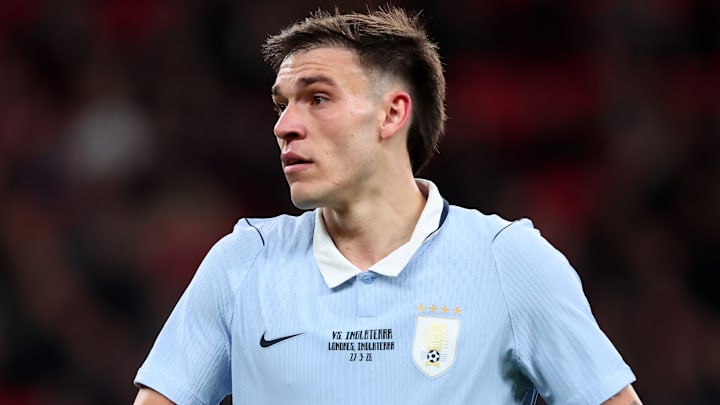
Why Man Utd’s Manuel Ugarte Received Two Yellow Cards But Wasn’t Sent Off vs. England
It can sometimes feel as though there are no constants in soccer: everything is subject to change.
The number of substitutes has risen, VAR’s powers threaten to spread and two halves will become four quarters at this summer’s World Cup. England’s friendly with Uruguay on Friday even called into question one of the most fundamental pieces of mathematics behind the sport: Now it appears that two yellow cards no longer lead to a red. For Manuel Ugarte at least.
Manchester United’s Uruguayan midfielder very much appeared to be booked twice in the second half of a defiantly drab pre-World Cup friendly at Wembley Stadium yet somehow left the pitch as a substitute rather than with a set of marching orders.
This fundamental breach of the game’s laws inspired a lot of questions in referee Sven Jablonski and also brought to mind the line from Manchester United’s legendary forward Denis Law. “The only thing that has never changed in the history of the game,” the Scotsman once said, “is the shape of the ball.” For now, at least.
Manuel Ugarte’s Two Yellow Cards vs. England
70th minute: Foul on Cole Palmer

In a way, Ugarte should be applauded for daring to enliven a listless contest in front of 80,000 spectators who had long since lost interest in the slow plod of flesh around north London.
Cole Palmer had been attempting to break that collective sense of inertia with the rarest of things—a dribble towards the byline—in the 70th minute when Ugarte came charging across to his Premier League rival. The Chelsea man could hear the 24-year-old’s lumbering stride above the low hum of spectators folding their programmes into paper aeroplanes and cleverly knocked the ball away, leaving his leg dangling as an invitation which Ugarte gleefully accepted.
The referee quickly blew his whistle and pointed for a free kick, inspiring complaints from Uruguay skipper José Maria Giménez. As was reported by multiple broadcasters, Ugarte received his first yellow card for a typically clumsy challenge.
81st minute: Dissent

Ten minutes later, with England 1–0 up and tempers starting to fray, Ugarte engaged in a dialogue with the match official which resulted in a clear brandishing of a yellow card.
The United midfielder is no stranger to a booking on English soil: During his first season at Old Trafford last term, only three players in the Premier League could better his tally of 11 yellow cards.
However, two in the same game normally result in a red which, remarkably, was not forthcoming on Friday night.
Fourth Official’s Explanation for Manuel Ugarte’s Double Booking

While some outlets reported that Giménez was shown the yellow card in the 70th minute for his protestations rather than Ugarte’s foul being punished, ITV Sport claimed during the broadcast that the fourth official Benjamin Brand duly confirmed that both bookings had been for the Manchester United man.
After some confused conferring, Brand was quoted as explaining that Ugarte’s second yellow card had been “rescinded.”
VAR technology was in place for the friendly—Sören Storks was tasked with manning the monitors—yet video assistant referees do not have the power to rescind yellow cards unless it is a case of mistaken identity. There is little doubt that it was Ugarte who was booked for what appeared to be dissent in the 81st minute.
One of the new rules set to be brought in for the 2026 World Cup is an expansion of VAR’s powers to cover second yellows in any scenario, yet that doesn’t get underway until June.
Thomas Tuchel Savages Referee Sven Jablonski

There was a lot for England manager Thomas Tuchel to be unhappy about after Friday’s 1–1 draw. Beyond the underwhelming performance of his team, the German coach questioned why Ronald Araújo wasn’t sent off for a reckless lunge on Phil Foden and also took issue with the award of a “very, very soft” stoppage-time penalty against England’s goalscorer Ben White.
On top of all that, there was the yellow card fiasco.
“I didn’t speak to him [the referee] after the match,” Tuchel lamented, “I don’t want to. I think it was not a good performance at all throughout the match.
“Like I said, I cannot understand [how] a tackle like this is not even checked and I think the penalty in the end was very, very soft. And then there were debates that a player got two yellow cards in the match without being sent off,” Tuchel added, looking across to England’s press officer in bemusement before turning back to the rows of assembled journalists with a wry smile and pronounced shrug. “Bad day at the office.”
READ THE LATEST SOCCER NEWS, ANALYSIS AND INSIGHT FROM SI FC
 Add us as a preferred source on Google
Grey Whitebloom is an Associate Editor for SI FC. He has more than half a decade of experience in sports media across all its various guises, from the fast-paced demands of news articles and match reports to in-depth research required for features. Whitebloom graduated with a First Class Honours from University College London and found himself named on the Dean’s List—which, despite his initial fears, was a form of praise rather than a punishment. He specialises in the Premier League and Champions League, while also boasting an extensive track record of La Liga coverage.