%20%20--%3E%0A%3Csvg%20version%3D%221.1%22%20id%3D%22Layer_1%22%20xmlns%3D%22http%3A%2F%2Fwww.w3.org%2F2000%2Fsvg%22%20xmlns%3Axlink%3D%22http%3A%2F%2Fwww.w3.org%2F1999%2Fxlink%22%20x%3D%220px%22%20y%3D%220px%22%0A%09%20width%3D%2239px%22%20height%3D%2240px%22%20viewBox%3D%220%200%2039%2040%22%20enable-background%3D%22new%200%200%2039%2040%22%20xml%3Aspace%3D%22preserve%22%3E%0A%3Cpath%20fill%3D%22%23FFFFFF%22%20d%3D%22M38.5%2C7H28.2v26h10.3V7z%22%2F%3E%0A%3Cpath%20fill-rule%3D%22evenodd%22%20clip-rule%3D%22evenodd%22%20fill%3D%22%23FFFFFF%22%20d%3D%22M26.1%2C25.5c0%2C5.8-4.1%2C7.5-12.9%2C7.5C3.9%2C33%2C0%2C31.2%2C0%2C25.2v-1.1h11.6%0A%09v2.4c0%2C0.7%2C0.1%2C1.4%2C1.2%2C1.4c1%2C0%2C1.2-0.4%2C1.2-1.3v-0.9c0-1.6-0.9-1.6-3.5-2.2C2.2%2C21.7%2C0%2C19.7%2C0%2C15.3v-0.9C0%2C9.3%2C5.5%2C7%2C12.9%2C7%0A%09c10.2%2C0%2C12.8%2C2.6%2C12.8%2C7.4v1.8h-11v-2.9c0-0.6-0.4-1.1-1.2-1.1c-0.6%2C0-1.2%2C0.4-1.2%2C1.1v0.9c0%2C1.5%2C0.9%2C2%2C3.3%2C2.5%0A%09c8%2C1.6%2C10.5%2C3.3%2C10.5%2C7.5V25.5z%22%2F%3E%0A%3C%2Fsvg%3E%0A)
Alexander Zverev, NYC’s Next Big Villain, Has a Controversial Serving Move. Should It Be Allowed?
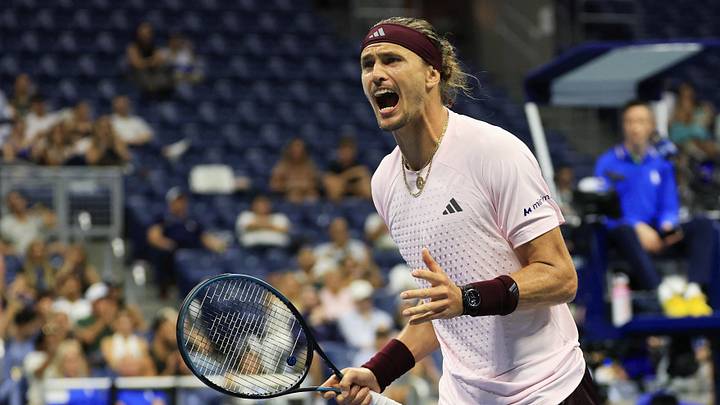
Trae Young. David Ortiz. Denis Potvin. And now, Alexander Zverev.
New York City’s newest villain is no stranger to the criticism. The top-seeded player at the U.S. Open is looking to end his dominant run stateside with his second Grand Slam championship this year, and he’ll have to go through fellow big-serving star Ben Shelton to hoist the trophy. Make no mistake, the New Yorker crowd at Arthur Ashe Stadium will be predominantly anti-Zverev, as the 23-year-old Shelton hopes to become the first American man to win the U.S. Open men’s singles title since Andy Roddick in 2003. Zverev himself said it best: “Hopefully I cannot make the American Dream come true on Sunday.”
Heading into the highly anticipated showdown at Flushing Meadows, Zverev is already shaping out to be one of NYC’s all-time biggest villains in recent history. His controversial serving routine won’t help his case.
In Zverev’s straight-set semifinal win over Karen Khachanov, the latter openly criticized the German’s lengthy ball-bouncing routine before his serves.
“His ball-bouncing before the serve bothers a lot of players,” Khachanov said, via José Morgado. “He takes a long time. You prepare yourself, then he bounces the ball another 12 times, so you have to prepare and split-step again almost every point. If he’s within the time limit, there's nothing I can say. If he’s going over the time limit, then he should get a warning. But it’s the chair umpire’s responsibility to monitor that, not mine.”
For reference, under the Grand Slam rules players are allowed a maximum of 25 seconds from the moment the ball goes out of play at the end of a point to strike the ball on their first serve. There are no parameters about how many times a player can bounce the ball during that span, and there is no separate clock for the second serve. The rulebook merely states that the second serve should be struck “without delay.”
Based on these guidelines, Zverev’s pre-serving antics are absolutely legal and by-the-book. But should they be?
Zverev did receive a time violation warning from the umpire at one point during Friday’s match, which elicited plenty of cheers from the audience. He was asked about his distinctive ball-bouncing habit after his semifinal win and claimed it wasn’t intentional.
“I have no idea why. I’m not doing it on purpose,” Zverev said. “I saw the stat that I’ve bounced the ball 12,000 times or something like that. It’s quite funny. ... I’m not counting them in my head, I’m not getting a certain number or anything like that. ... I forget about it every once in a while, and then it goes up to, I don’t know what number it is.”
Alexander Zverev was asked about how much he bounces the ball on serve 🤣
— Stan Sport (@StanSportAU) September 12, 2026
↳ US Open. Every Match. Live & On Demand.#StanSportAU #USOpen pic.twitter.com/2uTHhuKgcK
While watching clips or highlights, it’s difficult to pick up on Zverev’s frequent ball bounces prior to his serves simply because they get edited out most of the time. But on the court, Khachanov appears to hold a grievance with the reigning French Open champ’s service routine, and he’s not the only one.
Andy Roddick offers a solution to eliminate tennis players’ time-wasting service routines
Former U.S. Open winner and current tennis analyst Andy Roddick thinks the tournament rules should be modified in light of Zverev’s exasperating time-wasting tactics:
“Yeah, the rules should change. As long as he's doing it within the 24-second shot clock, what are you going to say? There needs to be a shot clock for the second serve," Roddick said on his podcast Served. “You cannot bounce the ball 20-something times between first and second serve. You cannot do it and then act shocked when we finish at three in the morning. Like, we just can’t do it.”
Roddick went on to propose his novel fix for the issue:
“You have four or five seconds to start your motion after your first serve—unless, how about you buy back time? If you start your first serve at 15 seconds, you get that added to your time between.”
In Zverev’s defense, he is far from the only player to get criticized for his time-wasting service routine. Long before the German ascended tennis’ top ranks, Rafael Nadal made a rather infamous reputation for himself with his ritualistic fidgeting and ball-bouncing, as has Novak Djokovic, who shockingly exited this year’s U.S. Open in the first round.
Back in 2017 when the Australian Open followed suit with the U.S. Open and announced it was implementing the 25-second shot clock, Nadal didn’t hold back his feelings on the change.
“I believe it is not something that is good for the future of the Tour,” Nadal said. ”For me personally, I am not worried at all. I don’t want to play for 10 more years. I can adapt easily to that. ... In my opinion, having a clock with 25 seconds playing in some extreme conditions you cannot have the best show possible.”
Now that the serving clock appears to be here to stay, more questions remain over the nitty-gritty nuances of time-keeping, as Roddick and Khachanov—albeit sorely—pointed out.
Entering Friday’s semifinal, Zverev has bounced the ball 12,040 times in his service motion during the U.S. Open, per ESPN. That amount is best considered as an approximation—who is really going through the tapes and counting all the bounces, anyway—but it does paint the world No. 2 as a bigger time-wasting offender than most, not to mention the mind games at play.
Solving the pesky problem could be as simple as introducing a second serve shot clock. But for the time being, Zverev’s ball-bouncing habits aren’t going away anytime soon, and that’s just something Shelton will have to adapt to in Sunday’s final. The bit of good news? Shelton will definitely have the crowd on his side.
 Add us as a preferred source on Google
Kristen Wong is a staff writer on the Breaking and Trending News team at Sports Illustrated. She has been a sports journalist since 2020 and has a bachelor’s in English and linguistics from Columbia University. Before joining SI in November 2023, Wong covered four NFL teams as an associate editor with the FanSided NFL network and worked as a staff writer for the brand’s flagship site. She is a lifelong Liverpool fan who enjoys solving crossword puzzles and hanging out at her neighborhood dive bar in NYC.
Follow kriscwong