%20%20--%3E%0A%3Csvg%20version%3D%221.1%22%20id%3D%22Layer_1%22%20xmlns%3D%22http%3A%2F%2Fwww.w3.org%2F2000%2Fsvg%22%20xmlns%3Axlink%3D%22http%3A%2F%2Fwww.w3.org%2F1999%2Fxlink%22%20x%3D%220px%22%20y%3D%220px%22%0A%09%20width%3D%2239px%22%20height%3D%2240px%22%20viewBox%3D%220%200%2039%2040%22%20enable-background%3D%22new%200%200%2039%2040%22%20xml%3Aspace%3D%22preserve%22%3E%0A%3Cpath%20fill%3D%22%23FFFFFF%22%20d%3D%22M38.5%2C7H28.2v26h10.3V7z%22%2F%3E%0A%3Cpath%20fill-rule%3D%22evenodd%22%20clip-rule%3D%22evenodd%22%20fill%3D%22%23FFFFFF%22%20d%3D%22M26.1%2C25.5c0%2C5.8-4.1%2C7.5-12.9%2C7.5C3.9%2C33%2C0%2C31.2%2C0%2C25.2v-1.1h11.6%0A%09v2.4c0%2C0.7%2C0.1%2C1.4%2C1.2%2C1.4c1%2C0%2C1.2-0.4%2C1.2-1.3v-0.9c0-1.6-0.9-1.6-3.5-2.2C2.2%2C21.7%2C0%2C19.7%2C0%2C15.3v-0.9C0%2C9.3%2C5.5%2C7%2C12.9%2C7%0A%09c10.2%2C0%2C12.8%2C2.6%2C12.8%2C7.4v1.8h-11v-2.9c0-0.6-0.4-1.1-1.2-1.1c-0.6%2C0-1.2%2C0.4-1.2%2C1.1v0.9c0%2C1.5%2C0.9%2C2%2C3.3%2C2.5%0A%09c8%2C1.6%2C10.5%2C3.3%2C10.5%2C7.5V25.5z%22%2F%3E%0A%3C%2Fsvg%3E%0A)
Australian Open 2026 Midterm Grades: Favorites Hold Steady
Come kids, gather round. Lean in. And we’ll tell you about an ancient concept. There was a time when a lower-ranked player beat a higher-ranked player, causing surprise. Sometimes a minor fissure in the draw. Sometimes a real tremor. “Upsets,” they were called. Ask your parents.
Here at the 2026 Australian Open, it’s class warfare. As Mark Carney/Thucydides might put it: “The strong can do what they can, and the weak must suffer what they must.” So few players with seedings alongside their names lost to lesser-ranked players. The favorites were scarcely pushed. At this writing, barring a fluky Félix Auger-Aliassime loss (see below), every remote contender remains in the draw, brushing aside opponents like dandruff flakes.
Truth be told, it made for a somewhat lackluster Week 1. The fashion, feuds and festival atmosphere eclipsed the actual, you know, tennis. But few upsets in Week 1 usually mean a tasty menu of clashes in Week 2. So bring on the seed-on-seed violence, the rivalry matches, the best facing the best for the biggest prizes.
But first, with no “come ons” between first and second serves, our Week 1 grades:
A
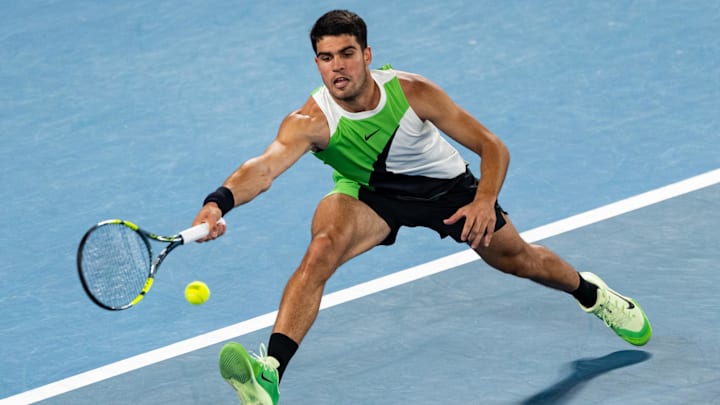
The favorites: Jannik Sinner, Carlos Alcaraz, Aryna Sabalenka, Coco Gauff, Iga Świątek, Novak Djokovic, Alexander Zverev, Elena Rybakina, Daniil Medvedev, Madison Keys, Taylor Fritz, Amanda Anisimova … if you named a contender a week ago, you have named a player still in the draw.
Michael Zheng: The Columbia senior—and repeat NCAA champion—qualified, beat Sebastian Korda and held his own against Corentin Moutet before a leg injury did him in. He’ll get his sheepskin. And then, a promising career awaits. Speaking of …
College tennis: The footprint continues to grow. There are too many players to mention, but some new names—Ethan Quinn (Georgia), Eliot Spizzirri (Texas)—left a mark.
The event itself: Assuming this is Tennis Australia CEO, Craig Tiley’s last waltz, what a way to go out. This tennis-fest will draw more than one million customers, has commandeered a city (country?) and set the standard for what a sports event can (and should) be.
Victoria Mboko: A year ago, she was outside the top 300. Now, age 19, she’s into Week 2.
The minors: Learner Tien, a fourth-round teenage revelation in 2025, defends his points, at a minimum in ’26, and is joined by Iva Jovic, Mirra Andreeva and Mboko.
Zeynep Sönmez: The Turkish qualifier doesn’t just perform spontaneous acts of goodness. She knocked off the 11th seed, Ekaterina Alexandrova, during the same match.
John Roberts and Guillermo Salatino: Letter grades seem weird and inappropriate, but the press room lost two lions last week.
Latisha Chan: An Asian tennis pioneer, Chan announced her retirement.
Fashion statements: Make of the attire what you will; let’s agree it sure got attention. (And we all hope for a speedy recovery for Naomi Osaka, who withdrew from her third-round match due to an abdominal injury.)
A-
Spizzirri: The Connecticut native was up a set and a break on Sinner. Then the roof closed and with it, his window. But what an effort and a player to watch.
Yulia Putintseva: Her on-court antics were maybe not the coolest, but you also have to reserve a measure of respect for someone who simply doesn’t care. And, more importantly, she’s into Week 2.
Yulia Putintseva’s reaction to the crowd after beating Zeynep Sonmez at the Australian Open.
— The Tennis Letter (@TheTennisLetter) January 23, 2026
The crowd immediately booed her after she put her hand to her ear.
Yulia starts dancing on the court.
It’s all happening. pic.twitter.com/KqmmP4KYVL
B+
Oleksandra Oliynykova: First, the tennis. She pushed defending champion Madison Keys in Round 1 before retreating. Then, in an admirable performance in the post-match press conference, called attention to Ukrainian courage, Russian barbarism and complicity of some players.
B
Venus Williams: It was an inspiration to see her out there, in her mid-40s, playing at a more-than-respectable level. So, it had to sting not closing out first-round opponent Olga Danilović after winning the first set and going up 4–0 in the third.
Sloane Stephens: Good on her for qualifying. But she had little against a like-aged former No.1, Karolina Plíšková.
C
Streaming tiers (or streaming tears?): Let’s just call it like it is. (We (over)paid a lot of money for rights to this kooky niche sport. And the time difference makes for ratings kryptonite. And it’s peak football season, anyway. And the audience is small but overindexes wealthy. So let’s push the pain point.)
Félix Auger-Aliassime: After a torrid fall semester—that included a run to the previous major semifinal—the Canadian sensation cramped after 90 minutes and couldn’t complete his first match.
Reciprocal wild cards: We need to stop this charade, which should be subject to the Foreign Corrupt Practices Act. (Acknowledge Wimbledon for having the integrity to opt out.) And note that, unsurprisingly, none of the beneficiaries won a match.
The overselling of grounds passes: It’s so crowded, no one goes there anymore. Record attendance is great. But fan after fan complained that they spent more time waiting to get into the outside courts than watching actual tennis. The U.S. Open suffers from this problem as well, especially over Labor Day weekend. I’m not sure there’s an obvious solution. If people want to buy tickets, you generally like to accommodate demand. But you feel for fans who shelled out serious money, only to stand, hoping, in vain, for a vacant seat on a back court.
A warming planet: The idea of playing a best-of-five match in a combustion engine that is the Melbourne climate is unappealing. The idea of being a ballkid, official or fan in these conditions is deeply concerning. Tennis can pass out free sunblock and encourage hydration. But at some point, there has to be a climate reckoning here.
More Tennis on Sports Illustrated
 Add us as a preferred source on Google
Jon Wertheim is a senior writer for Sports Illustrated and has been part of the full-time SI writing staff since 1997, largely focusing on the tennis beat, sports business and social issues, and enterprise journalism. In addition to his work at SI, he is a correspondent for “60 Minutes” and a commentator for The Tennis Channel. He has authored 11 books and has been honored with two Emmys, numerous writing and investigative journalism awards, and the Eugene Scott Award from the International Tennis Hall of Fame. Wertheim is a longtime member of the New York Bar Association (retired), the International Tennis Writers Association and the Writers Guild of America. He has a bachelor’s in history from Yale University and received a law degree from the University of Pennsylvania. He resides in New York City and Paris with his wife, who is a divorce mediator and adjunct law professor. They have two children.
Follow jon_wertheim