%20%20--%3E%0A%3Csvg%20version%3D%221.1%22%20id%3D%22Layer_1%22%20xmlns%3D%22http%3A%2F%2Fwww.w3.org%2F2000%2Fsvg%22%20xmlns%3Axlink%3D%22http%3A%2F%2Fwww.w3.org%2F1999%2Fxlink%22%20x%3D%220px%22%20y%3D%220px%22%0A%09%20width%3D%2239px%22%20height%3D%2240px%22%20viewBox%3D%220%200%2039%2040%22%20enable-background%3D%22new%200%200%2039%2040%22%20xml%3Aspace%3D%22preserve%22%3E%0A%3Cpath%20fill%3D%22%23FFFFFF%22%20d%3D%22M38.5%2C7H28.2v26h10.3V7z%22%2F%3E%0A%3Cpath%20fill-rule%3D%22evenodd%22%20clip-rule%3D%22evenodd%22%20fill%3D%22%23FFFFFF%22%20d%3D%22M26.1%2C25.5c0%2C5.8-4.1%2C7.5-12.9%2C7.5C3.9%2C33%2C0%2C31.2%2C0%2C25.2v-1.1h11.6%0A%09v2.4c0%2C0.7%2C0.1%2C1.4%2C1.2%2C1.4c1%2C0%2C1.2-0.4%2C1.2-1.3v-0.9c0-1.6-0.9-1.6-3.5-2.2C2.2%2C21.7%2C0%2C19.7%2C0%2C15.3v-0.9C0%2C9.3%2C5.5%2C7%2C12.9%2C7%0A%09c10.2%2C0%2C12.8%2C2.6%2C12.8%2C7.4v1.8h-11v-2.9c0-0.6-0.4-1.1-1.2-1.1c-0.6%2C0-1.2%2C0.4-1.2%2C1.1v0.9c0%2C1.5%2C0.9%2C2%2C3.3%2C2.5%0A%09c8%2C1.6%2C10.5%2C3.3%2C10.5%2C7.5V25.5z%22%2F%3E%0A%3C%2Fsvg%3E%0A)
Jessica Pegula Opens Up About Her Unconventional Path to Tennis Glory
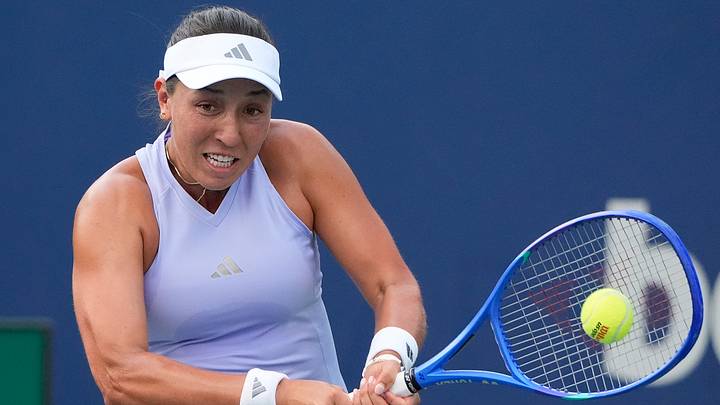
Do you remember the 2018 U.S. Open? Sure you do. It was only eight years ago. Novak Djokovic took the men’s singles title. Naomi Osaka took the women’s. Remember how Jessica Pegula fared? Likely no. Why? Because she lost in the qualifying round … for a fourth time in New York and the fourteenth time at a major.
Some careers come hot out of the chute, while others take time to bake. Pegula struggled through her mid-20s, but nevertheless she persisted. And then, the wins came, gradually, then steadily. And for the past half-decade, Pegula, now 32, has been a reliable winner. She does nothing overwhelmingly, but does everything well. And with a mature outlook and unrelenting professionalism, she gives herself every opportunity to be successful.
Pegula may be third in the WTA rankings, but she is the equivalent of the tour’s student body president. Last week, the U.S. Open announced its prize money for the 2026 event, which included a 20% year-over-year raise. The players’ group expressed satisfaction with the new wages and benefits. Both labor and management told me that Pegula played an indispensable role in the negotiations. When she wasn’t sitting in meetings or on Zoom calls, she was winning matches, more than 40 already this year.
In terms of tennis, Pegula is enough of a realist to know that, at her age especially, opportunities are finite. But after reaching the final of the Cincinnati event on Sunday, she’ll enter the U.S. Open seeded third (potentially second if Elena Rybakina’s leg injury prevents her from playing) with as good a chance as any of winning her first major.
Before the games begin in New York, Pegula sat down for a conversation, edited lightly for brevity and clarity.
Sports Illustrated: Self-assess, coming into the fourth major, how’s the season going?
Jessica Pegula: I think coming into the fourth major, my season has been great. It’s gone by really quickly. Tennis is just one of those sports that makes you move on very quickly—in a good, in a bad way. If I look at my year, it’s been incredible, to be honest. But of course, there’s a lot more work to do, and I think a lot more goals that I want to accomplish.
SI: Modesty aside, you have emerged as what in team sports we would call a clubhouse leader. Can you source that for us? Where do you get your leadership skills?
JP: Well, that’s a nice compliment. I’m very direct, and I think I’m very honest. But I also think I communicate it pretty well, where it’s not taken the wrong way. But I’m definitely pretty direct, and I think I don’t know if I got that from my mom. I want to say I think she was the same way: very direct with what she thought, and I think [she] was pretty thoughtful in the way she always put things, whether it was to employees or to us or stuff around work. So I think I probably got it from my mom. We weren’t super emotional. I would say my dad’s probably a little bit more emotional. I think my mom and I were definitely more the same personality, like kind of laid back.
SI: I wonder how the arc of your career, the years you spent not as a top five player, have impacted the way you see the sport.
JP: I’ve had such an interesting pathway, and I think not maybe the most typical pathway to becoming a top player. I didn’t do it until I was maybe 25 or older, and kind of worked my way up at an older age where, maybe, people usually are peaking. So I think being able to go through a lot of the stuff before that—before I turned 25—definitely taught me a lot. I think it also gave me a lot of respect on tour. Like I’ve seen a lot of these girls and coaches for a long time, from playing challengers when I was 18, and you know being in some really crazy places at a really different level than where I’m considered now, like being able to play on you know center court at all the Slams.
It’s been a long journey, so I think it’s made me very grateful, and given me a good perspective. Yeah, I’ve seen it all a bit in different ways. It worked out though the way that it was supposed to work out because I don’t think I would been able to kind of handle myself as a top player maybe as well as I have over the last few years if I didn’t quite go through a lot of growing up and and experiences and maturity through a lot of my younger years.
SI: What’s something about tennis that still brings you pleasure?
JP: I just love that it’s individual. I love the team aspect of it as well, but I think the individuality of it just makes it so special. Having to go out there on an Arthur Ashe solo, like just with you and your thoughts: I basically win or lose this match. I think that, to me, is still the best part. I think that what makes it so cool—makes it really hard if you lose—but I think it gives you so much joy when you win.

SI: What player would you like to coach you?
JP: Maybe Novak Djokovic because he’s the greatest player of all time. But I just, I would love to know what goes through his head tactically throughout a match. I feel like there’s some other top players … Serena just had her serve and she was so powerful. Like I don’t know what she’d be able to tell me, she’d be like, Just hit an ace. And I’d be like, I can’t do that. I think Roger Federer was just so talented that everything just came naturally to him, and I think Nadal had that crazy physicality and like competitive mindset. But I feel like Novak was very tactical, and I think that’s more related to my game style.
SI: One phrase in heavy rotation: Jess is incredibly normal. Agree? What are people missing about you?
JP: I’m very laid back, but at the same time, I’m thinking a lot out on the court, and so I think maybe some people think I just kind of just go with whatever’s happening on the court. But I’m actually thinking quite a bit—like a lot. I talk to myself a lot. I’m constantly running. I think when I’m competing—even when I play other sports for fun—I love to just talk to myself and talk myself through things a lot of the time out loud. And that’s where, like my husband, if we’re playing golf, he’s just like, Just hit the ball. I need to talk through things, so maybe it’s a little contradictory with my laid-backness.
SI: Especially at majors, what is your strategy for recovery?
JP: A big thing is just not draining my energy off the court. There’s so much going on during Slams. And as simple as it sounds, sleep is such a big part of it. And you’re like in such a big city, and you’re kind of running on adrenaline all the time. That can be easy, at least for me. I’m a little bit of a night owl. I like to stay up and like to go do things and kind of stay busy, which is fine. But I think at some point it kind of catches up to you. So making sure that you just take time to get your sleep in. If you have downtime, get as much out of that as possible because usually you’re on the go constantly.
SI: How does it feel to be part of the best tennis podcast after Served? Just kidding. Seriously, is this strictly for fun? Anything that you found helpful to your tennis?
JP: Couldn’t be more opposite. I think we are kind of showing just the more down-to-earth, fun side, whereas you guys are definitely showing a lot more like in-depth seriousness to it. I think [that’s] why we wanted to do it. We didn’t want it to be serious. We’re all still playing, so it wasn’t like Oh, let’s break down tennis even more. Sometimes we’re like, we really don’t want to talk about tennis today. Like, let’s talk about something funny that happened in the locker room that was a total disaster. For us, it’s very therapeutic, and I think that’s why we enjoy it so much and have so much fun. I think it just humanizes us a bit, and you get to see that we have all these crazy travel stories, and that these things happen just like they happen to you. I also think it’s made us more creative. Also, with different media and social media stuff, we always laugh that, you know, we don’t love to do things ourselves. Having to do media requests, we’re kind of like, Okay, like we have to do it. But for the podcast, it’s really fun because I think we get to control our own narrative a lot. So we have a joke: Anything for the podcast. I’ll do any requests as long as it’s for the podcast.
SI: Going back for the strategy for recovery—
JP: I think anything that can support my body in the best way, that’s really easy to take: Vital Proteins. And being consistent with it, not just during a Slam, but in weeks leading up to a Slam, during all these tournament weeks, I don’t want to show up kind of in the red. When you get to a Slam, you want to show up really well prepared. And so I think Vital Proteins gives me the best preparation I can. Again, it’s a controllable factor that I can work on and use that’s not related to anything outside of my control on the tennis court, and being able to do all that stuff and feel my best gives me a lot of confidence going out on court. So having that being part of my routine, it sounds kind of silly, but makes me feel relaxed when I go on the court, because I’m like, O.K, I did all my stuff. I took my Vital Proteins. I did all my supplements. I’m hydrated. I got my sleep. Now all I have to do is focus on playing tennis. So I think that’s also where it comes into play.
 Add us as a preferred source on Google
Jon Wertheim is a senior writer for Sports Illustrated and has been part of the full-time SI writing staff since 1997, largely focusing on the tennis beat, sports business and social issues, and enterprise journalism. In addition to his work at SI, he is a correspondent for “60 Minutes” and a commentator for The Tennis Channel. He has authored 11 books and has been honored with two Emmys, numerous writing and investigative journalism awards, and the Eugene Scott Award from the International Tennis Hall of Fame. Wertheim is a longtime member of the New York Bar Association (retired), the International Tennis Writers Association and the Writers Guild of America. He has a bachelor’s in history from Yale University and received a law degree from the University of Pennsylvania. He resides in New York City and Paris with his wife, who is a divorce mediator and adjunct law professor. They have two children.
Follow jon_wertheim