%20%20--%3E%0A%3Csvg%20version%3D%221.1%22%20id%3D%22Layer_1%22%20xmlns%3D%22http%3A%2F%2Fwww.w3.org%2F2000%2Fsvg%22%20xmlns%3Axlink%3D%22http%3A%2F%2Fwww.w3.org%2F1999%2Fxlink%22%20x%3D%220px%22%20y%3D%220px%22%0A%09%20width%3D%2239px%22%20height%3D%2240px%22%20viewBox%3D%220%200%2039%2040%22%20enable-background%3D%22new%200%200%2039%2040%22%20xml%3Aspace%3D%22preserve%22%3E%0A%3Cpath%20fill%3D%22%23FFFFFF%22%20d%3D%22M38.5%2C7H28.2v26h10.3V7z%22%2F%3E%0A%3Cpath%20fill-rule%3D%22evenodd%22%20clip-rule%3D%22evenodd%22%20fill%3D%22%23FFFFFF%22%20d%3D%22M26.1%2C25.5c0%2C5.8-4.1%2C7.5-12.9%2C7.5C3.9%2C33%2C0%2C31.2%2C0%2C25.2v-1.1h11.6%0A%09v2.4c0%2C0.7%2C0.1%2C1.4%2C1.2%2C1.4c1%2C0%2C1.2-0.4%2C1.2-1.3v-0.9c0-1.6-0.9-1.6-3.5-2.2C2.2%2C21.7%2C0%2C19.7%2C0%2C15.3v-0.9C0%2C9.3%2C5.5%2C7%2C12.9%2C7%0A%09c10.2%2C0%2C12.8%2C2.6%2C12.8%2C7.4v1.8h-11v-2.9c0-0.6-0.4-1.1-1.2-1.1c-0.6%2C0-1.2%2C0.4-1.2%2C1.1v0.9c0%2C1.5%2C0.9%2C2%2C3.3%2C2.5%0A%09c8%2C1.6%2C10.5%2C3.3%2C10.5%2C7.5V25.5z%22%2F%3E%0A%3C%2Fsvg%3E%0A)
Tennis Mailbag: Meet Michael Antonius, the American Teen Who Just Made History
Hey everyone …
• Here’s this week’s Served podcast:
• It’s official, Chris & Martina: The Final Set will debut on Netflix June 29.
• Also official, the Rafael Nadal docuseries will debut on Netflix on May 29.
• By now, you likely know the story of wronged Ukrainian artist Yana Boyko, whose illustration was used by the Monte Carlo Masters without her permission. Find and support her work here.
Onward …
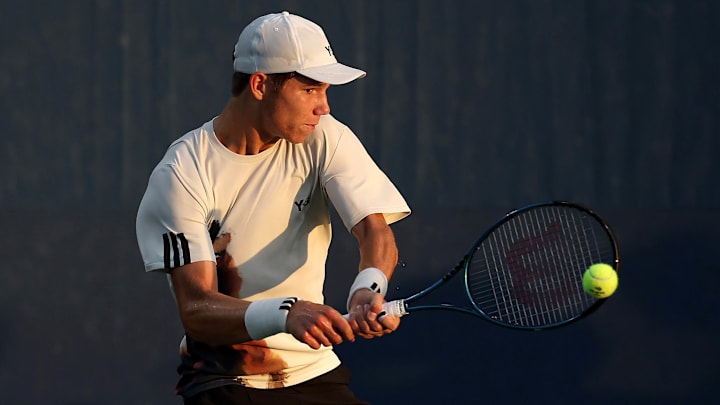
Meet Michael Antonius
Last month in Bakersfield, Calif., 16-year-old Michael Antonius of Buffalo won his first professional title, a USTA Pro Circuit M25 event. But wait, there’s more. A little digging by the good folks at the USTA revealed that Antonius thereby became the youngest player to win a men’s singles title on the global ITF World Tennis Tour in more than a decade. And he became the youngest American ever to win an ITF men’s singles title.
One tournament is one tournament, and yet it augurs well for future success. Not simply the result, but the result that came with patient, strategic tennis. We peppered Antonius with some questions and, well, meet the kid for yourself.
Jon Wertheim: You are the youngest American ever to win an ITF title. With a week plus to reflect on this, how are you processing this?
Michael Antonius: It’s surreal to think that I was able to accomplish this at such a [young age]. But, I just went back home to relax and spend time with friends and family and just try and get myself back down to earth. We play such a sport that’s um, it’s a new term every week. So I’m just back in Orlando training, and I’m getting ready for the next one.
JW: The great Jimmy Arias notwithstanding, upstate New York is not seen as a tennis hotbed. How did you come to the sport? Do you train elsewhere in the wintertime?
MA: We moved down to Orlando a few years ago to USTA player development for better training, better facilities. And it’s been a nice change. So I don’t have to stay indoors all year in New York, in Buffalo. But I met Jimmy Arias a few times, and you can learn so much from him, and what he’s accomplished is really remarkable from a city with not much tennis history.
JW: How did you come into tennis?
MA: When I was younger, my father took me to our local tennis club, the Buffalo Tennis & Squash Club. I didn’t really like to hit with him. I just was hitting against the wall and that’s the way I found love for the sport. And then some of my friends started taking tennis lessons as well, so I went with them and it just clicked. I started really enjoying it.
JW: How do you describe your game?
MA: I’d say my game style is based around patience and consistency. So I’d say overall, I’m an aggressive baseliner, working to become more of an all-court player. Transitioning to the net is one of the biggest goals that I’ve been working on in the last few months. But I’d say overall, I’m very patient. A lot of the times I’m able to outlast people just with my endurance and with my consistent rally ball.
JW: What should people know about you? How do you describe yourself?
MA: I describe myself as somewhat of a lazy personality. I feel like when I’m not I do a lot of hard work on court and a lot of time in the gym and practicing, but when I’m not doing that, I’m usually just on the couch at home, relaxing and just watching TV, and just because tennis is so many reps, and day in, day out, hard work. So I’m just relaxing every time I have the chance.
JW: What do your folks do?
MA: My father is a psychologist in Buffalo at the University at Buffalo. My brother, he plays baseball. And my mom, she’s with me a lot of the time in Florida, helping me out down here. I don’t like to come down on my own. It’s easier if somebody can help me with my school and traveling to tournaments.
JW: And what do you do for fun?
MA: Typically, I’m just watching sports. During the football season, I’m always watching the Bills games. But right now we’re getting into baseball season, so I’m a big fan of the Yankees. But always just something sports related, especially the Buffalo sports teams.
JW: What are some things that people don’t know about you?
MA: My dad’s side of my family is from Norway, so getting to see them, and every once in a while when we head over to Europe, is really cool for me. I speak English and Norwegian. I mean, my dad wouldn’t say I speak very well, but I speak a little bit. And then, yeah, I love learning languages. And yeah, I love traveling for tournaments as well, getting to see many new places.
JW: For years, the conventional wisdom was that the sport had gotten too physical for teenagers to make a dent as a pro. Now, the trend is bending the other way. Any thoughts on why this is, and what you are doing specifically for your strength and endurance, etc?
MA: The pros—even at the futures level—are much more physically developed than even the top juniors. So that’s why it’s difficult for many juniors to have a professional breakthrough early. For me personally, I’ve been doing a lot of fitness training and strength work in Orlando to get me ready for, I mean, the level I’ve been competing at the M25 and 15 level, and that’s really, it’s really helped me. First off, with my endurance, being able to last the matches, but also with like strength stuff, just being able to hit the ball as hard and as consistently aggressive as they are, because it’s not easy. Everyone’s good at that level, but doing little things to separate yourself and being able to last with them has really helped me.
I mean my coach at USTA always talks about training two levels above what you’re currently playing at. So, like, last year, when I was playing still juniors tournaments, he was telling me to train and work on certain aspects that he said would relate to the future and the Challenger level of tennis, just so I’d be ready in terms of, like, volleys, in terms of being aggressive, so you’re ready for that level once you get there.
JW: Tell us about your coaching situation …
MA: I’ve been with the USTA for three, around three years now. I moved down here in 2022 for better coaching and training from New York. But when I first got down here, I was with Troy Han and Eric Nunez. They worked closely with me. And then as of 2024 um, I’ve been with Sylvain Guichard, and he’s traveled with me all over to tournaments. And every time I’m in Orlando, I’m mainly training with him.
JW: College is obviously an increasingly popular pathway. Have you started thinking about that? Is the plan under reassessment now that you’re winning such big tournaments?
MA: I'm definitely not ruling out college as an option. It’s become such a good pathway for pros these days. I mean, so many people have went from college to play professional tennis, so I definitely don’t want to rule that out. But I also would love to go pro. That’s my eventual goal. I’m not sure, like, which way is best for me, and I’m not able to talk to colleges until June, but either way, I’m excited to see what’s ahead, but I’m definitely not ruling that out.
JW: What app gets the most use on your phone?
MA: I’d say I’m mostly on Instagram. … But usually I’m, like, also on Instagram Reels a lot, and sometimes I end up scrolling. And when I’m not on Instagram, a lot of times Netflix … my favorite series is Suits, so I’m usually watching that.
Q&A
Jon, I realized that as of the eve of the Monte Carlo finals, [Carlos] Alcaraz leads [Jannik] Sinner 10 to six in their head-to-head. But I think it is much closer. Although exhibition matches do not factor in head-to-head competition. It is worth considering that their 2024 and 2025 matches at the Six Kings Slam are different from your average exhibition match. With the winner taking home $6 million, it is difficult to believe that both Alcaraz and Sinner did not put forth their best efforts. I am amazed at how great these young tennis players are. As an avid tennis fan, I am glad that I am around to watch them perform.
Ray, Tennessee
• Obviously, the head-to-head now stands even closer, 10–7, after Sunday’s Monte Carlo final.
I agree and disagree with your premise. One of the foundational definitions of a rivalry: there must be oscillating results. Martina Navratilova and Chris Evert’s head-to-head was 43–37. Novak Djokovic and Nadal were 31–29. Even the clay-heavy battles between Nadal and Roger Federer were a 40/60 split, 24–16.
In the case of Alcaraz and Sinner, there is so much oscillating that it minimizes the 10–7 imbalance. This is whiplash stuff, especially lately. Both have beaten the other in major finals. In 2025, Alcaraz beat Sinner to win Roland Garros, but Sinner came back to unseat Alcaraz as Wimbledon champion. But, wait, Alcaraz came back to unseat Sinner as U.S. Open champion. Alcaraz won the first major of 2026, but Sinner has ripped off three straight masters and beat Alcaraz in their first clash of the year, and has won the past four sets against him. But Alcaraz also holds three of the past four majors.
(I often hate the word—if not the symbol—“asterisk” in a sports context. But there are mitigating points, too. From a pro-Sinner perspective, he was sick in Cincinnati and retired in the first set. Should that really count? If he had simply failed to take the court, it wouldn’t have. And last year in Rome, Sinner was rusty, playing his first match over 100 days since his doping ban. Note, too, that if Sinner won one additional point at the 2025 French Open, not only would that be a two-match swing, but it would also be a double-swing in majors results. Of course, the Alcaraz camp could make their counterpoints, noting the nearly 2:1 major title ratio and Sinner missing three months because of a doping charge and … well, this is why rivalries are so great.)
I wouldn’t, however, read too much into the Six King Slam. Yes, there was a lot of money on the line. But it was late in the season, played before a small crowd, at a new event. (One of the reasons so many of us accorded some weight to Taylor Fritz’s defeat of Alcaraz last September at Laver Cup was because it came in front of peers and around 20,000 fans.) Would Alcaraz have preferred to have won? Probably. But I don’t think he was watching video of the match the following day, seeking to improve, kicking himself over missed opportunities.
All of which is to say, your instincts about Alcaraz and Sinner appearing closer than the head-to-head suggests? Correct. However, citing exhibition results is not the strongest supporting point.

Hey Jon, hope all is well and wanted to share the mailbag note and question below.
I just returned from 10 days in Houston working on the media team at the U.S. Men’s Clay Court Championship and wanted to share a doubles storyline that feels bigger than the result itself. After losing early in singles, top seed Ben Shelton could have easily withdrawn from doubles (as many players in his position do) but instead he stuck around.
Not only did Shelton honor his commitment to play with his good friend and former Florida teammate, “Andy” Andrade, but the two ended up leaving as first‑time ATP doubles champions with four wins under their belt. Sure, Ben didn’t leave Houston with the trophy he wanted. But he didn’t leave empty‑handed either. He spent meaningful time on court with a close friend, gained high‑pressure match reps, earned extra prize money, and most importantly left the tournament on a high note in what otherwise could have been a disappointing week. His post‑championship quote captured it well.
My question: should doubles (and the tours) better capitalize on this from a messaging standpoint to promote and encourage more doubles participation? In an individual sport where singles players lose matches every week, doubles can serve as a social and mental reset button, helping players survive the tough, lonely weeks on tour and leave tournaments better than they started.
Curious to hear your thoughts on this.
Thanks, Hanlon Walsh
• Thanks for that contribution, and good on Shelton.
There are some logistical challenges to be surmounted, but the U.S. Open took the lead here. Delaying the doubles draw is the solution. Hold the draw, say Tuesday night, and you might be able to pick off singles players who lost early. Instead of departing in a dejected state, Singles Player A sticks around in search of more match play (and, cynically, prize money). Shelton in Houston is a great example of this win-win scenario. He got matches, built some confidence (or at least left on a high note) and enjoyed the time socially. The tournament—which paid him an appearance fee—got more sessions from Shelton, and doubles, as a sector, benefited from the notoriety.
Shots
• The SoCal Pro Series, USTA Southern California’s swing of International Tennis Federation (ITF) World Tennis Tour events, returns for its fifth consecutive year this summer. The SoCal Pro Series features seven straight weeks of men’s and women’s tournaments at premier tennis facilities across Southern California.
More Tennis from Sports Illustrated
 Add us as a preferred source on Google
Jon Wertheim is a senior writer for Sports Illustrated and has been part of the full-time SI writing staff since 1997, largely focusing on the tennis beat, sports business and social issues, and enterprise journalism. In addition to his work at SI, he is a correspondent for “60 Minutes” and a commentator for The Tennis Channel. He has authored 11 books and has been honored with two Emmys, numerous writing and investigative journalism awards, and the Eugene Scott Award from the International Tennis Hall of Fame. Wertheim is a longtime member of the New York Bar Association (retired), the International Tennis Writers Association and the Writers Guild of America. He has a bachelor’s in history from Yale University and received a law degree from the University of Pennsylvania. He resides in New York City and Paris with his wife, who is a divorce mediator and adjunct law professor. They have two children.
Follow jon_wertheim