%20%20--%3E%0A%3Csvg%20version%3D%221.1%22%20id%3D%22Layer_1%22%20xmlns%3D%22http%3A%2F%2Fwww.w3.org%2F2000%2Fsvg%22%20xmlns%3Axlink%3D%22http%3A%2F%2Fwww.w3.org%2F1999%2Fxlink%22%20x%3D%220px%22%20y%3D%220px%22%0A%09%20width%3D%2239px%22%20height%3D%2240px%22%20viewBox%3D%220%200%2039%2040%22%20enable-background%3D%22new%200%200%2039%2040%22%20xml%3Aspace%3D%22preserve%22%3E%0A%3Cpath%20fill%3D%22%23FFFFFF%22%20d%3D%22M38.5%2C7H28.2v26h10.3V7z%22%2F%3E%0A%3Cpath%20fill-rule%3D%22evenodd%22%20clip-rule%3D%22evenodd%22%20fill%3D%22%23FFFFFF%22%20d%3D%22M26.1%2C25.5c0%2C5.8-4.1%2C7.5-12.9%2C7.5C3.9%2C33%2C0%2C31.2%2C0%2C25.2v-1.1h11.6%0A%09v2.4c0%2C0.7%2C0.1%2C1.4%2C1.2%2C1.4c1%2C0%2C1.2-0.4%2C1.2-1.3v-0.9c0-1.6-0.9-1.6-3.5-2.2C2.2%2C21.7%2C0%2C19.7%2C0%2C15.3v-0.9C0%2C9.3%2C5.5%2C7%2C12.9%2C7%0A%09c10.2%2C0%2C12.8%2C2.6%2C12.8%2C7.4v1.8h-11v-2.9c0-0.6-0.4-1.1-1.2-1.1c-0.6%2C0-1.2%2C0.4-1.2%2C1.1v0.9c0%2C1.5%2C0.9%2C2%2C3.3%2C2.5%0A%09c8%2C1.6%2C10.5%2C3.3%2C10.5%2C7.5V25.5z%22%2F%3E%0A%3C%2Fsvg%3E%0A)
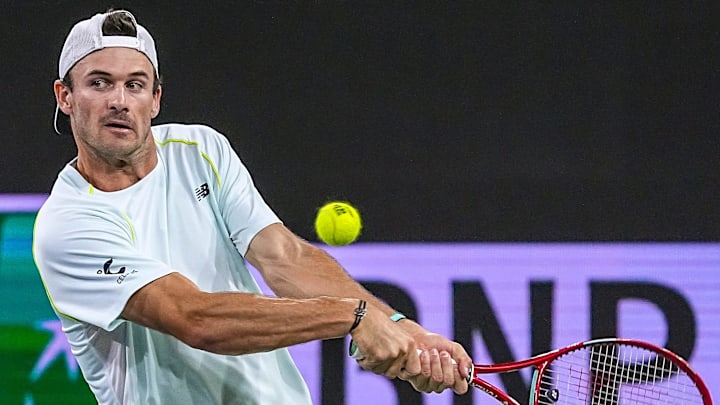
Tennis Mailbag: Tommy Paul Reflects on His Career and ‘Eventful’ Year
Submissions have been lightly edited for brevity and clarity.
Hey everyone,
We have a special edition of the mailbag this week, featuring an interview with American star Tommy Paul. And be sure to stick around after the conversation for some scattered Q&A. But first, some housekeeping …
• Here’s the week’s Served Podcast with special guest Alex Eala.
• In non-tennis news: Can the U.S. win the rare earth supply chain back from China?
• We will be back to our regular programming next week with questions from the Miami Open. Without further ado, my conversation with Tommy Paul …
In tennis, we talk about a transition game. Who has transitioned more gracefully than Tommy Paul? The 2015 French Open boys’ champion took a few years to get going as a pro, waiting for his emotional maturity to catch up with his talent. When it did, presto: a marriage of athleticism, precision and professionalism.
It enabled him to penetrate the top 10, win four titles and play deep into majors. Even as he plays through injuries—obvious to the eye but, again, the emotional maturity, not worthy of his mention—he is a formidable player who has put together an estimable career. Feared, early on, for being an underachiever, he’s transitioned to an overachiever who optimizes every variable in his control. On the eve of the Miami Open, fresh off debuting a signature shoe line from New Balance, Paul returned serve with Sports Illustrated.
Sports Illustrated: So far my year has been blank?
Tommy Paul: So far my year has been, I would say, eventful, pretty eventful. And a lot of travel.
SI: When you consider your career overall so far, what is the biggest source of pride that you have, or what are you most happy and excited about?
TP: I would say, the people around me, like having great people around me my whole career. I take pride in that, and obviously loyalty to those great people and their loyalty to me. I think that’s something that I take a lot of pride in.
SI: What is one thing you wish someone had told you before you started your career?
TP: I guess, surround yourself with good people, but that’s kind of a cop-out. That’s a great question. I think, invest in yourself and believe in yourself from the jump, and don’t go through the motions. You know, when you go through the motions, it catches up to you. Make sure you do everything 100% awesome.
SI: You don’t speak a ton about your injuries, but it’s clear sometimes you take the court when you might be feeling less than 100%. What should fans know about you, know when players go out when they’re less than 100%. What’s the biggest challenge when doing so?
TP: I think a lot of fans in some ways respect it; and then a lot of fans in other ways don’t like it, and I don’t think that they understand. I mean, I don’t want to be out there hurting any more than you don’t want to watch an injured player. But I want to win and I want to compete. It’s what I’ve done my entire life. And if I have to go out there hurting and try and win, I’m going to do it … unless it’s, you know, to the point where it’s going to take me out for way too long, then obviously I’m going to pull the plug. But it’s part of the sport in some ways. I mean, you’re never going to watch a player that doesn’t have one thing wrong with them. Everyone’s playing through something. It’s just the severity is always a little bit different. It’s not that we want to be playing hurt. It’s that we kind of have to be in some ways.
SI: If we looked right now, what apps would have the most use on your phone?
TP: It’s a good question. Probably like, ESPN is up there. I would say Instagram is up there, and then, like, I have this, like, the windy app, where it like, checks the ocean and the weather for you.
SI: You were born in May 1997. Novak Djokovic was born in May 1987. What are the odds that you’re doing this in 10 years?
TP: Wow, that’s crazy. That’s crazy. What are the odds I’m doing this in 10 years? Shoot, I don’t know … 25% chance?
SI: How much can a tennis player improve their speed?
TP: I think you can definitely improve your speed. I think, I mean a lot of fast-twitch lifting in terms of, like, moving weight very fast. Obviously, you gotta create a base and lifting heavier, and then towards the end, moving less weight, but moving it very fast, and developing this fast-twitch muscles, and then obviously, just a lot of speed work, a lot of moving side-to-side. I think the biggest thing to improve on your speed would be your form. You got to have your form well. So if you can improve in those two categories, you're going to improve your speed.
SI: Best movie, show or, you know, YouTube video that you’ve seen in 2026 so far?
TP: On the way back from Indian Wells, I watched like, three more episodes, and it was Your Friends & Neighbors.
SI: What is going to happen first? You move to Fresno, or your coach, Brad Stine, moves to Florida. How do you manage the distance? And, you know, does it help to sometimes have some space from your coach?
TP: Well, Brad’s lived in Florida before, so I would say there’s a better chance of him moving to Florida. I’ve never even been to Fresno, so it’s a pretty low chance I ever move there. In terms of, you know, how do we manage it? We have an unbelievable setup with my other coach, Hugo Armando, who lives down here in South Florida. He does so much work behind the scenes that nobody talks about, basically everything that we work on, it’s run through Hugo and through Brad. So I would say we manage it by having Hugo here and then on the road, Brad handles all my tournaments, for the most part, but Hugo is a real lifesaver for us.
SI: So your new New Balance PE is as much about your love of nature as your love for tennis. Where do you source your love for the outdoors?
TP: Just growing up being outside so much and loving doing it, whether it was fishing or hunting or just playing tennis. I mean, I always wanted to be outside. I was never one of those kids that was on Xbox or PlayStation playing too many video games or anything. I always wanted to be outside doing whatever. I mean, we would be building a tree house or doing something ridiculous, you know, I just, I think it’s something that really made me who I am, and it’s something that I just enjoy doing so much.
SI: We don’t see camo a lot in tennis.
TP: Yeah, I can’t remember the last time I saw camo in tennis. So to have something that looks so good and then also is different from what everyone else is seeing, I think it’s a complete bonus. I think it’ll turn some heads.

SI: Andy Reid, Doug Pederson or Nick Sirianni, who’s the best coach?
TP: Oh, my God, I would take out Doug Pederson, pretty immediately, even though he gave us a Super Bowl title. But I’m gonna go Sirianni, just because it hurts to see Andy Reid in Kansas City.
SI: It will be a successful year if ...
TP: If all the stuff that we’re working on right now works.
Q&A
Is [Valentin] Vacherot good?
J/B., Portland
• He is definitely good. Winning majors good? Maybe not. But a credible top-shelf player? Absolutely. Everyone, well, not everyone, but many can have a magical week, as Vacherot did in Shanghai. But look at what he’s done since. He’s won a bunch of matches on different surfaces, made a doubles final and pierced the top 25. Maybe most importantly, he’s taken virtually no bad losses. He’s 6' 4". He hits as hard as most players. If anything, the real question is: How in the world did someone with this much game and size and weaponry take so long to emerge? For perspective, a year ago this week, he lost in straight sets to a player ranked No. 609. Vacheto ranked No. 265, earning $365 for the week.
Just read your segment on the Brett Haber–stat attribution controversy.
I guess I just didn’t realize that TV guys do the stats themselves? Apologies to Habes, a fellow Marylander like me, but I just always assumed someone (Sharko???) fed stats to the TV people. Every baseball game I watch says something like “Stats provided by Stats Inc.” Does Tennis Channel not have stats providers? I mean, if B-Habes came up with this nugget, he should say so on air when he drops that knowledge! (Maybe he did, idk.)
Do they all do their own stats? Or does it vary like actors who do their own stunts? Does Prakash sit down at a seaside trattoria on the Amalfi Coast at sunset, pour a glass of Chianti, spritz some Sauvage by Dior into the air, sharpen his pencil, punch his calculator, and crunch out some stats?
I don’t know that the rule should be on attribution but the notion that it’s “just facts” isn’t the best argument for non-attribution. Gravity has been a fact forever but we still give Newton credit for discovering it.
Anyway, you’re right—it’s an interesting question.
P.
• One of my hot takes: At the time, when trust in the media is not exactly soaring, some of this could be addressed by greater transparency about the process. So any how-things-are-done questions? I’m especially happy to answer those.
There are various ways to obtain research. Tennis Channel has its own researchers. As does ESPN. Both tours send research packets almost daily, filled with nuggets. Sometimes the tournament offers broadcast packets as well. (Side issue: I understand marketing and dynamics here, but the packets—while invaluable—seldom traffic in anything negative or unflattering to a player. Aces, winners and streaks are easy to come by. A player could double-fault 20 straight times, or all eight wild cards could fail to win a set, and rest assured, it will not be accounted for.)
Anyway, some broadcasters—Brett among them; Brett perhaps chief among them—do their own homework. Alejandro Davidovich Fokina squandering match points is not something you’d find in a packet. Brett did the work here. I understand why he would be miffed about not being credited.
A discussion for another time: There’s a long conversation to be had—and this is hardly unique to tennis—about attribution. And I plead guilty here, too. Ben Rothenberg, to pick a name at random, asks a question in a press conference. He formulates the idea and risks the response. Then a clip gets posted, and the world has access to the fruits of his labor.
I just heard a good discussion about this on The Press Box podcast (attribution!). In a different context, political reporters do all the legwork, digging and asking tough questions. Then, the podcasters and influencers not only take this information, but discuss it without the onus of regular journalistic principles and conventions (seeking response, fact-checking etc.).
My favorite current women’s players are Jessica Pegula and Elina Svitolina. Both are playing pretty well in 2026 and have had good careers. The only downside is they both have never won a Grand Slam title. They are over 30 now and first time Slam winners don’t happen often after 30. Do you think either one or both can break through and win one? If so, which player would be the one most likely to win a Grand Slam title.
Bob Diepold, Charlotte, NC
• Two players of similar age, worthy of your fandom, and you could scarcely craft two more different sets of circumstances, life experiences and motivation. Ah, tennis …
As for your question, I would have to go with Pegula. She’s been to a major final. She’s under less pressure. (Never once has she won a quarterfinal match and been asked, What would a title here mean for your country and its brave soldiers?) Svitolina is an extraordinary player with an incredible story. But she has reached four major semifinals and has yet to win a set. (h/t Keith Jacobson.)
HAVE A GOOD WEEK, EVERYONE!
More Tennis from Sports Illustrated
 Add us as a preferred source on Google
Jon Wertheim is a senior writer for Sports Illustrated and has been part of the full-time SI writing staff since 1997, largely focusing on the tennis beat, sports business and social issues, and enterprise journalism. In addition to his work at SI, he is a correspondent for “60 Minutes” and a commentator for The Tennis Channel. He has authored 11 books and has been honored with two Emmys, numerous writing and investigative journalism awards, and the Eugene Scott Award from the International Tennis Hall of Fame. Wertheim is a longtime member of the New York Bar Association (retired), the International Tennis Writers Association and the Writers Guild of America. He has a bachelor’s in history from Yale University and received a law degree from the University of Pennsylvania. He resides in New York City and Paris with his wife, who is a divorce mediator and adjunct law professor. They have two children.
Follow jon_wertheim