%20%20--%3E%0A%3Csvg%20version%3D%221.1%22%20id%3D%22Layer_1%22%20xmlns%3D%22http%3A%2F%2Fwww.w3.org%2F2000%2Fsvg%22%20xmlns%3Axlink%3D%22http%3A%2F%2Fwww.w3.org%2F1999%2Fxlink%22%20x%3D%220px%22%20y%3D%220px%22%0A%09%20width%3D%2239px%22%20height%3D%2240px%22%20viewBox%3D%220%200%2039%2040%22%20enable-background%3D%22new%200%200%2039%2040%22%20xml%3Aspace%3D%22preserve%22%3E%0A%3Cpath%20fill%3D%22%23FFFFFF%22%20d%3D%22M38.5%2C7H28.2v26h10.3V7z%22%2F%3E%0A%3Cpath%20fill-rule%3D%22evenodd%22%20clip-rule%3D%22evenodd%22%20fill%3D%22%23FFFFFF%22%20d%3D%22M26.1%2C25.5c0%2C5.8-4.1%2C7.5-12.9%2C7.5C3.9%2C33%2C0%2C31.2%2C0%2C25.2v-1.1h11.6%0A%09v2.4c0%2C0.7%2C0.1%2C1.4%2C1.2%2C1.4c1%2C0%2C1.2-0.4%2C1.2-1.3v-0.9c0-1.6-0.9-1.6-3.5-2.2C2.2%2C21.7%2C0%2C19.7%2C0%2C15.3v-0.9C0%2C9.3%2C5.5%2C7%2C12.9%2C7%0A%09c10.2%2C0%2C12.8%2C2.6%2C12.8%2C7.4v1.8h-11v-2.9c0-0.6-0.4-1.1-1.2-1.1c-0.6%2C0-1.2%2C0.4-1.2%2C1.1v0.9c0%2C1.5%2C0.9%2C2%2C3.3%2C2.5%0A%09c8%2C1.6%2C10.5%2C3.3%2C10.5%2C7.5V25.5z%22%2F%3E%0A%3C%2Fsvg%3E%0A)
One Down, Three to Go: Jordan Stolz Jumpstarts Legendary Run With First Gold
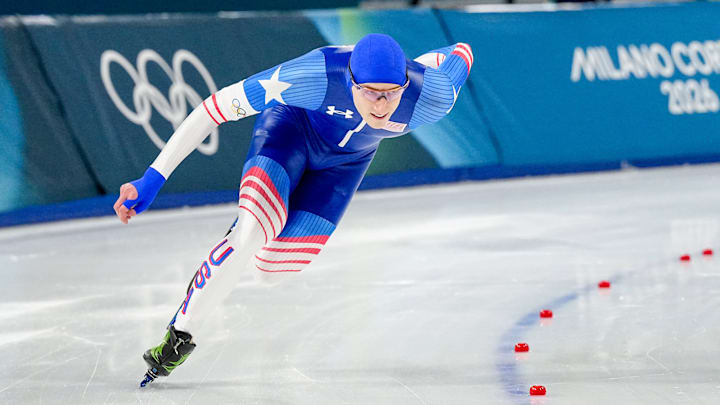
MILAN — Jordan Stolz would like you to know he is quite happy with one Olympic gold medal, and he doesn’t know if he will win another, but goshdarnit, he is going to try. I would sooner believe that Michael Phelps swam all those years just to stay in shape.
Stolz is made for this. The Olympics. The stage. The expectations. All of it. He has even mastered the art of sounding humble and supremely confident at the same time.
Everybody at the Milano Speed Skating Stadium knew Stolz was favored to win the 1,000-meter race here Wednesday. After 600 meters, he trailed the man on the ice with him, the Netherlands’s Jenning de Boo. The Dutch fans—and roughly 97% of speedskating fans are Dutch—were roaring.
Was Stolz worried?
“I would have liked to be even with him coming out, just because it would have been a bit less pressure in the last lap,” he said. “I knew the last lap is still a strong point, so there was still a chance.”
This is how a superstar reminds you he is a superstar without sounding like a superstar. The last lap is not Stolz’s “strong point.” It is when he destroys people. There have been five World Cup 1,000s this season. Stolz only had the fastest time entering the final lap once. He won all five.
In the media mixed zone, Stolz was asked if de Boo’s lead after 600 meters means for the upcoming 500-meter race. He said, “I guess we’ll have to wait and see.” He smiled. Stolz was asked the same question again in the medalists’ press conference.
“I think he’s doing well,” Stolz said. “I think he’s gonna be good. Yeah, we’ll see.”
Stolz could have said that trailing a 1,000-meter race after 600 meters is obviously not the same as trailing a 500-meter race after 500 meters. He could have said that he is No. 1 in the World Cup standings in the 500 and de Boo is third. Instead: We’ll see.
These are short races. There is so little room for anything to go wrong. The Netherlands’s Joep Wennemars was in medal contention in the 1,000 when China’s Lian Ziwen clipped his skate on a crossover. Lian was physically ahead of Wennemars on the ice, but well behind his pace; in that situation, Lian has an obligation to make sure he does not impede Wennemars.
“I wouldn’t want that to happen to anybody,” Stolz said. “I felt pretty bad for him.”

Wennemars was livid, and rightfully so. He told Dutch reporters afterward that he thought he could have medaled. But he also said he would not have beaten Stolz.
In this race, at least, the only way anybody would beat Stolz was if the pressure got to him. It decidedly did not. Stolz said the Olympics are “something that takes a lot of planning. And I think I did it well.”
This is how he planned. Before Stolz and de Boo raced, Stolz told himself, “If he’s ahead, I have to catch him on the last lap.” Yes, that’s how it works. It’s also what he does.
“I’ve won so many 1,000 meters,” he said. “So it’s not something like, ‘I don’t know what to do.’ ”
Stolz finished in 1:06.28, which is an Olympic record. He (sort of) admitted that came up in the planning: “I knew I’d have to skate a fast one, because 1:07.1, I think, was the record.”
The record was 1:07.18. I “think” he knew that.
He has his first gold. Will he win more? Well, goodness gracious, now that you bring it up …
“One gold medal is … you know … it’s huge enough, right?” Stolz said. “I mean, it would be super nice to have two … three … right? But just having one means a lot.”
He almost had me at “two,” but when he said “three,” I knew what he really meant:
He is gunning for four.

Besides the 500, Stolz will also race in the 1,500 and the mass start. He has, at least, a realistic shot at four gold medals, which … well … wowzers …
“That would be super huge,” he said. “I think it would be second to Eric Heiden. I don’t know if it’s gonna happen. It’s hard enough to get one gold medal.”
He “thinks” it would be second to Eric Heiden. Every speedskater on the planet knows Heiden won five gold medals in 1980. But Stolz is careful not to get ahead of himself publicly, even as he plans to finish ahead of everybody else privately.
Stolz and de Boo were asked if they prefer the inside or outside lane for the 500. Said de Boo: “I think I would like [the] outer lane and I can chase him on the straight.” He laughed. Stolz said he had no preference.
It was yet another glimpse into the mind of a champion. If Stolz says he prefers one lane, what happens if he gets the other? Doubt might creep in—and doubt is definitely not in his plans.
More Winter Olympics on Sports Illustrated
 Add us as a preferred source on Google
Michael Rosenberg was a senior writer for Sports Illustrated, covering any and all sports. He writes columns, profiles and feature stories and has covered almost every major sporting event. He joined SI in 2012 after working at the Detroit Free Press for 13 years, eight of them as a columnist. Rosenberg is the author of “War As They Knew It: Woody Hayes, Bo Schembechler and America in a Time of Unrest.” Several of his stories also have been published in collections of the year’s best sportswriting. He is married with three children.
Follow rosenberg_mike