%20%20--%3E%0A%3Csvg%20version%3D%221.1%22%20id%3D%22Layer_1%22%20xmlns%3D%22http%3A%2F%2Fwww.w3.org%2F2000%2Fsvg%22%20xmlns%3Axlink%3D%22http%3A%2F%2Fwww.w3.org%2F1999%2Fxlink%22%20x%3D%220px%22%20y%3D%220px%22%0A%09%20width%3D%2239px%22%20height%3D%2240px%22%20viewBox%3D%220%200%2039%2040%22%20enable-background%3D%22new%200%200%2039%2040%22%20xml%3Aspace%3D%22preserve%22%3E%0A%3Cpath%20fill%3D%22%23FFFFFF%22%20d%3D%22M38.5%2C7H28.2v26h10.3V7z%22%2F%3E%0A%3Cpath%20fill-rule%3D%22evenodd%22%20clip-rule%3D%22evenodd%22%20fill%3D%22%23FFFFFF%22%20d%3D%22M26.1%2C25.5c0%2C5.8-4.1%2C7.5-12.9%2C7.5C3.9%2C33%2C0%2C31.2%2C0%2C25.2v-1.1h11.6%0A%09v2.4c0%2C0.7%2C0.1%2C1.4%2C1.2%2C1.4c1%2C0%2C1.2-0.4%2C1.2-1.3v-0.9c0-1.6-0.9-1.6-3.5-2.2C2.2%2C21.7%2C0%2C19.7%2C0%2C15.3v-0.9C0%2C9.3%2C5.5%2C7%2C12.9%2C7%0A%09c10.2%2C0%2C12.8%2C2.6%2C12.8%2C7.4v1.8h-11v-2.9c0-0.6-0.4-1.1-1.2-1.1c-0.6%2C0-1.2%2C0.4-1.2%2C1.1v0.9c0%2C1.5%2C0.9%2C2%2C3.3%2C2.5%0A%09c8%2C1.6%2C10.5%2C3.3%2C10.5%2C7.5V25.5z%22%2F%3E%0A%3C%2Fsvg%3E%0A)
Mikaela Shiffrin Vanquishes Olympic Nightmare by Reminding Us of Her Greatness
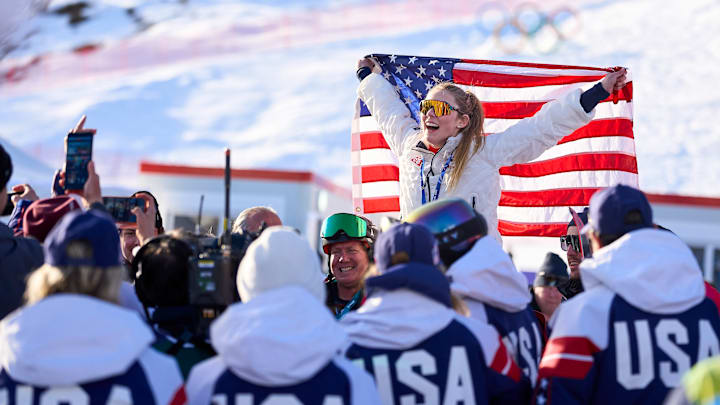
CORTINA d’AMPEZZO, Italy — When she flashed past the finish line, smashing her Olympic mental block into rubble, Mikaela Shiffrin decelerated and stared at the scoreboard. Stared some more. Kept staring. For several seconds, there was no reaction at all.
Roars reverberated around her. Everyone at the Olympia delle Tofane was celebrating Shiffrin’s return to quadrennial dominance, winning the gold medal that had weirdly eluded her for eight years and eight consecutive Olympic races. But it took a moment to get there herself Wednesday—a moment of confusion, then caution, then inner clarity.
“I just didn’t know what actually happened because I never seem to be able to read the scoreboard,” Shiffrin said. “I did see the green [showing the margin of victory], but then sometimes it’s a little bit hard to believe, sort of. So it’s like, wait, are we sure? It will be embarrassing to celebrate and have that not be real.”
Finally, the pregnant pause ended. The most accomplished World Cup skier in history sank into a crouch above the snow and bowed her head. Then she came back up, sticking a triumphant fist in the air. It was quite the symbolic fall and rise, while her thoughts turned inward.

“These moments for me that take so long—years—to process what that actually means,” she said. “So I just wanted to take that moment and communicate in my heart and in my mind with the people who have been there and thank them.”
She did that again at the medal ceremony, tearfully pausing for a beat before taking the podium. She kissed her fingers and patted them on the snow, then raised a finger and her face to the sky.
She was thinking of her late father, Jeff, who had been such an integral part of her career before dying unexpectedly in 2020. She was thinking about her brother and sister-in-law, who were home anticipating the birth of a child. She was thinking about her fiancé, Norwegian skier Aleksander Aamodt Kilde, who is not here after withdrawing from the Olympics as he recovers from injuries. She was thinking about her mom, Eileen, who was present and embraced her shortly after the run.
A GOLDEN MOMENT FOR MIKAELA SHIFFRIN. 🥇 pic.twitter.com/HVBmdC0TW2
— NBC Olympics & Paralympics (@NBCOlympics) February 18, 2026
Before celebrating with the world, Shiffrin wanted to celebrate internally with them.
“These moments, we do build them up for sure,” Shiffrin said, in an extraordinarily open press conference. “I think everybody builds it up, and I’m building it up for myself, too. … This was a moment I have dreamed about. I’ve also been very scared of this moment.
“Everything in life that you do after you lose someone you love is like a new experience. It’s like being born again. And I still have so many moments where I resist this. I don’t want to be in life without my dad. And maybe today was the first time that I could actually accept this like reality.”
Jeff Shiffrin would have loved what his daughter did Wednesday.
After the pain of Beijing in 2022, going 0-for-6 in medals and failing to finish half those races, there were the additional layers of doubt after already going 0-for-2 here. Then she dropped the hammer and said enough was enough.
The Mikaela Shiffrin who went to the start gate Wednesday was GOAT Shiffrin. Boss Shiffrin. Terminator Shiffrin. Her margin of victory across two slalom runs was 1.5 seconds, an eternity in a sport that parses time to the hundredth. It was the biggest margin in an Olympic slalom since 1988, and the third-biggest since 1960.
This was the woman who has won a record 108 World Cup races. This was a 1980s Mike Tyson first-round knockout. It was 2000s Tiger Woods, leaving everyone behind as soon as possible.
Shiffrin put her competitors on notice with her first run, blazing through in 47.13 seconds to take a fat lead of .82 over second-place Lena Duerr of Germany. That’s how she’s rolled much of the time, pouncing on the first run and taking control of the event. Then the cushion grew wider when Duerr shockingly missed the very first gate of her run, and the woman in third place, 20-year-old Cornelia Öhlund of Sweden, also skied off the course.
All Shiffrin had to do was what she’s always done, with the high-profile exception of the eight Olympic races coming into Wednesday’s slalom. The giant slalom, in which she finished 11th on Sunday, was a slight disappointment. The team combined event earlier, when Shiffrin just flat misfired in the slalom after being staked to a lead by downhill teammate Breezy Johnson, was a massive disappointment.

In her last shot at these Olympics, she reconnected with her best self. Truth be told, it hadn’t been hidden for very long—she’d won seven out of eight slalom events on the World Cup tour this season and finished second in the other one. It was, frankly, high time for her to launch.
The mission today: “Take away the noise and to just be simple with it.”
Simplicity can be elusive when you think deeply, and Shiffrin is definitely a thinker. She processes everything. She can reduce her sport to the most fundamental technical details, yet grapple with the wider context of what she does and how it is perceived in the world at large.
She’s perceptive enough to know what the world was saying about her 15th-place slalom run in the team combined. She chafes at the casual observers who are critical of herself and others in her sport, but also understands that events like the Olympics give her a chance to make a lot of money and elevate skiing.
“As far as narratives outside, what’s reality, I knew after the team combined that there would be some stories out there that would be really frustrating to look at because it’s just not the reality of the sport,” she said. “It’s a different perspective when you are watching it and not totally understanding all of the demands that go into it. And that would be from the keyboard warriors and for sure from media as well. But I have been so lucky that the whole media has told my story in such a beautiful way over the course of my career.
“These moments of challenge, you don’t necessarily get to avoid them. So I just didn’t look at what anyone was saying. I didn’t look at social media, I didn’t look at anything. And I just kept reminding myself what is important to me was the moments between the start and the finish. And there will always be criticism, but I am here to earn the moment and that is going to require some risk.”

With risk can come reward, and Shiffrin was rewarded by becoming the first individual athlete in Winter Olympics history to win gold in the same event 12 years apart—her first came in 2014, in Sochi. After that there was a gold in giant slalom in 2018 and a silver in the combined.
Shiffrin was just a teenager in 2014,. Someone asked her Wednesday what she would tell her 18-year-old self in order to be prepared for what was to come.
“Buckle up,” Shiffrin shot back, then turned serious. “I want to have certainty. I would’ve given anything today to be certain about what was going to happen, but we don’t get that. So I would’ve wanted that when I was 18 years old, too. But actually I think back then I was more comfortable being uncertain. And that’s also probably because there was quite a lot less expectations, and I had an ever-evolving relationship with expectations. So at that time the world was my oyster and I did not know what the path over the next, even the next four years was going to hold. So I wouldn’t want to tell her too much. I think it’s important to learn them as you go.”
Shiffrin offered her own postscript on these Olympics on Instagram shortly after her victory—posting it so quickly that it was clearly written beforehand. She said she authored it three days ago, as a form of self-talk.
“I’ve been much more externally vocal to myself than usual,” she said. “Normally I don’t really talk to myself in this way, but I’ve had to be actually loud with myself to say, ‘You want a big mentality, you want to earn the moment, you want to do this game, you want to be there, you want to be in that start gate and then you want to take on the course ahead of you.’ It was a manifesting moment.”
The post says, “I won” repeatedly. But the deep thinker, the athlete purist, the pursuer of big meaning, says what she won was not quite the same as what everyone else was celebrating for her.
“I won,” she wrote. “I f---ing won. This, right here, is the lottery and I won. Oh, and I got a medal, too.”
More Winter Olympics on Sports Illustrated
 Add us as a preferred source on Google
Pat Forde is a senior writer for Sports Illustrated who covers college football and college basketball as well as the Olympics and horse racing. He cohosts the Others Receiving Votes podcast for SI and is a regular contributor to the Tony Kornheiser Show podcast. He previously worked for Yahoo Sports, ESPN and The (Louisville) Courier-Journal. Forde has won 28 Associated Press Sports Editors writing contest awards, has been published three times in the Best American Sports Writing book series, and was nominated for the 1990 Pulitzer Prize. A past president of the U.S. Basketball Writers Association and member of the Football Writers Association of America, he lives in Louisville with his wife. They have three children, all of whom were collegiate swimmers.
Follow ByPatForde