%20%20--%3E%0A%3Csvg%20version%3D%221.1%22%20id%3D%22Layer_1%22%20xmlns%3D%22http%3A%2F%2Fwww.w3.org%2F2000%2Fsvg%22%20xmlns%3Axlink%3D%22http%3A%2F%2Fwww.w3.org%2F1999%2Fxlink%22%20x%3D%220px%22%20y%3D%220px%22%0A%09%20width%3D%2239px%22%20height%3D%2240px%22%20viewBox%3D%220%200%2039%2040%22%20enable-background%3D%22new%200%200%2039%2040%22%20xml%3Aspace%3D%22preserve%22%3E%0A%3Cpath%20fill%3D%22%23FFFFFF%22%20d%3D%22M38.5%2C7H28.2v26h10.3V7z%22%2F%3E%0A%3Cpath%20fill-rule%3D%22evenodd%22%20clip-rule%3D%22evenodd%22%20fill%3D%22%23FFFFFF%22%20d%3D%22M26.1%2C25.5c0%2C5.8-4.1%2C7.5-12.9%2C7.5C3.9%2C33%2C0%2C31.2%2C0%2C25.2v-1.1h11.6%0A%09v2.4c0%2C0.7%2C0.1%2C1.4%2C1.2%2C1.4c1%2C0%2C1.2-0.4%2C1.2-1.3v-0.9c0-1.6-0.9-1.6-3.5-2.2C2.2%2C21.7%2C0%2C19.7%2C0%2C15.3v-0.9C0%2C9.3%2C5.5%2C7%2C12.9%2C7%0A%09c10.2%2C0%2C12.8%2C2.6%2C12.8%2C7.4v1.8h-11v-2.9c0-0.6-0.4-1.1-1.2-1.1c-0.6%2C0-1.2%2C0.4-1.2%2C1.1v0.9c0%2C1.5%2C0.9%2C2%2C3.3%2C2.5%0A%09c8%2C1.6%2C10.5%2C3.3%2C10.5%2C7.5V25.5z%22%2F%3E%0A%3C%2Fsvg%3E%0A)
Valkyries Embrace Change, Come Back to Life to Even WNBA Finals
In this story:
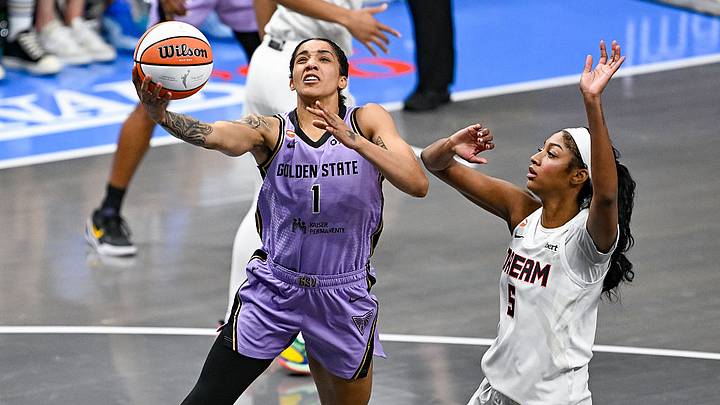
Gabby Williams gathered her team into a huddle at the buzzer of Game 3, and delivered an impassioned speech after a demoralizing 26-point loss to the Dream.
“I wanted to show my team something different because we need something different,” Williams said at practice on Friday. “I had to get out of my comfort zone and try to remotivate the troops.”
The fiery address paid off, with Golden State leveling the series 2–2 on Saturday and suffocating Atlanta in a gritty 67–62 win in Game 4. Before their two-game slide in the Finals, the Valkyries hadn’t lost consecutive games since August. Determined not to make it an unprecedented three-game skid, Williams, who said she’d been “too loose as a leader,” knew she had to shake things up. And the galvanizing sermon was as much for her as for her team.
“I didn’t like where I was in that last game. So I think stepping up in that role made me step up also individually,” Williams said after Game 4. “If I want to lead my team, I have to be the one that sets the tone, and I have to lead by example as well.”
Natalie Nakase has also been self-reflective, acknowledging that she has had to tailor her message so it lands better with her team—something she learned from 14-year veteran Tiffany Hayes. Intense and competitive by nature, Nakase said she needed to be more composed in the huddles so she could deliver her adjustments to her players more directly.
The Golden State coach wasn’t afraid to switch things up on the floor either. She made a consequential starting lineup change, swapping in Kaila Charles and Hayes for Kayla Thornton and Cecilia Zandalasini.
“The best thing about our team is like, no one cares who starts. No one cares,” Nakase said after Saturday’s win. “People come off the bench; it doesn’t matter. We do that because we have a really selfless team.”
The new look seemed to pay dividends, as the Dream attempted just 19 shots in an out-of-sorts first two frames for Karl Smesko’s side. After being held scoreless for the first five minutes of Game 3, Golden State punched first on Saturday. And while a Valkyries knockout may not be an ear-ringing blow, their series of subtle jabs add up, amounting to a slugfest.

Golden State’s asphyxiating ball pressure came from another adjustment Nakase wasn’t afraid to make, deploying more of a zone look on defense that left the Dream perplexed and without answers. The Valkyries finished with 18 points off 16 Dream turnovers, thanks in large part to Williams, who led the charge in flustering Atlanta, logging three steals on top of 17 points and five rebounds.
“I thought her defense was on an elite, elite level,” Nakase said of Williams. “I mean, she’s one of the top defenders in the world for a reason. And you can see when she’s locked in on her matchup, and her game plan, she can get after it and create more possessions.”
Slowing down the Dream, the Valkyries didn’t let Atlanta get out in transition, with Smesko’s squad finishing with only two fast-break points. Golden State also won the battle inside, scoring 38 paint points to the Dream’s 28. Much of that came down to Kiah Stokes making life difficult for Angel Reese. After back-to-back blockbuster performances, Reese was held to eight points—shooting 2-for-12 from the field—and nine rebounds.
”She’s been the head of their snake all series,” Stokes said of Reese. “So for me, it was just trying to make every look that she had at the basket difficult. It’s a tough job, but I think being our best defensive big, I gotta own up to that challenge.”
Perhaps Nakase’s NBA experience as an assistant with the Clippers has prepared her for the rollercoaster that is a seven-game series (which the WNBA implemented in 2025) and the flexibility to bend without breaking. By being bold in its willingness to transform—whether in tone, disposition, personnel or approach—Golden State has actually found a way back to itself. A 67–62 final scoreline reflects exactly the type of game the Valkyries want to play: a physical slog that cuts off their opponent’s oxygen. And remaining guileless even in the face of defeat has brought Golden State back to life.
“I listen more after losses because I need to know what they’re thinking, what they’re feeling,” Nakase said. “And so, again, just credit to our players. They’re super vulnerable after losses. And like I mentioned before, we get even closer after losses because we learn from our lessons after losses.”
That openness, trust and experimentation, born of defeat, may just be Golden State’s winning formula.
 Add us as a preferred source on Google

Clare Brennan is an associate editor for Sports Illustrated focused on women’s sports. Before joining SI in October 2022, she worked as an associate editor at Just Women’s Sports and as an associate producer for WDET in Detroit. Brennan has a bachelor’s in international studies from the University of Wisconsin and a master’s in art history from Wayne State University.