%20%20--%3E%0A%3Csvg%20version%3D%221.1%22%20id%3D%22Layer_1%22%20xmlns%3D%22http%3A%2F%2Fwww.w3.org%2F2000%2Fsvg%22%20xmlns%3Axlink%3D%22http%3A%2F%2Fwww.w3.org%2F1999%2Fxlink%22%20x%3D%220px%22%20y%3D%220px%22%0A%09%20width%3D%2239px%22%20height%3D%2240px%22%20viewBox%3D%220%200%2039%2040%22%20enable-background%3D%22new%200%200%2039%2040%22%20xml%3Aspace%3D%22preserve%22%3E%0A%3Cpath%20fill%3D%22%23FFFFFF%22%20d%3D%22M38.5%2C7H28.2v26h10.3V7z%22%2F%3E%0A%3Cpath%20fill-rule%3D%22evenodd%22%20clip-rule%3D%22evenodd%22%20fill%3D%22%23FFFFFF%22%20d%3D%22M26.1%2C25.5c0%2C5.8-4.1%2C7.5-12.9%2C7.5C3.9%2C33%2C0%2C31.2%2C0%2C25.2v-1.1h11.6%0A%09v2.4c0%2C0.7%2C0.1%2C1.4%2C1.2%2C1.4c1%2C0%2C1.2-0.4%2C1.2-1.3v-0.9c0-1.6-0.9-1.6-3.5-2.2C2.2%2C21.7%2C0%2C19.7%2C0%2C15.3v-0.9C0%2C9.3%2C5.5%2C7%2C12.9%2C7%0A%09c10.2%2C0%2C12.8%2C2.6%2C12.8%2C7.4v1.8h-11v-2.9c0-0.6-0.4-1.1-1.2-1.1c-0.6%2C0-1.2%2C0.4-1.2%2C1.1v0.9c0%2C1.5%2C0.9%2C2%2C3.3%2C2.5%0A%09c8%2C1.6%2C10.5%2C3.3%2C10.5%2C7.5V25.5z%22%2F%3E%0A%3C%2Fsvg%3E%0A)
Welcome to the Ballhalla Blast Powering the Valkyries Through the WNBA Finals
In this story:
SAN FRANCISCO — “What’s my favorite word?!”
Too $hort’s “Blow the Whistle” reverberated through the Chase Center as the Valkyries’ starting lineup was announced for Game 1 of the WNBA Finals. The Bay Area rapper’s 2006 hit, already blaring at ear-splitting volume, contended with the cheers of a thunderous 18,064-person Golden State crowd, creating a buzz that lasted through all four quarters of a narrow 68–64 win over the Dream.
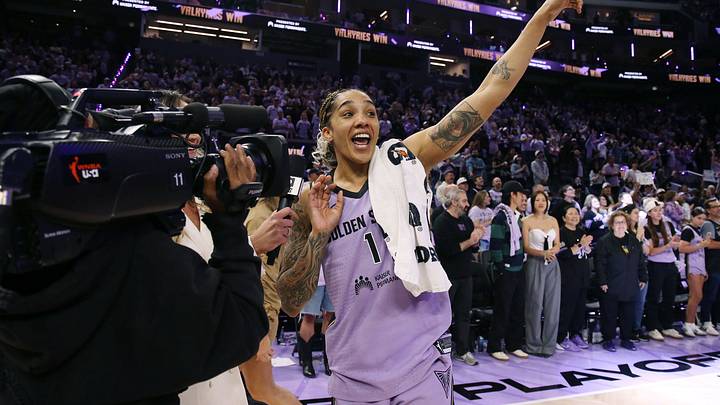
Welcome to Ballhalla, the WNBA’s Richter-breaking, violet-hued rave. Aptly named, Golden State’s home crowd has created a majestic basketball palace and one of the WNBA’s most vibrant environments. After just two years in the league, the Valkyries are three wins away from a championship, thanks in part to a loud, loyal fanbase in lockstep with the team.
“It is crystal clear that that’s a Bay Area crowd,” Too $hort says of Ballhalla. “You can tell by the songs they play during the game. You can tell by the breaks, the timeouts, what they do during the timeouts, the dances and the songs they dance to.”
A longtime Bay Area sports fan, Too $hort heard from people who worked at Chase Center that the Valkyries games were more energetic than the Warriors. So when he was asked to perform at halftime for Golden State’s first postseason game in September, he jumped at the chance. He hasn’t missed a Valkyries home playoff contest since, likening the atmosphere to the Oracle Arena during the Warriors’ heyday.
“They’re not lying, like Ballhalla is louder. The fans are more intense,” Too $hort says. “For some reason, those fans, those Valkyrie fans are loud and proud, really.”
Megan Doherty-Baker, an originator of ValQueeries, a queer Valkyries fan community, is one of those devotees. Like many born in San Francisco, Doherty-Baker is a longtime Bay Area sports diehard, but that mostly focused on men’s teams like the 49ers and Giants. Already well acquainted with women’s sports through her support of the 2019 World Cup–winning U.S. women’s national soccer team, she was primed to jump into action when the Valkyries joined the WNBA as an expansion team in 2025.
“I just saw after the first preseason game like there are so many of us here, queer people, you know, visible folks, and then I knew there were other people that I couldn’t just see, but I was like, How are we ever going to get to know one another?” Doherty-Baker says.
She called up her Valkyries ticket representative and asked who was bringing the queer fans together. Doherty-Baker was encouraged to take on the unifying task and reassured that there would be plenty of demand for such a group. And sure enough, an avalanche of momentum followed the start of the ValQueeries, with Doherty-Baker collecting fans’ email addresses and starting a newsletter. She also posted up at a brewery kitty-corner to the Chase Center, wearing a rainbow bandana and encouraging other supporters to say hello. A community was born.
Tonishia Short, a self-proclaimed Bay Area transplant by way of Virginia, joined the group in pursuit of connection. Brittney Griner initially drew her to the league because she was a similar age, a queer athlete and a proven winner. When a team of her own cropped up in the Bay, Short started going to games and was immediately struck by the camaraderie.
“In my particular section, we have these little rituals that we do,” Short says. “If we get a three-point shot, we pretend that we’re mimicking a bow and arrow being launched.”
In another section, fans gather streamers that rain down from the arena’s rafters after a Valkyries win, bottle the confetti in capsules, and hand it out as “Balhalla magic.”
Doherty-Baker and Short are both moved by the intergenerational nature of the ValQueeries. Young and old fans—and everyone in between—come to meetups to share what a group like this means to them. And in the case of the elder queer hoops fans, they talk about how long they’ve waited for something like this. As such, Ballhalla has served as a rowdy haven.
“I think there’s just a knowing,” Short says, “And we’re so used to hiding ourselves. In this space, you don’t have to do that.”
The feeling is mutual, with the Valkyries players and fans bonded in a symbiotic, almost telepathic relationship. “For the gays!” Gabby Williams exclaimed to the cameras after winning on Golden State’s Pride night in June. The rebel yell only endeared her further to the fan base.
So when Williams put out a call after the Valkyries’ first playoff win in Chase Center, Ballhalla responded without hesitation. Williams grabbed the mic and sang, “What’s my favorite word,” quoting Too $hort. At once, a sellout crowd screamed back “B----,” finishing the lyric.
“What’s my favorite word?” 🗣️
— USA Sports (@usasports) September 28, 2026
Gabby Williams couldn’t lose Game 1 with Bay Area legend Too $hort in the building 🤣 pic.twitter.com/g7ZAihwgks
“I mean, I’m sure that moment was very empowering for her,” Too $hort says. “I love seeing the clip. I’ve seen the clip a dozen times.
“I’m a real sports fan. And they’re glad to see Too $hort in the building, I’m glad to be in the building.”
That reciprocal embrace, not just of Too $hort but of all of Ballhalla, has spelled success. The Valkyries led the league in home wins during the 2026 regular season with a 17–5 record. They have also yet to lose a home playoff game this year, winning five games in the Chase Center.
Since the beginning, fans have been showing up for the expansion team. The Valkyries sold out every home game in their inaugural season and set an all-time WNBA attendance record for average attendance in the process. That continued in 2026, and the team has not played in front of anything less than a sellout crowd since joining the league.
“We mirror them, and they mirror us,” Doherty-Baker says. “If you have a fan base that is representative of the players themselves who are on the court and everybody’s free to come fully as ourselves and be celebrated, then that’s a successful recipe.”
Ballhalla is an extension of the squad—a sixth starter, if you will—so much so that even fans can’t escape being coached up by Natalie Nakase. Ahead of Game 1, she challenged Ballhalla to come to Chase Center with a game plan. “I need that game to be rocking,” she said. Less than an hour after Saturday’s win, she already had her sights set on Monday. “Great job, but hey, level up,” Nakase said. “Game 2 it has to be better. Rest and recover, Ballhalla; careful what you drink tonight.”
If they follow her directive, expect the Valkyries to be tough to beat in Game 2, hyped up by the raucous, relentless background music that is Ballhalla.
 Add us as a preferred source on Google
Clare Brennan is an associate editor for Sports Illustrated focused on women’s sports. Before joining SI in October 2022, she worked as an associate editor at Just Women’s Sports and as an associate producer for WDET in Detroit. Brennan has a bachelor’s in international studies from the University of Wisconsin and a master’s in art history from Wayne State University.