%20%20--%3E%0A%3Csvg%20version%3D%221.1%22%20id%3D%22Layer_1%22%20xmlns%3D%22http%3A%2F%2Fwww.w3.org%2F2000%2Fsvg%22%20xmlns%3Axlink%3D%22http%3A%2F%2Fwww.w3.org%2F1999%2Fxlink%22%20x%3D%220px%22%20y%3D%220px%22%0A%09%20width%3D%2239px%22%20height%3D%2240px%22%20viewBox%3D%220%200%2039%2040%22%20enable-background%3D%22new%200%200%2039%2040%22%20xml%3Aspace%3D%22preserve%22%3E%0A%3Cpath%20fill%3D%22%23FFFFFF%22%20d%3D%22M38.5%2C7H28.2v26h10.3V7z%22%2F%3E%0A%3Cpath%20fill-rule%3D%22evenodd%22%20clip-rule%3D%22evenodd%22%20fill%3D%22%23FFFFFF%22%20d%3D%22M26.1%2C25.5c0%2C5.8-4.1%2C7.5-12.9%2C7.5C3.9%2C33%2C0%2C31.2%2C0%2C25.2v-1.1h11.6%0A%09v2.4c0%2C0.7%2C0.1%2C1.4%2C1.2%2C1.4c1%2C0%2C1.2-0.4%2C1.2-1.3v-0.9c0-1.6-0.9-1.6-3.5-2.2C2.2%2C21.7%2C0%2C19.7%2C0%2C15.3v-0.9C0%2C9.3%2C5.5%2C7%2C12.9%2C7%0A%09c10.2%2C0%2C12.8%2C2.6%2C12.8%2C7.4v1.8h-11v-2.9c0-0.6-0.4-1.1-1.2-1.1c-0.6%2C0-1.2%2C0.4-1.2%2C1.1v0.9c0%2C1.5%2C0.9%2C2%2C3.3%2C2.5%0A%09c8%2C1.6%2C10.5%2C3.3%2C10.5%2C7.5V25.5z%22%2F%3E%0A%3C%2Fsvg%3E%0A)
Alabama’s Brazen Charles Bediako Play Backfires and Gives NCAA a Rare Win
In this story:
Alabama’s brazen attempt at court-ordering its way to a key roster reinforcement has officially blown up in the Crimson Tide’s face.
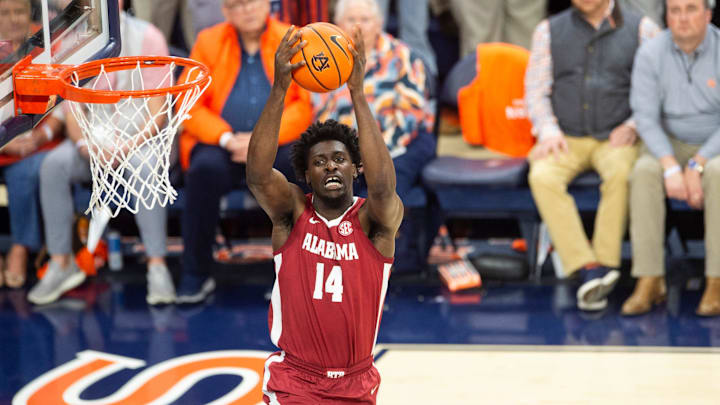
Charles Bediako, Alabama’s controversial former G Leaguer, was denied an injunction against the NCAA by an Alabama judge Monday, likely ending a near three-week saga that saw the Tide attempt to use the legal system to bring back a key piece of their 2023 SEC title team. Though Bediako (and head coach Nate Oats, long one to push the boundaries in search of victories) may have achieved the impossible in the process: make the NCAA look like a sympathetic figure in court.
The NCAA has largely been a legal punching bag over the past four years, one rule after another struck down or stripped away by the court system as it clumsily pivots toward a much more professionalized version of college sports. For once, it seemed to have public opinion on its side, though that didn’t necessarily mean it had enough legal standing to keep Bediako out of college basketball. But in the filing Monday announcing Bediako’s temporary restraining order will expire Tuesday, judge Daniel Pruet poked holes in the rather dubious arguments Bediako’s legal team made in their Hail Mary to revitalize his career.
Among the most humorous was the assertion in Friday’s hearing that Bediako was simply interested in continuing his college studies, something he wouldn’t be able to do without the scholarship Alabama would provide him … only for Oats to undercut that argument by confirming just hours later in a news conference that Bediako would stay on scholarship regardless of his eligibility status. In Monday’s ruling, Pruet expressed plenty of skepticism about that very argument, writing that “if the plaintiff wishes to pursue a degree, he is free to do so.”
The judge also ripped the idea pushed by Oats and Bediako’s legal team (however ludicrous it seemed to the average college basketball consumer) that Bediako’s situation was no different than the dozens of pros, both foreign and domestic, who have cashed in on college hoops’ gold rush in the last two years. Bediako’s situation was always different: He left college, knowingly forgoing his remaining eligibility, and signed pro contracts once he did. The NCAA rules on staying in the NBA draft have never been unclear or arbitrarily enforced. Bediako had months to get NBA feedback, do workouts and make an informed decision on returning to college or turning pro.
This ruling may not provide permanent stability for the NCAA as it fights on several different fronts to maintain some semblance of control over who can and can’t play college sports. But it’s a welcome reprieve in the meantime as it continues to shout from the rooftops for Congressional help to codify its eligibility rules. ESPN’s Dan Wetzel smartly wrote last week that the NCAA should be advocating for a “skinny bill” that sets clear eligibility standards around the five-year window that the NCAA has long used; this ruling gives them time to sound the alarm without an influx of other lawsuits to fight.
But perhaps more powerfully, the way this whole saga went down might discourage the next coach from going down this road … or their athletic director and school president from signing off on being the renegade school advocating it. The biggest thing destabilizing the NCAA right now are the schools intent on a “rules for thee, not for me” landscape doing whatever it takes to win the next football or basketball game. And while Oats has never been afraid of a little public heat to put his team in the best position to win, he comes out of this with egg on his face that the next coach in his spot may want to avoid. To the coaches considering recruiting Amari Bailey, the former UCLA guard looking to go from the NBA back to college: Is a good-but-not-great shooting guard worth all this trouble?
Alabama certainly isn’t apologizing for its desperate legal maneuver, writing in a statement to Sports Illustrated in part that “granting eligibility to some former professionals, and not to others, is what creates the havoc we are currently in.” They conveniently don’t acknowledge the havoc created by attempting to bring back a current G Leaguer midway through the season (with the help of a judge who was a known supporter of the program), a play that threatened to blow up not just the SEC race but the entire system of how college teams build rosters. And they did all that just to get beat at home by Tennessee and bludgeoned by a Florida team whose frontcourt made it clear why Bediako’s NBA dreams had largely flamed out.
Legally, the NCAA isn’t allowed to retaliate against Alabama for playing Bediako during the injunction period, nor can it vacate the three wins Alabama secured with Bediako in the lineup. But this is a scarlet letter the Tide should and will have to carry throughout the NCAA tournament seeding process, especially given Bediako had a tangible impact in two hotly contested games vs. potential bubble teams in the last week. Alabama AD Greg Byrne being on the selection committee may help soften the rhetoric against the Tide, but it’s hard to imagine many being happy with Alabama’s handling of the situation. Alabama shouldn’t get the benefit of the doubt on Selection Sunday when compared to similar résumés of teams that didn’t play ineligible players for five games in the middle of the SEC race. And if Auburn is on or near the bubble on Selection Sunday, it’d be a pretty compelling argument that one of its SEC losses came with Bediako scoring 12 points in 22 minutes while Pruet deliberated over the weekend on his eligibility.
Bediako’s TRO expiring is, as NCAA commissioner Charlie Baker put it, an example of “common sense [winning] a round.” Perhaps this very public failure will make others think twice before following Alabama’s lead and trying to blow up the few eligibility rules the NCAA has left.
More College Basketball from Sports Illustrated
Listen to SI’s college sports podcast, Others Receiving Votes, below or on Apple and Spotify. Watch the show on SI’s YouTube channel.
 Add us as a preferred source on Google
Kevin Sweeney is a staff writer at Sports Illustrated covering college basketball and the NBA draft. He joined the SI staff in July 2021 and also serves host and analyst for The Field of 68. Sweeney is a Naismith Trophy voter and ia member of the U.S. Basketball Writers Association. He is a graduate of Northwestern University’s Medill School of Journalism.
Follow CBB_Central