%20%20--%3E%0A%3Csvg%20version%3D%221.1%22%20id%3D%22Layer_1%22%20xmlns%3D%22http%3A%2F%2Fwww.w3.org%2F2000%2Fsvg%22%20xmlns%3Axlink%3D%22http%3A%2F%2Fwww.w3.org%2F1999%2Fxlink%22%20x%3D%220px%22%20y%3D%220px%22%0A%09%20width%3D%2239px%22%20height%3D%2240px%22%20viewBox%3D%220%200%2039%2040%22%20enable-background%3D%22new%200%200%2039%2040%22%20xml%3Aspace%3D%22preserve%22%3E%0A%3Cpath%20fill%3D%22%23FFFFFF%22%20d%3D%22M38.5%2C7H28.2v26h10.3V7z%22%2F%3E%0A%3Cpath%20fill-rule%3D%22evenodd%22%20clip-rule%3D%22evenodd%22%20fill%3D%22%23FFFFFF%22%20d%3D%22M26.1%2C25.5c0%2C5.8-4.1%2C7.5-12.9%2C7.5C3.9%2C33%2C0%2C31.2%2C0%2C25.2v-1.1h11.6%0A%09v2.4c0%2C0.7%2C0.1%2C1.4%2C1.2%2C1.4c1%2C0%2C1.2-0.4%2C1.2-1.3v-0.9c0-1.6-0.9-1.6-3.5-2.2C2.2%2C21.7%2C0%2C19.7%2C0%2C15.3v-0.9C0%2C9.3%2C5.5%2C7%2C12.9%2C7%0A%09c10.2%2C0%2C12.8%2C2.6%2C12.8%2C7.4v1.8h-11v-2.9c0-0.6-0.4-1.1-1.2-1.1c-0.6%2C0-1.2%2C0.4-1.2%2C1.1v0.9c0%2C1.5%2C0.9%2C2%2C3.3%2C2.5%0A%09c8%2C1.6%2C10.5%2C3.3%2C10.5%2C7.5V25.5z%22%2F%3E%0A%3C%2Fsvg%3E%0A)
What Charles Bediako Ruling Means for Alabama Amid NCAA Tournament Chase
In this story:
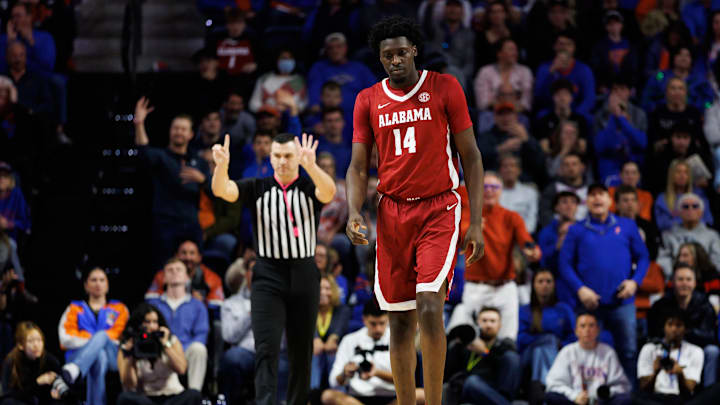
Charles Bediako’s second stint with the Crimson Tide came to an end on Monday, when Alabama circuit court judge Daniel Pruet denied the ex-G Leaguer’s request for an injunction against the NCAA, rendering him ineligible to play for Alabama basketball.
The implications of the Bediako ruling are far-reaching, from its effect on the NCAA’s battle to protect its exploitable eligibility rules to the headaches it will cause the selection committee when it meets in March to seed the NCAA tournament.
Bediako’s ineligibility will also impact a Crimson Tide team looking to continue sculpting its résumé for March Madness.
Big Bediako ruling will force Alabama basketball to go small
If you were wondering about the state of Alabama’s big man rotation before Bediako’s reinstatement, look no further than just how much coach Nate Oats was willing to play the ex-G Leaguer in his brief, five-game stint. Bediako, who averaged 10.0 points, 4.6 rebounds and 1.4 blocks per game, played 21.6 minutes per contest, often seeing the court for meaningful action in tilts against SEC rivals.
On Tuesday, Oats was asked whether it was worth it to bring back Bediako for five games. His answer? “100%,” according to Nick Kelly of al.com. Oats cited the benefits Bediako’s return will have on his quest for a degree, as well as his basketball advancement. But there’s another reason Bediako’s return may have been worth it from a basketball standpoint, one that Oats isn’t saying out loud.
Oats, in addition to scoring a few résumé-boosting intraconference wins with Bediako on the roster, was given a legitimate option to turn to at the center position, a spot where the program’s depth is especially thin this season.
Sophomore Aiden Sherell, who has thrived in increased playing time in his second season with the Tide, will likely be tasked with handling the bulk of the playing time at center. Fellow big man Keitenn Bristow has dealt with leg and ankle injuries this season in what could amount to a redshirt year. That leaves senior Noah Williamson, who has played just 8.9 minutes per game in 21 contests, as the only other true center on the roster.
Bediako certainly didn’t play like Kareem Abdul-Jabbar for the Crimson Tide. But his impact was felt in big games: 13 points and two blocks in a narrow loss to Tennessee in his return, 14 points and six rebounds in a win over Missouri and, 12 points on 5-of-5 shooting in a win over Auburn.
Bediako’s absence leaves Alabama thin in the front court when Sherrell is not on the floor, leaving Oats with one option: small ball.
“We've got to turn the focus back to the guys that are going to be on the floor, and we've got some very capable players that we've won a lot of big games before—won some big games before Charles got here," Oats said, according to 247 Sports. “We're gonna have to go back, play a little small ball when [Sherrell] is not in. We'll figure it out. That's what coaches are here for.”
Would Alabama have been better served by continuing to let bigs such as Sherrell gain more playing time than even entertaining its dalliance with Bediako? Perhaps. Will a small-ball approach work? Who knows.
In a year where some of college basketball’s best are turning to big ball, it’s a less-than-ideal pivot, even for an offensively-skilled Alabama team. Time will tell whether it hurts the Crimson Tide when it matters most.
More College Basketball on Sports Illustrated
 Add us as a preferred source on Google
Tim Capurso is a staff writer for Sports Illustrated, primarily covering MLB, college football and college basketball. Before joining SI in November 2023, Capurso worked at RotoBaller and ClutchPoints and is a graduate of Assumption University. When he's not working, he can be found at the gym, reading a book or enjoying a good hike. A resident of New York, Capurso openly wonders if the Giants will ever be a winning football team again.
Follow TimCapurso