%20%20--%3E%0A%3Csvg%20version%3D%221.1%22%20id%3D%22Layer_1%22%20xmlns%3D%22http%3A%2F%2Fwww.w3.org%2F2000%2Fsvg%22%20xmlns%3Axlink%3D%22http%3A%2F%2Fwww.w3.org%2F1999%2Fxlink%22%20x%3D%220px%22%20y%3D%220px%22%0A%09%20width%3D%2239px%22%20height%3D%2240px%22%20viewBox%3D%220%200%2039%2040%22%20enable-background%3D%22new%200%200%2039%2040%22%20xml%3Aspace%3D%22preserve%22%3E%0A%3Cpath%20fill%3D%22%23FFFFFF%22%20d%3D%22M38.5%2C7H28.2v26h10.3V7z%22%2F%3E%0A%3Cpath%20fill-rule%3D%22evenodd%22%20clip-rule%3D%22evenodd%22%20fill%3D%22%23FFFFFF%22%20d%3D%22M26.1%2C25.5c0%2C5.8-4.1%2C7.5-12.9%2C7.5C3.9%2C33%2C0%2C31.2%2C0%2C25.2v-1.1h11.6%0A%09v2.4c0%2C0.7%2C0.1%2C1.4%2C1.2%2C1.4c1%2C0%2C1.2-0.4%2C1.2-1.3v-0.9c0-1.6-0.9-1.6-3.5-2.2C2.2%2C21.7%2C0%2C19.7%2C0%2C15.3v-0.9C0%2C9.3%2C5.5%2C7%2C12.9%2C7%0A%09c10.2%2C0%2C12.8%2C2.6%2C12.8%2C7.4v1.8h-11v-2.9c0-0.6-0.4-1.1-1.2-1.1c-0.6%2C0-1.2%2C0.4-1.2%2C1.1v0.9c0%2C1.5%2C0.9%2C2%2C3.3%2C2.5%0A%09c8%2C1.6%2C10.5%2C3.3%2C10.5%2C7.5V25.5z%22%2F%3E%0A%3C%2Fsvg%3E%0A)
Forde-Yard Dash: Is a Super League Next After 24-Team College Football Playoff?
In this story:
Forty names, games, teams and minutiae making news in college football, where AI has finally made itself useful. First Quarter: Now It’s a Crisis. Second Quarter: The Compression of the SEC. Third Quarter: Please Allow Me to Reintroduce Myself.
Fourth Quarter: Could an Independence Ripple Effect Be Next?
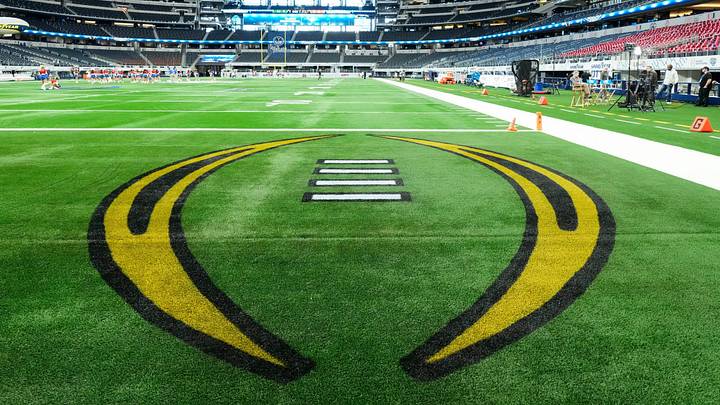
With a handshake agreement in place to disastrously expand the College Football Playoff (31) to a cluttered 24 teams, the potential damage to the sport is multifaceted. The Dash’s thoughts have been expressed on this topic many times, most recently here.
ESPN’s Dan Wetzel, longtime Friend of The Dash and a keen studier of how things work (and don’t work) in college sports, offered up a doomsday theory Friday—top brands leaving their conferences and going independent, like Notre Dame. The Fighting Irish should have a clear path of their choosing to the playoff every year in the 24-team world; why wouldn’t others want that?
This is an intriguing thought, although not a new one. Several years ago, one of the nation’s top athletic directors told me he believed Texas, Michigan, Ohio State and USC could all successfully go independent, perhaps others. Wetzel’s point is that dumbing down the playoff for the sake of mid-tier power-conference teams could hasten a breaking from traditional ties for the biggest brands. If winning a nonsensically large league has almost no inherent value, why do it when more lucrative, autonomous alternatives exist?
There are a couple of significant roadblocks, though: where to house every other varsity sport (dozens of them), and how to schedule games.
While it’s easy to wave a hand and say none of those sports matter, they actually do (especially basketball and all those with federally protected equal access and opportunity via Title IX). In the case of the Big Ten, it isn’t going to grant a Notre Dame–style, friends-with-benefits arrangement to departing members. Same with the SEC and, say, Texas. Maybe other leagues would, but any such agreement would be complicated and further exacerbate the practical and financial challenges already facing those sports.
As for scheduling football games: Who is willing to play the independents, and what’s in it for them? The blueblood independents could all play each other and fill out maybe one-third of a schedule, then they might have to buy the other two-thirds at a highway robbery rate. (Notre Dame has discovered the difficulty of scheduling quality opponents outside its yearly ACC agreement. BYU was driven mad trying to schedule during its stint as an independent.)
Perhaps a more likely short-term move by the big dogs in the big leagues is to bully their way into uneven revenue sharing (32), as has transpired in the ACC. Those who advance in the postseason or draw the most broadcast viewing eyeballs get the most money.
But down the road, anything is possible. If college football is willing to deconstruct its special nature to the point of a 24-team playoff, then all Armageddon scenarios are on the table. There is nothing necessarily left to forestall an eventual and inevitable super league (33) of 20 to 40 schools.
Instead of protecting a passion-steeped, tradition-rich, quirk-accented alternative to the NFL, the intent seems to be creating NFL Lite. The same as the pro product, only not as good, with none of the charm. Seems like a great goal to steer the entire enterprise toward.
Speaking of Leadership Failures …
One of the wildest and most enjoyable football Saturdays in history did not occur amid optimal conditions. Mostly because those in charge of officiating and administering several games screwed them up. The Dash has a brief request list to avoid undercutting the competitive product:
Please learn to tell time (34)
The Big 12 acknowledged a timing error in the Notre Dame–BYU game that ended with one second left on the clock. This is the second high-profile, end-of-game timing controversy of the season, following the Western Michigan–Michigan circus in Week 1. After that multiday melodrama, everyone involved in game operations should have been on high alert to make sure a game consists of 60 minutes—not 60:01 or, in this case, 59:59. That clearly didn’t happen.
Notre Dame should have had a final snap from the BYU 8-yard line, where the degree of scoring difficulty is far lower than, say, Michigan heaving a 47-yard Hail Mary. But then again, it could persuasively be argued that Notre Dame could have had that final snap from 1-yard line …
Please find some consistency in calling pass interference (35)
Most observers, including ESPN rules analyst Matt Austin, believed Cougars defensive back Evan Johnson interfered with Fighting Irish receiver Jaden Greathouse in the end zone. No flag was thrown. A week earlier, Georgia safety KJ Bolden ran over Alabama receiver Rico Scott in the end zone late in a three-point game. No penalty was assessed on that one, either.
It’s absolutely true that fans and media members speak out of both sides of their mouths about late-game officiating—lamenting when they call something instead of “letting the players decide the outcome,” and then complaining when they keep the flags in their pockets. And pass interference is among the hardest calls to judge. But when the call is clear, make it.
Please stop over-calling roughing the passer (36)
The zeal to protect quarterbacks has reached a stage where defensive players are being tied in knots to avoid certain hits that seem to be getting flagged with great frequency this season. Of particular note, the “body weight” personal foul assessed to pass rushers who essentially drop anchor when falling on a quarterback. It’s difficult for a defensive player to rush with legitimate zeal, apply a hit within a step of the QB releasing the ball and then somehow not follow through on the way to the ground. There have been several examples of those hits leading to flags in key moments.
As always, there have been plenty of quarterback injuries this season, with more to come. But aside from USC’s clear targeting shot on Oregon’s Dante Moore, most of the injury-inducing hits this season have come on clean plays. Quarterbacks cannot be bubble-wrapped.
Stat of the Week
After researching the Second Quarter data on the SEC’s home/road standoff, The Dash decided to look at the other power conferences. The results are noteworthy—the SEC is not alone. There might be a disappearing home field advantage (37) in 2026.
Big Ten home teams are actually significantly underwater, with a 13–19 record thus far. A 6–2 road mark one September weekend wasn’t an isolated incident, as it turns out.
The SEC is 16–16 after a flurry of massive road upsets. ACC home teams are 18–14. The Big 12 has been the most formful home conference at 15–9. The total for all four: Home teams 62, road teams 58. That’s a combined winning percentage of just .517.
Coach Who Earned His Comp Car This Week
JaMarcus Shephard (38), Oregon State
The rookie head coach with a Kalen DeBoer pedigree and unlimited enthusiasm has roared to 5–2, with a five-game winning streak and an offense averaging 42.7 points per game. The Beavers have the national leader in passing yards and passing touchdowns in Mercer transfer Braden Atkinson, and the national leader in receiving yards and receiving touchdowns in freshman Jesse Legree. As one of the programs left for dead in the raiding of the old Pac-12, Oregon State’s rise to the top of the new Pac-12 standings under Shephard is a great developing story.
Coach Who Should Take the Bus to Work
Pat Fitzgerald (39), Michigan State
Being 2–5 is not good. Being winless in the Big Ten is not good. Being both those things and losing at home to your old school, Northwestern, is even worse. The Spartans are injury plagued and have at least progressed to losing close games instead of wipeouts, but there may be no relief in sight before the season finale against Rutgers.
Point After
When thirsty in Bloomington, Ind., The Dash recommends a visit to the venerable Nick’s English Hut (40). Get a stromboli and a Quarrymen APA from local Bloomington Brewing Company and lose yourself in the black-and-white photos covering the walls. You’ll emerge at least halfway a hardcore Hoosier and thanking The Dash later.
PODCAST: Listen to Sports Illustrated’s college sports podcast, Others Receiving Votes, hosted by Pat Forde, on Apple and Spotify. Watch the show on SI’s college YouTube channel or on SI TV.
 Add us as a preferred source on Google

Pat Forde is a senior writer for Sports Illustrated who covers college football and college basketball as well as the Olympics and horse racing. He cohosts the Others Receiving Votes podcast for SI and is a regular contributor to the Tony Kornheiser Show podcast. He previously worked for Yahoo Sports, ESPN and The (Louisville) Courier-Journal. Forde has won 28 Associated Press Sports Editors writing contest awards, has been published three times in the Best American Sports Writing book series, and was nominated for the 1990 Pulitzer Prize. A past president of the U.S. Basketball Writers Association and member of the Football Writers Association of America, he lives in Louisville with his wife. They have three children, all of whom were collegiate swimmers.
Follow ByPatForde