%20%20--%3E%0A%3Csvg%20version%3D%221.1%22%20id%3D%22Layer_1%22%20xmlns%3D%22http%3A%2F%2Fwww.w3.org%2F2000%2Fsvg%22%20xmlns%3Axlink%3D%22http%3A%2F%2Fwww.w3.org%2F1999%2Fxlink%22%20x%3D%220px%22%20y%3D%220px%22%0A%09%20width%3D%2239px%22%20height%3D%2240px%22%20viewBox%3D%220%200%2039%2040%22%20enable-background%3D%22new%200%200%2039%2040%22%20xml%3Aspace%3D%22preserve%22%3E%0A%3Cpath%20fill%3D%22%23FFFFFF%22%20d%3D%22M38.5%2C7H28.2v26h10.3V7z%22%2F%3E%0A%3Cpath%20fill-rule%3D%22evenodd%22%20clip-rule%3D%22evenodd%22%20fill%3D%22%23FFFFFF%22%20d%3D%22M26.1%2C25.5c0%2C5.8-4.1%2C7.5-12.9%2C7.5C3.9%2C33%2C0%2C31.2%2C0%2C25.2v-1.1h11.6%0A%09v2.4c0%2C0.7%2C0.1%2C1.4%2C1.2%2C1.4c1%2C0%2C1.2-0.4%2C1.2-1.3v-0.9c0-1.6-0.9-1.6-3.5-2.2C2.2%2C21.7%2C0%2C19.7%2C0%2C15.3v-0.9C0%2C9.3%2C5.5%2C7%2C12.9%2C7%0A%09c10.2%2C0%2C12.8%2C2.6%2C12.8%2C7.4v1.8h-11v-2.9c0-0.6-0.4-1.1-1.2-1.1c-0.6%2C0-1.2%2C0.4-1.2%2C1.1v0.9c0%2C1.5%2C0.9%2C2%2C3.3%2C2.5%0A%09c8%2C1.6%2C10.5%2C3.3%2C10.5%2C7.5V25.5z%22%2F%3E%0A%3C%2Fsvg%3E%0A)
A History of Top Quarterbacks Skipping Draft, Staying in College As Dante Moore Returns to Oregon
In this story:
On the heels of Oregon’s blowout loss to Indiana in the College Football Playoff semifinal, Ducks quarterback Dante Moore made a rare, but far from unheard of decision for a top NFL draft prospect. Rather than make the jump to the pros, and compete with Hoosiers quarterback Fernando Mendoza to be the potential No. 1 pick in the draft, Moore will remain at Oregon.
Moore just finished his third college season, but he remains pretty green, especially for an NFL prospect. Moore started five games as a true freshman at UCLA, and then sat behind Dillon Gabriel after transferring to the Ducks for the 2024 season. With 15 more starts under his belt in ‘25, he still has just 20 starts in his college career. He also won’t turn 21 until May.
Oregon is expected to be in the mix for the College Football Playoff yet again in 2026, and even after a tremendous first full year as starter (3,565 yards, 30 touchdowns, 10 interceptions), Moore has plenty of room to grow as a quarterback next season. He’s also set to make a pretty penny via name, image and likeness payments while quarterbacking a cash (and attention)-rich program like the Ducks, reducing some of the financial concerns that played a bigger factor before college players were able to legally make money while in school.
There is also the lurking fit factor; Moore was frequently connected to the Jets, who will pick at No. 2 after the Raiders, who are expected to take Mendoza. New York will likely enter the year with second-year coach Aaron Glenn on the hot seat and very questionable direction on offense after a dreadful 3–14 season in ‘25. While it is impossible to project what will happen next season, if Moore was, in part, looking to avoid the Jets, it is hard to blame him.
How has this decision worked out for top quarterback draft prospects in the past? Some of the biggest names in the sport have elected to return to school for one last year and turned into Hall of Fame caliber players. For others, the decision proved to be a pretty clear mistake.
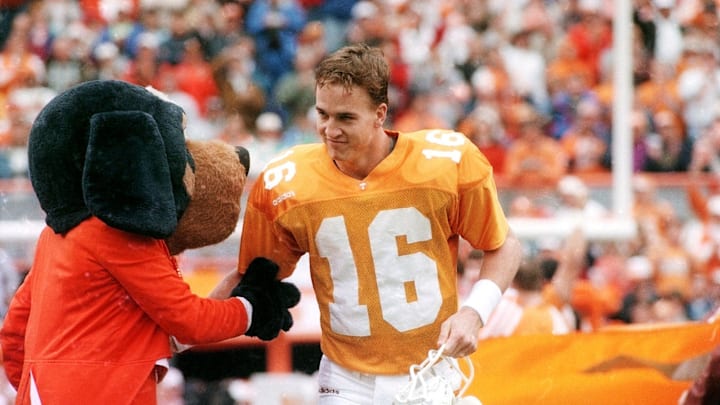
Peyton Manning—Returns to Tennessee in 1997, No. 1 pick to Colts in ‘98

When Peyton Manning stepped up to the microphone on March 5, 1997, conventional wisdom was that he would announce his departure from Tennessee for the NFL draft.
For the first minute or so of his announcement, it seemed to be going that way. Of course, Manning is famous for his sense of humor as well as his quarterbacking prowess, and had to know he was stringing the Vol faithful along, making them believe he’d depart for the draft—until he finally said that he would return to Knoxville for his senior season, leading to an explosion of applause in the room.
How it worked out for Manning
An unambiguous win. The likely No. 1 pick in the 1997 draft instead led Tennessee to an 11–2 season and its first SEC championship since ‘90. He would ultimately become the No. 1 pick in ‘98, going to the Colts. He won four of his five NFL MVP awards in Indianapolis, leading the franchise to a championship in Super Bowl XLI. He’d add another MVP and Super Bowl with the Broncos, closing an exemplary 18-year pro career.
Manning is a member of both the College and Pro Football Halls of Fame, a clear signal that he made the right call.
What if: Manning went to the Jets
New York held the No. 1 pick in the 1997 draft, and for a franchise that hasn’t had many true long-term starting quarterbacks in its history outside of Joe Namath and Ken O’Brien, it is hard to imagine them passing on Manning, who was rightfully viewed as a can’t miss prospect.
Former Jets cornerback Ray Mickens told ESPN’s Rich Cimini in 2016 that some believed that Manning’s father, Saints great Archie Manning, wanted his son to avoid the Jets and coach Bill Parcells.
“We were hoping he’d come out of Tennessee early in '97 because we all thought he’d be a Jet,” he said. “I’m still upset about that decision. I think we could’ve won a championship or two with that group of players. It was brutal, just brutal. There were a lot of conspiracy theories floating around. His dad orchestrated a lot of things, and some people think his dad didn’t want Peyton playing for [coach Bill] Parcells because Parcells was, quote-unquote, a quarterback killer. That was one of the conspiracy theories. People still ask me about that. It still hurts to this day.”
The elder Manning would, of course, help steer his younger son Eli to New York, with a draft-day trade to the Giants to avoid playing for the Chargers in 2004. San Diego would land another vaunted quarterback, Philip Rivers.
The Jets would ultimately trade down, swapping the No. 1 pick with the Rams for picks No. 6, 67, 102 and 207, and would then trade down two more spots with the Buccaneers, acquiring picks No. 8 and 104. St. Louis drafted legendary offensive tackle Orlando Pace with the top selection. The most notable player selected by New York with its array of picks from the would-be Manning slot turned into linebacker James Farrior (who would later become an All-Pro with the Steelers).
Manning’s college stats before and after draft decision
Year | Comp. | Att. | Comp. % | Pass Yards | TD | Int |
|---|---|---|---|---|---|---|
1997 | 243 | 380 | 63.9 | 3,287 | 20 | 12 |
1998 | 287 | 477 | 60.2 | 3,819 | 36 | 11 |
Matt Leinart—Returns to USC in 2005, No. 10 pick to Cardinals in ‘06

Matt Leinart had virtually nothing to prove after his 2004 season at USC. He was fresh off of a Heisman Trophy campaign and led the Trojans to a dominant win over Oklahoma in the BCS national championship, capturing the program’s second straight claimed national title. (USC was named the country’s No. 1 team by the AP and FWAA, while LSU won the BCS national championship game that season).
Leinart may have ultimately gone No. 1 had he declared for the 2004 NFL draft. Instead, he opted to chase history—a potential second BCS title and Heisman were achievements that could have given him claim to the title of greatest college quarterback ever.
Also, he just really enjoyed college.
“I realized the opportunity right now to support my family by going to the NFL early, but to me I think college football and this whole atmosphere here and being with my friends and my teammates ... is ultimately more satisfying and will make me happier than any amount of money could make someone happy,” he announced in January 2005, per the Associated Press.
SI VAULT: Leinart’s Last Dance
How it worked out for Leinart
The reigning Heisman winner had another strong season, finishing third in Heisman voting—his third year finishing in the top six—behind teammate Reggie Bush and Texas quarterback Vince Young, with whom his college career became inextricably linked after the Longhorns defeated the Trojans in the national championship at the Rose Bowl in one of the greatest college football games ever played.
While 2005 was still a very strong season for Leinart, he didn’t take the step forward that he likely hoped for when he returned to USC, and the draft evaluation process raised questions about his arm strength, footwork and mobility. Once seen as the favorite to go No. 1 in ‘05, Leinart fell to the Cardinals at No. 10 a year later and struggled in the pros, appearing in just 33 games with 18 starts across seven seasons with Arizona, the Texans and Raiders.
A similar slide could have popped up had Leinart entered himself into the ‘05 draft, given the physical concerns that front offices clearly had, but assuming that he would have gone No. 1 the year before, he likely cost himself significant guaranteed money on his rookie deal. Leinart went on to make $8.475 million across his NFL career; ‘05 No. 1 pick Alex Smith had cleared more than twice that amount by his second season.
What if: Leinart was picked No. 1 by the 49ers in 2005
Had Leinart entered the draft in 2005 as expected, it likely would have changed the complexion of the NFL for years to come.
That year’s draft became known for the two quarterbacks that dueled for the top spot with Leinart out of the picture—Utah’s Smith and Cal’s Aaron Rodgers. Smith was ultimately selected with the top pick by the 49ers while Rodgers, in a draft that did not feature many quarterback-needy teams towards the top of the first round, fell all the way to the Packers at No. 24. Smith was a late bloomer, eventually putting things together for San Francisco after a disappointing start to his career, before moving on to play his best football for the Chiefs from 2013 to ‘17. Rodgers became a Super Bowl winner and four-time MVP in Green Bay.
Even if Leinart hadn’t gone No. 1, his presence likely changes the tenor of the draft and Rodgers may not have been the pick for the Packers at No. 24.
Given Smith’s struggles early on with the 49ers, Leinart likely wouldn’t have fared much better and his NFL career may not have turned out much differently as the No. 1 pick in 2005, but he wouldn’t have minded the guaranteed money that came with being picked atop the draft.
Leinart’s college stats before and after draft decision
Year | Comp. | Att. | Comp. % | Pass Yards | TD | Int |
|---|---|---|---|---|---|---|
2004 | 269 | 412 | 65.3 | 3,322 | 33 | 6 |
2005 | 283 | 431 | 65.7 | 3,815 | 28 | 8 |
Sam Bradford—Returns to Oklahoma in 2009, No. 1 pick to Rams in ‘10

Sam Bradford’s 2008 season was truly one for the record books—4,720 yards, 50 touchdowns to just eight interceptions with another five scores on the ground. Oklahoma came up short of a second national championship for coach Bob Stoops, falling to Urban Meyer, Tim Tebow and Florida in the BCS national championship, 24–14.
Had Bradford elected to jump to the NFL after that sensational redshirt sophomore season, he was expected to be in the mix for the top of the draft, perhaps even the No. 1 pick. The Lions ultimately used that selection on another quarterback: Georgia’s Matthew Stafford. But like Leinart, he was not ready to end his college career prematurely.
“There’s no need to cut this experience short when I’m really looking forward to coming back and competing for a fourth straight Big 12 Championship and another opportunity for a National Championship,” said Bradford in January 2009, via News on 6.
How it worked out for Bradford
Unfortunately, the injury issues that came to define his pro football career began in 2009 with the Sooners.
Bradford played juyst three games for Oklahoma, suffering an AC joint sprain in the season opener against BYU, costing him three weeks, and re-aggravated it in mid-October. Shoulder surgery caused him to miss a fair amount of the pre-draft testing, but he still went No. 1 in the 2010 draft to the Rams.
He had some bright moments in the NFL, winning Offensive Rookie of the Year for St. Louis, but injuries continued to impact his career. He missed six games in 2011, nine games in ‘13 and the full season in ‘14, after which he was traded to the Eagles. He had a decent season in Philadelphia, but the team used the No. 2 pick in the 2016 draft on Carson Wentz, and on the eve of that season, Bradford was dealt to the Vikings, where he had the best full season of his career, completing a league-high 71.6% of his passes for a career-high 3,877 yards, 20 touchdowns and just five interceptions.
Bradford was hampered by a knee injury in 2017, and was ineffective in ‘18 with the Cardinals. He would play just five games over those final two seasons after the promising ‘16 campaign in Minnesota.
His injury at Oklahoma did not ultimately cost him in draft positioning, and given Stafford’s place in the 2009 draft class, Bradford might have boosted his stock a bit by returning. Ultimately, injuries hampered his career from that final college season, so it is unclear whether coming out in ‘09 rather than ‘10 would have made much of a difference.
Bradford made over $130 million across nine NFL seasons, per Spotrac.
What if: Bradford competed with Stafford for the No. 1 pick in 2009
Bradford was the more prolific passer in 2008, though the offense was better designed for him to put up monster numbers. He had 100 more pass attempts than Stafford did at Georgia. OU’s offense under coordinator Kevin Wilson ran 79 plays per game, to just 63.5 per game for Mark Richt and Mike Bobo’s Georgia offense.
Had the two gone through the combine together, Stafford’s remarkable arm strength likely wins out. Assuming he still went to the Lions at No. 1, Bradford could have been in the mix at No. 2 ... for the same St. Louis franchise that took him a year later. The Rams were coming off of a rough season for veteran quarterback Marc Bulger, and while they opted to draft Baylor offensive tackle Jason Smith, it isn’t a stretch to think that the same St. Louis brain trust that was happy to take Bradford off an injury in 2010 would have reached the same conclusion after his 50-touchdown season a year earlier.
In a world where the Rams passed on Bradford, there’s a chance he would have been taken at No. 5, the spot where the Jets traded up to take Mark Sanchez—yet another potential sliding doors moment involving the New York franchise that has been on a quarterback carousel for most of its existence.
Bradford’s college stats before and after draft decision
Year | Comp. | Att. | Comp. % | Pass Yards | TD | Int |
|---|---|---|---|---|---|---|
2008 | 328 | 483 | 67.9 | 4,720 | 50 | 8 |
2009 | 39 | 69 | 56.5 | 562 | 2 | 0 |
Andrew Luck—Returns to Stanford in 2011, No. 1 pick to Colts in ‘12

It was apparent from his time at Stanford that Andrew Luck was a different kind of athlete, so in January 2012, when he announced his return to Stanford for his redshirt junior season, it probably shouldn’t have been a major surprise—even though he was considered the heavy favorite to go No. 1 in the draft.
Luck was coming off of two excellent seasons as Cardinal starter, finishing as runner-up for the Heisman Trophy to Auburn’s Cam Newton in 2010.
Even so, Luck still had some classes left to finish out his degree, of course.
“I am committed to earning my degree in architectural design from Stanford University and am on track to accomplish this at the completion of the spring quarter of 2012,” Luck announced via statement.
How it worked out for Luck
Luck largely reached his potential on the field, making four Pro Bowls, eclipsing 4,000 yards four times in his career and leading the NFL with 40 touchdowns in 2014. Unfortunately, injuries stymied his career as he looked on pace to become one of the league’s truly elite quarterbacks.
After posting three consecutive 11–5 seasons with trips to the playoffs to begin his career, Luck missed nine games due to shoulder and kidney injuries in 2015. He returned and had a solid ‘16 season, but missed all of ‘17 with a shoulder injury. Luck was the comeback player of the year in ‘18, putting together one of the best seasons of his career with 4,593 yards yards and 39 touchdowns. It would prove to be his final year, as he abruptly retired ahead of the ‘19 season.
Now the general manager at Stanford, Luck doesn’t seem to have any regrets.
What if: Luck went No. 1 over Cam Newton in 2011
Following the 2010 college season, Newton was coming off of one of the greatest years in the sport’s history, though Luck was seen as the more traditional player at the position, and was the easier player to project to the NFL at the time, rightly or wrongly. The Panthers could have certainly stuck with Newton, but conventional wisdom is that Luck would have been the top pick had he come out a year earlier.
Looking back at that hypothetical 15 years later, with Luck and Newton’s careers both over, it seems like things worked out best for everyone involved. Newton wound up capturing an NFL MVP award and led Carolina to a Super Bowl appearance in 2015, and served as one of the most dangerous dual-threat quarterbacks in the league for much of the decade. Perhaps Luck would have achieved same heights with the Panthers, but that is far from a guarantee, as Newton’s supporting casts were far from elite during much of his tenure.
Had Luck bumped Newton out of the No. 1 spot in 2011, it could have led fascinating changes atop one of the most loaded drafts in recent memory. The Broncos selected franchise legend Von Miller at No. 2, but certainly could have used a generational quarterback with Tim Tebow starting most of that season. The same could be said of the Bills at No. 3—Alabama defensive tackle Marcell Dareus became an All-Pro for Buffalo, but it would be difficult to turn down the chance to take Newton, even with the popular Ryan Fitzpatrick under center.
The next team to take a quarterback after Carolina drafted Newton was the Titans at No. 8 (Jake Locker). It is hard to imagine Newton falling that far.
Had Luck come out a year early, Robert Griffin III might have slotted in as the top pick to the Colts in 2012. Does he suffer the same career-altering injuries with a team other than Washington to begin his career? It’s another fascinating scenario to think about.
Luck’s college stats before and after draft decision
Year | Comp. | Att. | Comp. % | Pass Yards | TD | Int |
|---|---|---|---|---|---|---|
2010 | 263 | 372 | 70.7 | 3,338 | 32 | 8 |
2011 | 288 | 404 | 71.3 | 3,517 | 37 | 10 |
Matt Barkley—Returns to USC in 2012, No. 98 pick to Eagles in ‘13

Barkley served as a four-year starter at USC, and was remarkably consistent throughout, topping out with an impressive 2011 junior year in which he finished sixth in Heisman voting, tossing for 3,528 yards, 39 touchdowns and seven interceptions. While he wasn’t expected to challenge Luck or Griffin at the very top of the draft, Barkley looked like a solid bet to go in the first round. Midway through the 2011 season, Sports Illustrated had Barkley at No. 5 player in the class.
But like Leinart (and Carson Palmer) before him, he enjoyed life as a Trojan a bit too much to leave early.
"I have firmly decided to forgo the NFL draft in 2012 and finish the unique journey I have started at USC," Barkley announced at the end of his junior season.
How it worked out for Barkley
Perhaps more than anyone else on this list, Barkley made a clear miscalculation in returning to USC, though that wasn’t immediately apparent. With 2013 considered a light year for quarterbacks, it felt relatively logical for Barkley to return and compete to be the No. 1 pick rather than slot in somewhere behind Luck and Griffin.
ESPN’s Mel Kiper Jr. and NFL.com’s Bucky Brooks were among the draft analysts projecting Barkley as the top pick ahead of his senior season.
Barkley posted solid numbers in 2012, but they largely dipped from his junior season. Most glaringly, his 15 interceptions were a career high, and he more than doubled his rate of picks from 1.6% to 3.9%. Barkley was more efficient (8.5 yards per attempt from 7.9 as a junior), though his adjusted yards per attempt number declined. He did not finish in the Heisman voting and was not an All-American after earning third-team honors the year before. Barkley also suffered a separated shoulder towards the end of the year that cost him the chance to finish out his USC career under center.
The injury, as well as some of the concerns presented by his senior season, saw him plummet all the way into the fourth round, despite being in a very weak quarterback draft. The Bills took EJ Manuel No. 16, the only quarterback to go in the first round. Barkley was also jumped by Geno Smith (No. 39, Jets) and Mike Glennon (No. 73, Buccaneers). Smith is the only QB of the entire class to come close to panning out, and that took years and multiple team changes.
Barkley’s career played out the way you’d expect for a fourth-rounder. From 2013 to ‘23, he had 13 different stints on rosters and practice squads with 11 different franchises, appearing in a total of 20 games. He went 2–5 in seven starts (six of which came with the Bears in ‘16), throwing for 2,699 total yards, 11 touchdowns and 22 interceptions. His last appearance came with the Jaguars in ‘23.
The financial loss that came from a perceived fall from the first round to the fourth was also significant, as Peter King wrote for SI after the 2013 draft (as shared by ESPN):
“P.S.: Wondering what that extra year of school cost Barkley? He went 98th overall. Let's say he'd have been the eighth pick a year ago -- that's where Ryan Tannehill went. It's all speculation, of course. But the consensus was he'd have been a top 10 pick. Tannehill's deal: four years, $12.7 million. The 98th pick last year, Ravens center Gino Gradkowski, signed for four years and $2.58 million. Turns out it was a $10.1 million year of school for Matt Barkley.”
Barkley finished with a career earnings of just over $10.6 million, per Spotrac.
What if: Barkley declared for the 2012 draft
He would not have dealt with the concerns about his shoulder injury, though the general issues with his play seemed to be the bigger issue when it came to Barkley’s draft stock. He also wouldn’t have had an up-and-down 2012 season of film, but front offices still inevitably would have prodded at concerns about his arm and footwork in the pocket.
It is very unlikely that he would have competed with Luck or Griffin, but would the Titans have taken him over Ryan Tannehill—a talented but green former wide receiver out of Texas A&M—at No. 8? The two were about as different of prospects as one can imagine. The next quarterback drafted was Brandon Weeden, a 28-year-old former baseball player, to the Browns at No. 22.
Even if he slid from the top five status that some ascribed to him during the 2011 season, Barkley likely would have found significantly more financial stability if nothing else, had he held on as a first-round pick coming off of a great season.
Barkley’s college stats before and after draft decision
Year | Comp. | Att. | Comp. % | Pass Yards | TD | Int |
|---|---|---|---|---|---|---|
2011 | 308 | 446 | 69.1 | 3,528 | 39 | 7 |
2012 | 246 | 387 | 63.6 | 3,273 | 36 | 15 |
Justin Herbert—Returns to Oregon in 2019, No. 6 pick to Chargers in ‘20

Justin Herbert looked like the prototypical 2020s NFL quarterback during his first three years at Oregon. The 6' 6" Ducks quarterback was athletic with a cannon of an arm, and was safe with the ball. There were questions about his accuracy and ball placement, but coming out of the 2018 season he was considered a likely first-round pick and potentially the No. 1 pick, with Heisman winner Kyler Murray—a 5' 10" jitterbug out of Oklahoma—as his main competition.
Instead, the Eugene, Ore. native opted to see his college career through. One day after Christmas 2018, with Oregon preparing for the Redbox Bowl against Michigan State, he announced his intention to return for the 2019 season.
“As we prepare for our bowl game, I would like to ensure that there are no distractions outside of this game,” Herbert wrote on X (then known as Twitter). “My commitment to my teammates, our coaches, Duck fans, and the University of Oregon has never been stronger. I'll be returning to the University of Oregon for my senior year.”
How it worked out for Herbert
So far, so good.
After he led Oregon to a Rose Bowl win to cap the 2019–20 college season, the Chargers took Herbert with the No. 6 pick in 2020, a move that paid immediate dividends as he took home the Offensive Rookie of the Year award that year. He’s gone on to make two Pro Bowls and is a total darling of the analytics-minded sect of NFL media members.
Herbert has succeeded despite inconsistency around him in Los Angeles. Coach Anthony Lynn was fired after his rookie year, and his replacement Brandon Staley was dismissed towards the end of 2023, his third year with the franchise, after the Chargers suffered one of the worst playoff collapses in NFL history against the Jaguars a year earlier.
L.A. still hasn’t found playoff success with Herbert under center, but the franchise should be on steadier ground with Jim Harbaugh wearing the headset. Herbert is certainly locked in as the franchise quarterback. He signed a five-year, $262.5 million contract extension ahead of the 2023–24 season.
What if: Herbert declared for the 2019 draft
Herbert may have competed with the aforementioned Murray to be the No. 1 pick in the draft. Murray was the far more productive college player, throwing for 4,361 yards and 42 touchdowns with another 1,001 yards and 12 scores on the ground during his Heisman season, while Herbert’s physical gifts translated more clearly to the next level.
If the Cardinals decided to stick with Murray at No. 1, Herbert likely slots right in at No. 6 with the Giants, who wound up taking a similar but less accomplished prospect in Duke’s Daniel Jones. The New York Post’s Giants reporter Paul Schwartz wrote with some certainty that Herbert would have been New York’s pick in this situation ahead of a 2021 Giants-Chargers matchup.
Instead, he was the No. 6 pick to Los Angeles a year later, and the Giants have been searching for answers at coach and quarterback ever since (though Jim’s brother John Harbaugh and rookie Jaxson Dart are a promising combination entering the 2025 season).
Chargers general manager Tom Telesco also said after the 2020 draft that Herbert had been Los Angeles’s top player on the board the year earlier, but the team didn’t pick until No. 28 in the ‘19 draft, so it would’ve required a huge move up in the draft to be in a position to take a top quarterback.
Herbert’s college stats before and after draft decision
Year | Comp. | Att. | Comp. % | Pass Yards | TD | Int |
|---|---|---|---|---|---|---|
2018 | 240 | 404 | 59.4 | 3,151 | 29 | 8 |
2019 | 286 | 428 | 66.8 | 3,471 | 32 | 6 |
The NFL draft is both art and science, and even the greatest coaches and front offices swing and miss on prospects, especially at the quarterback position. Some college superstar quarterbacks destined for NFL success turn out exactly the way analysts expect, like Manning. Others, like Leinart, Barkley and Ja’Marcus Russell, fail to cash in on their physical gifts or replicate their college success at the next level.
The same can be said for players looking to make the leap at the right moment. Typically, players make the leap, both to take advantage of the millions of dollars at stake, but also accelerate their timelines towards the lucrative second NFL contract. NIL has changed the equation a bit, with elite college quarterbacks able to make millions—even those without tremendous NFL upside. And yet, those who stayed in college for an extra year still work out at a pretty decent rate, especially if injury concerns aren’t factored in. Great players are great players, after all, and there isn’t a great replacement for the college football experience, even in its more commoditized and professionalized form.
More College Football on Sports Illustrated
Listen to SI’s new college sports podcast, Others Receiving Votes, below or on Apple and Spotify. Watch the show on SI’s YouTube channel.
 Add us as a preferred source on Google
Dan Lyons is a staff writer and editor on Sports Illustrated's Breaking and Trending News team. He joined SI for his second stint in November 2024 after a stint as a senior college football writer at Athlon Sports, and a previous run with SI spanning multiple years as a writer and editor. Outside of sports, you can find Dan at an indie concert venue or movie theater.