%20%20--%3E%0A%3Csvg%20version%3D%221.1%22%20id%3D%22Layer_1%22%20xmlns%3D%22http%3A%2F%2Fwww.w3.org%2F2000%2Fsvg%22%20xmlns%3Axlink%3D%22http%3A%2F%2Fwww.w3.org%2F1999%2Fxlink%22%20x%3D%220px%22%20y%3D%220px%22%0A%09%20width%3D%2239px%22%20height%3D%2240px%22%20viewBox%3D%220%200%2039%2040%22%20enable-background%3D%22new%200%200%2039%2040%22%20xml%3Aspace%3D%22preserve%22%3E%0A%3Cpath%20fill%3D%22%23FFFFFF%22%20d%3D%22M38.5%2C7H28.2v26h10.3V7z%22%2F%3E%0A%3Cpath%20fill-rule%3D%22evenodd%22%20clip-rule%3D%22evenodd%22%20fill%3D%22%23FFFFFF%22%20d%3D%22M26.1%2C25.5c0%2C5.8-4.1%2C7.5-12.9%2C7.5C3.9%2C33%2C0%2C31.2%2C0%2C25.2v-1.1h11.6%0A%09v2.4c0%2C0.7%2C0.1%2C1.4%2C1.2%2C1.4c1%2C0%2C1.2-0.4%2C1.2-1.3v-0.9c0-1.6-0.9-1.6-3.5-2.2C2.2%2C21.7%2C0%2C19.7%2C0%2C15.3v-0.9C0%2C9.3%2C5.5%2C7%2C12.9%2C7%0A%09c10.2%2C0%2C12.8%2C2.6%2C12.8%2C7.4v1.8h-11v-2.9c0-0.6-0.4-1.1-1.2-1.1c-0.6%2C0-1.2%2C0.4-1.2%2C1.1v0.9c0%2C1.5%2C0.9%2C2%2C3.3%2C2.5%0A%09c8%2C1.6%2C10.5%2C3.3%2C10.5%2C7.5V25.5z%22%2F%3E%0A%3C%2Fsvg%3E%0A)
How the Pac-12 Went From Near Extinction to a New Beginning
In this story:
Perusing the list of college athletic conferences that are no longer in existence ranges from the esoteric to the indelible.
Some recall some fond memories of the Metro Conference. Southwest Conference memorabilia still circulates around the state of Texas along with wistful stories from a bygone era. Look hard enough at some university trophy cabinets and you might find a few dusty relics from the Skyline Conference.
Back in August 2023, through a combination of self-inflicted errors, blind leadership, excessive hubris and a bit of presidential panic, the Pac-12 appeared poised to add its name to such an ignominious list. As dominoes continued to tip over following the stunning decampment of USC and UCLA to the Big Ten the prior summer, the conference of champions teetered on the doorstep of extinction as the league dwindled from a dozen schools down to just a pair.
Right on the precipice of signing a new grant of rights one Friday, the Pac-12 instead saw the bottom fall out from under it in less than 24 hours. Oregon and Washington joined the Trojans and Bruins in forming a western wing of the Big Ten. Colorado picked up an offer to return to the Big 12, which signaled it was time to follow suit for Utah, Arizona and Arizona State. Cal and Stanford eventually jumped on a power conference life raft from the ACC.
Things looked bleak for the bedrock of college athletics out West after more than a century in operation. That was especially so for those left behind as the tectonic plates of realignment shifted yet again.
“Things moved extraordinarily quickly. In retrospect, it feels like we should have seen it coming, but I don’t think anybody in the conference actually did leading up to that particular day,” Oregon State president Jayathi Murthy says. “In short order it was [Washington State] and OSU and I think about the place in which we found ourselves. There’s suddenly two members left in it, no media rights contract at all, no conference schedule coming up that fall. It’s all falling apart right in front of us.”
The NCAA allows for a two-year grace period for FBS conferences to meet the required minimum of eight member schools, which can seem like plenty of time to regroup and reassemble on the surface—but is far from it when it feels like a guillotine on a timer hanging above the head of the Cougars and the Beavers.
After the initial shock wore off and a bit of legal wrangling ran its course, leadership at the two remaining universities placed their hands fully on the wheel of control in the Pac-12 in an attempt to chart a path forward. Following an uneasy final football season with all 12 schools twinged with sadness, the beginning stages of a reboot were initiated.
Commissioner George Kliavkoff was let go in early 2024. The end of carrier agreements meant that the linear cable channels making up the Pac-12 Networks were taken offline. Conference office and in-house broadcast staff was slashed from more than 150 people to 30, eventually moving out of their longtime office space in downtown San Francisco.
There was little left but a name, a record book and a tiny bit of hope amid a fairly bleak situation.
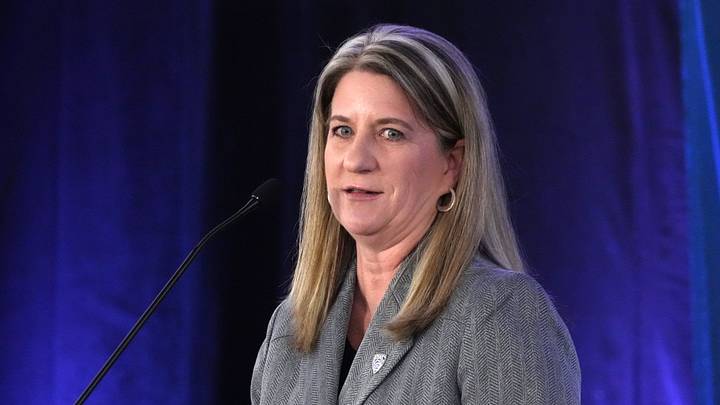
“You think about two years ago, I handpicked 30 people to jump on the Titanic with me,” Pac-12 commissioner Teresa Gould says. “When I got on a Zoom with them, I said, ‘I don’t know how long you’re going to have a job. I don’t know if this league is going to exist. I can’t promise you much, but I need help in this fight.’ ”
“The outrage and the anger and the grief was just about as multidimensional as you can possibly imagine. I don’t know that people from the outside understand,” Murthy says. “But superimposed on that is a very positive story of fighting it out—out of resilience and toughness and imagination and seeing ourselves through to the end.
“It brought home to me, as much as any event could have, how foundational athletics is to identity, to loyalty, to the emotions that people have about their college years.”
Armed with a bit of grit and what amounted to a war chest full of millions of dollars from NCAA tournament units, College Football Playoff revenues and the Rose Bowl among other sources, a rebuild was initiated in much the same way the Pac-12 was torn down—gradually, then suddenly.
A scheduling partnership with the Mountain West allowed Oregon State and Washington State to find a temporary home for many of their sports for 2024 which, a year later, proved to be contentious after the Pac-12 poached five members—Boise State, Colorado State, Fresno State, San Diego State and Utah State—to join the conference on July 1, 2026. Gonzaga came into the fold as a full member, without football, from the WCC as well.
Texas State joining as the ninth member opened up a new time zone and gave the league status as an NCAA automatic qualifying conference. Twelve affiliate members also signed on in several Olympic sports, including Dallas Baptist’s highly regarded baseball program and wrestling programs as far away as Northern Illinois.
Pac-12 Current Membership
School | Join Date |
|---|---|
Boise State | Joined July 1 |
Colorado State | Joined July 1 |
Fresno State | Joined July 1 |
Gonzaga | Joined July 1 |
Oregon State | Member since 1964 |
San Diego State | Joined July 1 |
Texas State | Joined July 1 |
Utah State | Joined July 1 |
Washington State | Member since 1962 |
“The Pac-12 brand, and the tradition and the legacy and the history, is still really meaningful in our industry. People, particularly in our region but really all over the country, I think have a great amount of excitement and admiration and respect for what we’ve been able to pull off in terms of salvaging the brand and taking that tradition and transforming it into something new and exciting,” Gould says. “We’re on some level a start-up while we’re still under this legacy brand. Seven of the members are new so everything is different, right? It’s a completely different league and a once-in-a-lifetime opportunity.
Indeed, what once was labeled the Titanic seems to be patched up and seaworthy even if the interior looks much different. Gould is in the process of doubling the league office’s head count to nearly 60 people by September in conjunction with the relaunch. The Pac-12 is also returning to Las Vegas for its men’s and women’s basketball tournaments and will hold both at the MGM Grand Garden Arena—a fitting spot where the conference first played postseason games a decade ago following a move from Los Angeles. Pac-12 Enterprises, the in-house production arm has proven to be a critical piece to the league’s future as a revenue-generation tool and benefited from retaining much of the infrastructure left behind from the former TV networks.
In May, new media deals were also signed with CBS Sports, USA Network and The CW. Though sources around the league tell Sports Illustrated the figures involved do not come anywhere close to what a power conference brings in, the trade-off is increased broadcast exposure in ways even former members would be impressed with. In contrast to the days where it was difficult to watch Pac-12 sports, every football game will be aired on over-the-air broadcast channels or easily available cable options. The men’s basketball championship game is set for a prime slot on CBS and nearly three quarters of games will be on either cable or broadcast.
There’s also an updated logo, borrowing many elements from the former one but with cleaner lines and a simplified look. It’s part of a familiar brand for fans but with plenty of new elements that are leading to optimism over the future.
“I think the conference has massive potential. We can do really innovative things. I think we can act fast on things, we can pivot quickly, we can choose our own path,” Utah State AD Cameron Walker says. “I think we have the potential to get in the mix with the Big East, basketball conference-wise. I think we have the potential to push and get in the mix with the American on the football side. If we can do both those things, a year from now, or two years from now, people are going to ask what is the best conference outside [the Power 4]?
“That can be us.”
Pac-12 Affiliate Members
School | Joined Pac-12 in This Sport |
|---|---|
Dallas Baptist | Baseball |
Cal Baptist | Men’s soccer, women’s swimming |
Cal Poly | Men’s soccer |
UC Riverside | Men’s soccer |
UC San Diego | Men’s soccer |
Southern Utah | Women’s gymnastics |
Air Force | Wrestling |
Northern Colorado | Wrestling |
North Dakota State | Wrestling |
Northern Illinois | Wrestling |
South Dakota State | Wrestling |
Parity is part of the way the new Pac-12 aims to achieve that.
Some of that is based on general talent as one of the best options for players in the western half of the country who either don’t have the ability to play at one of the Power 4 schools in the region or who are looking for a greater opportunity. Some of it is also based on money.
Though there are some slight outliers in terms of overall athletic budget and on general roster spend when it comes to NIL and revenue sharing—Gonzaga men’s basketball and Boise State football being two of the most cited examples by several coaches in the league—it’s notable that most of the schools making up the rebuilt conference are closely bunched together when it comes to what is actually being put on the field or on the court starting later this fall.
“There’s a lot of ambition in this group, a lot of perseverance,” Murthy says. “They want big things for themselves. You know we don’t have a bazillion dollars in our back pockets, but we are trying to build excellence with the resources we’ve got.”
“I think one of the unique things in our league is that, for example in football, anybody can win the league this year. I don’t see a bottom feeder. I don’t see somebody who is going to be absolutely dominant and set themselves apart. I wouldn’t be shocked if anybody won the league in this first year,” says Utah State deputy AD Ike Ukaegbu, who previously worked at Washington State. “That’s what’s exciting. Everybody has a chance and that’s not the case just in football, I think that’s the case in every sport.”
An equally open question is whether or not this is the final form for the Pac-12. Gould stressed that the conference would “never” stop thinking about schools which can add value moving forward and is keeping an open mind when it comes to further expansion.
Until then, the nine schools remain content with celebrating the relaunch of the Pac-12 and looking toward an optimistic future.
“At our staff meeting yesterday, I did a commissioner’s Q and A. One of the staff members asked, ‘What are you most excited about in this new league?’ I said handing out the very first Pac-12 trophy,” Gould says. “The last time I got to hand out a trophy, it wasn’t that pleasant to be honest. So this [upcoming one] feels a little bit different I can imagine.”
Gould will still have to wait until Oct. 30 when the conference hosts its men’s and women’s cross country championships. For her and others who have suffered through the near-death experience the Pac-12 has gone through the last few years however, it will certainly be worth it knowing that it will mark the next step in the league’s rebirth from the brink and back.
More College Football From Sports Illustrated
Listen to SI’s college sports podcast, Others Receiving Votes, below or on Apple and Spotify. Watch the show on SI’s College YouTube channel.
 Add us as a preferred source on Google
Bryan Fischer is a staff writer at Sports Illustrated covering college sports. He joined the SI staff in October 2024 after spending nearly two decades at outlets such as FOX Sports, NBC Sports and CBS Sports. A member of the Football Writers Association of America’s All-America Selection Committee and a Heisman Trophy voter, Fischer has received awards for investigative journalism from the Associated Press Sports Editors and FWAA. He has a bachelor’s in communication from USC.
Follow bryandfischer