%20%20--%3E%0A%3Csvg%20version%3D%221.1%22%20id%3D%22Layer_1%22%20xmlns%3D%22http%3A%2F%2Fwww.w3.org%2F2000%2Fsvg%22%20xmlns%3Axlink%3D%22http%3A%2F%2Fwww.w3.org%2F1999%2Fxlink%22%20x%3D%220px%22%20y%3D%220px%22%0A%09%20width%3D%2239px%22%20height%3D%2240px%22%20viewBox%3D%220%200%2039%2040%22%20enable-background%3D%22new%200%200%2039%2040%22%20xml%3Aspace%3D%22preserve%22%3E%0A%3Cpath%20fill%3D%22%23FFFFFF%22%20d%3D%22M38.5%2C7H28.2v26h10.3V7z%22%2F%3E%0A%3Cpath%20fill-rule%3D%22evenodd%22%20clip-rule%3D%22evenodd%22%20fill%3D%22%23FFFFFF%22%20d%3D%22M26.1%2C25.5c0%2C5.8-4.1%2C7.5-12.9%2C7.5C3.9%2C33%2C0%2C31.2%2C0%2C25.2v-1.1h11.6%0A%09v2.4c0%2C0.7%2C0.1%2C1.4%2C1.2%2C1.4c1%2C0%2C1.2-0.4%2C1.2-1.3v-0.9c0-1.6-0.9-1.6-3.5-2.2C2.2%2C21.7%2C0%2C19.7%2C0%2C15.3v-0.9C0%2C9.3%2C5.5%2C7%2C12.9%2C7%0A%09c10.2%2C0%2C12.8%2C2.6%2C12.8%2C7.4v1.8h-11v-2.9c0-0.6-0.4-1.1-1.2-1.1c-0.6%2C0-1.2%2C0.4-1.2%2C1.1v0.9c0%2C1.5%2C0.9%2C2%2C3.3%2C2.5%0A%09c8%2C1.6%2C10.5%2C3.3%2C10.5%2C7.5V25.5z%22%2F%3E%0A%3C%2Fsvg%3E%0A)
Indiana Created a Blueprint for an Impossible Turnaround. Now, Northwestern Is Building Even Bigger.
In this story:
As David Braun stood on the sideline late Friday night in Bloomington, Ind., watching time run out on Northwestern’s upset bid of Indiana, he couldn’t help but feel disappointed. Not at his team’s effort after the group rallied from an “absolutely awful” first half, in which they dug themselves into a 12-point deficit against the No. 5 team in the country. Not at his team’s resiliency after quarterback Aidan Chiles scored three touchdowns in four straight scoring drives to close the game and put the Wildcats back within one score of the Hoosiers each time.
He’s disappointed at the missed opportunity. “We felt like we were in the driver’s seat,” he says.
It’s been 67 years since Northwestern has won a game against an AP top-five opponent, the last such win coming in 1959 against Oklahoma. The drought continues.
Braun doesn’t want a moral victory. It’s antithetical to the “why not us” mantra that he used to signal his aspiration for Big Ten championships and College Football Playoff appearances this past August at Big Ten media days. But he does believe the 29–23 loss to the Hoosiers can instill confidence in his team. Confidence that Northwestern didn’t need lucky breaks to stay in a game against a national title contender. And still an acknowledgement that belief isn’t enough to win games.
“That confidence is false confidence if we think that almost beating the defending national champs on the road means we’ve got it figured out,” he says. “We’ve got a lot to work on if we want to achieve the things we want to achieve as a team.
“It’s time to get back to work.”

Indiana changed the fabric of what the college football world thought was possible when Curt Cignetti turned the losingest program in history into a national championship winner. It’s one of the most impressive turnarounds in any sport and has instantly injected hope into similar programs that anything is possible in the new landscape.
Any number of teams would fancy becoming “the next Indiana.” But none of them is as deep in college football’s basement as the Hoosiers were before the 2025 season. No team had more losses than Indiana—a whopping 715—entering that year. That is until the Hoosiers rattled off an undefeated season and redefined their legacy. Now a new lucky loser has the regrettable crown: a fellow Big Ten team that resides 244 miles to the northwest, fittingly enough.
Following Friday’s loss to the defending national champion, Northwestern has 718 losses, the most of any program in college football. That’s due in part to the historical record counting Wildcats’ games all the way back to 1876, making the program one of the longest running in the country. It’s also the product of extreme futility for long stretches of the team’s existence. Between joining the Big Ten as one of the league’s original members in 1953 to the end of the century, Northwestern had just nine winning seasons and two bowl game appearances (both losses) across 47 years. The Wildcats had more seasons (10) where they won one game or went winless.
That hasn’t stopped Braun and the new era of Northwestern leadership under athletic director Mark Jackson from dreaming big and aspiring for more. There’s an expectation the football program shouldn’t accept prolonged periods of disappointment anymore. And strides have been taken, from the opening of a state-of-the-art stadium to the hire of Chip Kelly as offensive coordinator to an influx of investment into the program for roster building. But Friday showed the Wildcats aren’t quite there yet.
“We’ve got a lot of momentum and there’s been a lot of growth,” Braun says. “Everyone should acknowledge and be proud of that. But let’s not fall into the trap that better is good enough.
“That’s what Curt [Cignetti] did a great job of. He came in and said, ‘No, we’re not messing around. We’re going to evaluate everything that touches our football program.’ They’ve not only approached it that way, but they’ve executed.”

Friday wasn’t the first time Braun and Cignetti had met. Neither was the 2024 matchup when Cignetti, in his first year with the Hoosiers, came to Evanston, Ill., and beat Northwestern by three scores. The two have familiarity from rising up the FCS ranks at the same time, so much so that Cignetti tried to hire Braun, not once, but twice.
Following the 2018 season, Braun traveled to Harrisonburg, Va., to interview for the Dukes’ vacant tight ends coach/special teams coordinator position. He opted instead to take the defensive coordinator job at North Dakota State, but Cignetti came knocking again a few years later. After NDSU beat JMU in the FCS national semifinal in 2021, Braun had conversations about becoming the defensive coordinator for the Dukes as they made the leap up to FBS in the Sun Belt. Braun says he and his wife, Kristin, wrestled with the decision but ultimately opted to continue with North Dakota State, which he says was a move that “worked out the way it was supposed to.” Bryant Haines, who was on the same staff with Braun at UC Davis in 2016, was bumped up to full-time DC at JMU and followed Cignetti to Indiana, where he’s become one of the most valuable assistant coaches in the country.
Braun is right to say that it worked out, even if the circumstances that led to him becoming Northwestern’s head coach were unpredictable and unorthodox. He was hired as the Northwestern defensive coordinator in January 2023, his first coaching gig at a Power 4 program, and was named interim head coach seven months later in July after the firing of Pat Fitzgerald. He won Big Ten Coach of the Year in his first season on the job, delivering an 8–5 record during a campaign when a black cloud hovered over the program.
Fast forward to 2026 and Braun has two winning seasons and two bowl victories across three years at the helm. His 21–19 record in his first 40 games is the best start ever for a Northwestern head coach. He signed an extension with the program earlier this month, which put him under contract through the 2031 season, just days before the Wildcats demolished Deion Sanders’s Colorado Buffaloes, 41–7.

Jackson, who arrived from Villanova in September 2024 ahead of Braun’s first season without the interim title, calls Braun a “dynamic leader” and in many ways “the CEO” of Northwestern football. What Jackson has seen over the past few years, particularly Braun’s ability to adapt to the ever-changing landscape and still stay competitive in recruiting and the transfer portal, was key in making the extension decision. Especially given the circumstances under which the then 38-year-old took over.
“I talk about resilience with Dave a lot, to inherit what was the darkest time in the history of the program that summer that he had to take over and how he held it together and was the Big Ten Coach of the Year …” Jackson says. “All of those things told me that we had the right guy.”
Evanston has become home for Braun, Kristin and their three sons. Braun was born in Lake Forest, Ill., and his parents are still just an hour-and-a-half away. He acknowledges it’s a cliche, but reflecting back, he called becoming the Northwestern defensive coordinator “a dream job.” He speaks earnestly in the power of college football to change lives and bring communities together, suggesting that being able to deliver that to Northwestern in a way that the school hasn’t seen since the 1995 team that played for a Rose Bowl is something that motivates him.
He’s also relentless about getting better. Even if that means admitting when he’s wrong.
One way in which Braun did that was to acknowledge that Northwestern’s offense wasn’t operating at a championship level. It wasn’t even close. Under Zach Lujan, Braun’s first offensive coordinator hire who came from South Dakota State, the Wildcats struggled to gain any traction offensively, finishing 128th and 94th in scoring over the past two years. Braun says staff changes are “by far” his least favorite part of being a head coach, but recognized that he had to live up to the championship standard he set out for the program.
“Too often people make changes just to make a change and say, ‘See? I changed something,’ ” Braun says. “And I went to Mark and said this needs to be transformational in terms of the way we operate offensively.”
Getting Kelly, fresh off of 11 games with the Raiders and a 2024 national champion as the OC at Ohio State, to come to Evanston was another task. Jackson’s connections, having grown up in the New England area and spending time in the NFL with the Patriots while Kelly was rising the coaching ranks at New Hampshire, were valuable in making an introduction. But Jackson gives all the credit to Braun for something actually coming together. The two flew out to Southern California to meet with Kelly and the connection between head coach and future OC was instant.

“All of the sudden they started talking football and I just kind of stepped back,” Jackson says with a laugh. “I could just feel there was a chemistry there and that we were onto something. On the flight back I was optimistic that we could get something done and that’s where Dave really took over and got into the weeds about how they were gonna align and what Chip was going to bring with him to help.”
That staff included key figures like fast-rising offensive mind Jerry Neuheisel as quarterbacks coach and a pair of other former Kelly assistants in offensive line coach Tim Drevno and tight ends coach Bob Bicknell. The staff was integral in enticing Chiles, a transfer from Michigan State, to join receiver Griffin Wilde and running back Caleb Komolafe to form the backbone of one of the most formidable Northwestern offenses of the century on paper.
The numbers thus far speak volumes. Since 2017, Northwestern hasn’t finished better than 93rd in scoring and 95th in yards per game, both of which came during the COVID-impacted 2020 season. Through three games under Kelly in ’26, the Wildcats rank 59th in scoring and 63rd in total offense. That small sample size is still in the bottom half of the Big Ten and not close to the offensive peak Northwestern hopes to hit, but it’s a significant step in the right direction.
Braun says Kelly dove in “full bore” on “all offense,” but has also been a key asset for him to lean on in improving as a head coach in all facets, and game management in particular. He references a specific late-fourth-quarter decision against Indiana to kick a field goal to cut the deficit to one score rather than keep an offense that had scored three straight touchdowns on the field. The decision almost paid off as Northwestern nearly recovered an onside kick and used the timeouts to try for one last stop before Indiana ultimately picked up the game-sealing first down. There was no hesitation from Braun in the game plan, because he was moving in lockstep with Kelly, a collaboration forged quickly in the opening stages of the season.

It takes security on Braun’s part to acknowledge what he doesn’t know and allow someone like Kelly, who has ample experience as a head coach and was one as recently as 2023, to step in and challenge the status quo. But it’s what the Northwestern coach believes is his biggest strength, being a “sound decision-maker” and putting those like Kelly and defensive coordinator Tim McGarigle in positions to be at their best.
“I know I’ve grown a lot over the course of the last three-and-a-half years,” Braun says. “I know I’m a better head coach today than I was even a year ago. But the trap I never want to fall into is thinking that I’ve got this figured out.
“I think the best leaders are willing to say, ‘I want to hire people that are smarter than me, that are better than me.’ And I think I’ve been fortunate to assemble a really, really good team on and off the field.”
Pat Ryan Jr. is tired.
Building a stadium is hard work and though Ryan is not one of the 1,100-plus workers who poured the concrete or installed the seats or rigged the electrical wiring for one of the two giant video boards hanging above each end zone, he’s obsessed over the details for much longer than the past 30 months of construction. As he shows off the $875 million creation, he sips on a Diet Coke poured over ice, and then pours another, joking that there’s been “a lot of late nights” in the buildup to the grand opening. It’s just after 9 a.m. in Evanston on Sept. 24—eight days until Northwestern plays its first game at the new stadium.
The Wildcats will open the new Ryan Field on Friday against Penn State, 100 years to the day that they opened its predecessor, originally named Dyche Stadium. That stadium was renamed Ryan Field in 1997 after Pat’s father.
The last name Ryan has become synonymous with Northwestern, with Pat Ryan Sr. spending the better part of the last 50 years contributing significantly financially to both academic and athletic pursuits, including the new stadium, and serving as a member of the board of trustees. Multiple buildings on campus bear the Ryan name, in addition to the main athletic facility, Ryan Fieldhouse, located on the shores of Lake Michigan on the north side of the campus.
Ryan Jr. is the chief developer and has spent the better part of the 2020s working to improve a venue that he admits “was long in the tooth.” He kicked the tires on a renovation, a common practice for college football stadiums, but found that the move was too pricey (around $300 million) for what the improvement would be (some premium seats, additional stands in the north end zone). That led to conversations with his father about the opportunity in front of them. This was the once-in-a-hundred-years chance they would get to build a stadium from the ground up.

“In a lot of ways we’re just bringing the football facility and stadium up to the level of everything else at the university,” Ryan Jr. says.
It’s become an all-encompassing project and understandably so. Jackson remembers being hired on a Wednesday and the first meeting of his Northwestern career was about the stadium on Friday. Not with the president. Not with Braun. But with Ryan Jr., about the new stadium.
While Northwestern has spent the last two seasons playing at a temporary venue on Lake Michigan that held just 12,000 fans, Ryan Jr. was working to both design and gain the necessary approval for the permanent home. With the opportunity to do something from scratch, with nothing left to preserve from the old Ryan Field also came the chance to do something different. Northwestern is the first Power 4 school to build a stadium from the ground up since Baylor and Houston in 2014. Before that was Minnesota in ’09.
“There’s a way you’re supposed to build the stadium …” Ryan Jr. says. “There is conventional wisdom in stadium design that we are bucking in a pretty significant way.”
Had a chance to tour the new Ryan Field this morning and will have some more thoughts/details in something I’m working on for @SInow, but a general overview: this place is the real deal. pic.twitter.com/hmP26a82TV
— Zach Koons (@ZachKoons) September 24, 2026
The result was an NFL-style creation, with a smaller capacity down to 35,000 from about 47,000, but over 500,000 square feet larger in area when including the fenced-in area directly around the stadium. A giant canopy covers every seat, which every fan will have instead of the custom college football bleachers, protecting the attendees from the elements, but preserving the feeling of November football in the Midwest.
But perhaps the most unique element isn’t the capacity, the smallest in the Big Ten by a significant margin. It’s that the new stadium will have “the intimacy of a basketball arena combined with the scale of the football stadium,” Ryan says. That’s the result of the worst seat in the stadium being just 136 feet away from the field. Renderings compare the new Ryan Field to the Clippers’ Intuit Dome or the Bulls’ United Center, instead of Notre Dame Stadium or Michigan Stadium. Ryan says the “paradox” of the stadium is that it can feel contained and intimate when up in the stands, but on the field, it still has a grandiose quality.
Northwestern’s new Ryan Field is bringing fans up close to the action 🏟️@PatRyanChicago breaks down the technology of @NewRyanField and how it reimagines the fan experience. pic.twitter.com/mNIUpKNz44
— Big Ten Network (@BigTenNetwork) December 12, 2025
As he shows off the stadium, still a construction site eight days before the Penn State game, Ryan maintains it’s just undergoing the finishing touches, but there will be tweaks made constantly in the coming months. He points out some of the details: murals for the 1948 and 1995 Rose Bowl teams, different clubs for young alumni and bigger spenders with signs that are declared as “home team respectful spaces,” the student section—dubbed the “Wildcat Wall” which has no seats, a feature borrowed from European soccer supporters’ sections. He’s reluctant to pick a favorite part: “That would be like choosing a favorite child.”
Ryan’s aware of criticism from “Twitter trolls” who suggest it looks like a soccer stadium, implying that it doesn’t suit the scale needed for a Big Ten college football stadium. He says he has to stop himself from engaging, from posting the Game of Thrones “You know nothing Jon Snow” meme in response. After all, he’s the one who’s spent countless hours thinking about this, mulling over the details with his team and then overseeing construction. He won’t let someone behind a screen change his mind. But he does know that, starting Friday, the world will tell him and Northwestern what it thinks.
“I joke with people, I say this is a very different stadium,” Ryan says. “And if we’re right then you’ll probably see echoes of it in other buildings at some point in the future. And if we’re wrong people will blame me.
“But we’ll also have the benefit of it being the only one of its kind.”
The stadium is ready to be opened. The head coach is secure. The offense is in the midst of its best season in a decade. In many ways the pieces of the puzzle have been gathered, but haven’t yet been assembled and can only be tied together by one group: the players.
Jackson acknowledges that the next area of focus is roster construction, and making sure Northwestern stays competitive as dollar amounts are spent nationally by football programs. Assembling a roster is a group effort in today’s college football landscape, with general managers working alongside coaches and athletic directors to make the necessary offers and negotiations to players, families and agents. The result has been an outsized importance on having a professional front office structure, one that Northwestern pivoted to by hiring Christian Sarkisian as general manager in the spring of 2025.
Northwestern football is in Sarkisian’s blood, with his grandfather, Alex, playing center and linebacker as a captain on the 1948 team that won the Rose Bowl. Christian spoke at his grandfather’s memorial which was hosted in the press box of the old Ryan Field, and listened to “old war stories" from former players who were a part of the golden era of football in Evanston. He gained an understanding of how integral Northwestern and the surrounding area was in the development of college football that we see today. But he also witnessed firsthand “the dark ages,” much like Ryan Jr., growing up as a fan after his father also went to Northwestern and watching the Wildcats go without a bowl win for 64 years.

That deep personal connection was part of what enticed Sarkisian to return to Northwestern after initially serving as the assistant director of player personnel during the Fitzgerald regime from 2015 to ’17. He then made the leap to the NFL, spending nearly seven years in the Bengals’ personnel department. He cut his teeth under longtime general manager Duke Tobin and was a part of the front office that led Cincinnati to two AFC championship game appearances during the 2021 and ’22 seasons.
Sarkisian admits that Northwestern, because of everything it gave his family, is the only college that could have taken him out of the NFL, but only if the school showed a commitment to acquiring the resources necessary to create a roster that could compete.
“You kind of do all your due diligence and checking your boxes and for me it was really apparent that I do have full faith that we can turn this place into a championship contending program,” he says. “And we need to become a lot more comfortable talking about that.”
That’s not to say that Sarkisian expects a blank check with which to work. The Athletic reported earlier this month that Northwestern is spending between $21 million and $25 million on a roster, approximately 10th in the Big Ten and just below the conference average, in league with Maryland, Michigan State and Washington. Jackson says that estimate is “in the ballpark,” while Sarkisian suggests it’s “an old report,” with neither willing to disclose specifics.
But Sarkisian emphasizes the importance of “minimizing the misses” and “doing the most with enough as opposed to needing to do more” when building a roster, whether that’s through high school recruiting, annual retention—a focus for Northwestern—or in the transfer portal.
“It’s not necessarily how much you’re spending, it’s how many of those dollars are on the field,” he says. “If there’s a team with a $50 million roster but 20 million of those dollars are tied up in players who aren’t performing or who are on the sideline, that’s really a $30 million roster.”
Sarkisian admits that the “enough” number is only going to increase, pending the outcome of the Protect College Sports Act which passed the Senate on Tuesday and now awaits a vote in the House of Representatives, so Northwestern has to increase its own output.
Over the summer, the program made national headlines when it landed one of its largest donations yet, announcing that the family of Elizabeth and Richard Uihlein, who co-founded the shipping company Uline and are the grandparents of former Wildcats linebacker Mac Uihlein, committed $35 million to the program over the next three years. Jackson says the gift inspired other donors to follow suit. Many of those conversations are ongoing, but there’s a certain level of excitement from big-money donors to get involved.

With an increased budget and more of a national spotlight landing on Evanston, particularly after the second-half rally against Indiana, there’s undoubtedly more pressure. And most of that’s self-imposed.
“I look forward to creating an environment where we go on the road against a top-five team in the country and lose and you don’t get people that pat you on the back and say, ‘Great effort,’ ” Braun says. “You guys played well. You guys fought hard.
“I look forward to creating an expectation that people are upset and they’re like, ‘Hey, can’t wait to see you guys bounce back next week.’
“I think sometimes people can write this story in their own mind where it’s like this victim mentality of, ‘We don’t have this and we don’t have that and it’s so hard.’ Or it could be like, ‘No, this is what we’re going after, here’s the challenge and let’s go attack it.’ ”
Northwestern has a chance to do exactly that with Penn State in town this weekend. The Nittany Lions are coming off of a second-half collapse to Wisconsin, riding the opposite wave of momentum of the Wildcats.

But Northwestern’s new era of leadership knows that momentum alone isn’t enough. Aspiring for a championship won’t be either. Indiana’s playbook from lovable losers to national champions isn’t replicable, at least not entirely. And even if it was, Northwestern doesn’t want to do it in the same way.
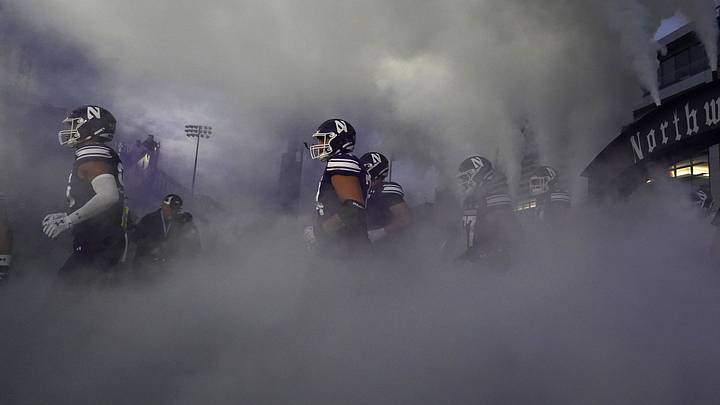
Braun will walk the sideline Friday at the new Ryan Field with Kelly by his side and Jackson, Sarkisian and a number of high-profile donors in attendance. It’s a culmination of how far Northwestern has come and a night for celebration.
The next part of the plan can be something the Wildcats learn from Indiana and Cignetti. Execute.
PODCAST: Listen to Sports Illustrated’s college sports podcast, Others Receiving Votes, hosted by Pat Forde, on Apple and Spotify. Watch the show on SI’s college YouTube channel or on SI TV.
 Add us as a preferred source on Google
Zach Koons is a programming editor at Sports Illustrated who frequently writes about Formula One. He joined SI as a Breaking and Trending News writer in February 2022 before joining the programming team in 2023. Koons previously worked at The Spun and interned for the Atlanta Journal-Constitution. He currently hosts the “Bleav in Northwestern” podcast and received a bachelor’s in journalism from Northwestern University.
Follow ZachKoons