%20%20--%3E%0A%3Csvg%20version%3D%221.1%22%20id%3D%22Layer_1%22%20xmlns%3D%22http%3A%2F%2Fwww.w3.org%2F2000%2Fsvg%22%20xmlns%3Axlink%3D%22http%3A%2F%2Fwww.w3.org%2F1999%2Fxlink%22%20x%3D%220px%22%20y%3D%220px%22%0A%09%20width%3D%2239px%22%20height%3D%2240px%22%20viewBox%3D%220%200%2039%2040%22%20enable-background%3D%22new%200%200%2039%2040%22%20xml%3Aspace%3D%22preserve%22%3E%0A%3Cpath%20fill%3D%22%23FFFFFF%22%20d%3D%22M38.5%2C7H28.2v26h10.3V7z%22%2F%3E%0A%3Cpath%20fill-rule%3D%22evenodd%22%20clip-rule%3D%22evenodd%22%20fill%3D%22%23FFFFFF%22%20d%3D%22M26.1%2C25.5c0%2C5.8-4.1%2C7.5-12.9%2C7.5C3.9%2C33%2C0%2C31.2%2C0%2C25.2v-1.1h11.6%0A%09v2.4c0%2C0.7%2C0.1%2C1.4%2C1.2%2C1.4c1%2C0%2C1.2-0.4%2C1.2-1.3v-0.9c0-1.6-0.9-1.6-3.5-2.2C2.2%2C21.7%2C0%2C19.7%2C0%2C15.3v-0.9C0%2C9.3%2C5.5%2C7%2C12.9%2C7%0A%09c10.2%2C0%2C12.8%2C2.6%2C12.8%2C7.4v1.8h-11v-2.9c0-0.6-0.4-1.1-1.2-1.1c-0.6%2C0-1.2%2C0.4-1.2%2C1.1v0.9c0%2C1.5%2C0.9%2C2%2C3.3%2C2.5%0A%09c8%2C1.6%2C10.5%2C3.3%2C10.5%2C7.5V25.5z%22%2F%3E%0A%3C%2Fsvg%3E%0A)
Pat Forde: The Big 12 Must Stop the Brendan Sorsby Scam Before It Engulfs College Football
In this story:
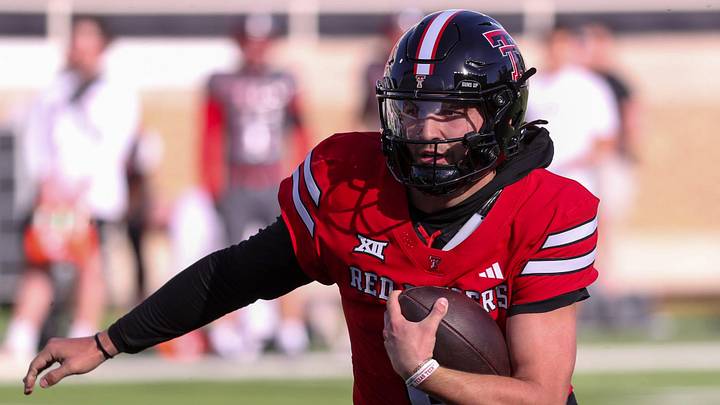
There are concentric circles of responsibility and accountability in the Brendan Sorsby fiasco. The two innermost circles failed. We’re on to the third now.
The first circle is personal accountability. Like many addicts, the Texas Tech quarterback didn’t seek help until he’d been caught in his addictive behavior, making thousands of impermissible wagers on sports. He was given direct, fair consequences for that—ineligibility to play college football. It wouldn’t have ended his football life, but it would have ended his college career.
Instead of accepting the consequences, he chose a legal end-around and found several enablers: big-dollar attorneys Jeffrey Kessler and Scott Tompsett, and a favorable judge in Lubbock District Court. This was Sorsby’s first big win since arriving at Tech in January (and continuing his impermissible wagering).
Sorsby entered rehab, and hopefully that will help him on the road to recovery—but it’s a long road, often marked by relapses and missteps. Will the star quarterback prioritize his mental health above everything else in his life, including playing football and getting paid for it? Will those around him prioritize his recovery?
Which brings us to the second circle—institutional accountability. Texas Tech cravenly failed in that area, tacitly supporting Sorsby’s lawsuit against the NCAA and issuing feeble justifications during and after the proceedings. The Red Raiders could have accepted a black-and-white, no-gray-area, completely uncontroversial ruling and sidelined Sorsby. But they don’t seem to care about the rules they helped vote into being. They don’t care that Sorsby violated the one unbreakable tenet in sports at any level—wagering on his own team. What ended Pete Rose’s baseball career became a blithely excusable peccadillo to Tech, because Tech wants to win football games this fall.
So we’re on to the third circle—outside entities that could rein in a scofflaw school. In terms of pertinence, that starts with the Big 12 Conference. This is the sweet spot. This is where sanctions could and should come forth.
My colleague Bryan Fischer suggested that the College Football Playoff intervene against Texas Tech. I don’t think that’s the proper route. The CFP is a neutral-party enterprise that has abstained from making judgments on anything other than what happens between the white lines, most notably with Michigan amid the Connor Stalions affair of 2023.
Rival conferences are advocating for a scheduling boycott of the Red Raiders. That’s entirely their prerogative, though it would be a rock fight in a glass village. While the Sorsby situation might be the lowest moment yet for college sports’ ability to govern itself, there aren’t many athletic departments that can claim the moral high ground—especially those who also have tried suing the NCAA in direct refutation of the established rules.
The Big 12 is different. This is a mess in its own backyard, and it has both the right and the obligation to force a cleanup. It has a duty to its entire membership, 1/16th of which is Texas Tech. Everyone else is furious at the Red Raiders, who have unashamedly gamed the system.
The league’s athletic directors met at a national conference Tuesday, which one participant described as “intense but professional.” The league’s executive board, comprising the presidents of Kansas, Kansas State and BYU, is scheduled to have what could be a momentous call with commissioner Brett Yormark this week. A full board meeting could come next week.
The entire conference is outraged by the Sorsby scam, to the point of contemplating radical action. Some athletic directors have suggested that league members shouldn’t play Texas Tech this season in football. Others have opined that any Tech victories in which Sorsby plays should not be counted in the conference standings. But 15 out of 16 schools seem to be aligned in favor of conference action against the Red Raiders if Sorsby plays in league games.
“Everyone was legitimately sympathetic to his addiction but felt there is no way he should compete this year in college football,” says one Big 12 athletic director.
“My belief is that something can and will be done,” says another league AD.
Admittedly, this is a scorching hot potato for Yormark to handle. Since taking over the job in 2022 and declaring the Big 12 “open for business,” his tenure has been marked by aggressively pushing to enhance revenue streams, championing the league’s power-conference credentials and chasing national championships. Significantly penalizing the defending football champion and 2026 favorite runs counter to all those things.
An outright boycott of playing Tech would likely violate the league’s media-rights agreements, which would not go over well with its media partners. For a conference playing catchup in the revenue race, taking nine games out of its contracted TV inventory sounds like a nonstarter. Nor would ducking Tech help Big 12 teams seeking quality wins.
But declaring all Big 12 games in which Sorsby plays a Texas Tech forfeit? That could be on the table. The league has rather wide disciplinary discretion, per its bylaws, which allow for sanctioning members via a supermajority vote. Eight years ago, the Big 12 fined member Baylor $2 million for “reputational damage” to the conference after a sexual assault investigation cast a shadow over the Bears under former coach Art Briles.
This would be different than taking a school’s money, of course. It would be taking away a potential College Football Playoff season. In terms of a direct hit on a team’s competitiveness, the closest comparison would be the Big Ten suspending Michigan coach Jim Harbaugh for the final three games of the 2023 regular season.
The Wolverines won all three and went on to claim the national championship. But sidelining a star quarterback would likely have a bigger impact on a team’s season than taking out the head coach for three Saturdays.
Tech being Tech, it is already rattling its litigation saber over the possibility of league sanctions, according to Yahoo Sports. “School representatives are actively exploring potential legal action not only against the league itself but individual conference universities whose officials claim they would not play the Red Raiders,” Yahoo reported.
Whether the university has lost its soul or simply abdicated all power to billionaire booster and system disruptor Cody Campbell is unclear at this point. But Texas Tech’s attempts to money-whip and lawyer-whip the rest of college sports has gone from cheeky to crass to repugnant. This is not the Red Raiders pushing the envelope; this is shredding the envelope, throwing it away and daring anyone to call them on it.
If Tech is comfortable wearing this embarrassment, fine. But where personal and institutional accountability fail, others can step in.
The rest of the league is not going to stand by passively and watch it happen. The Big 12 has a chance to not just call out the Red Raiders, but to stop the scam.
More College Football From Sports Illustrated
Listen to SI’s college sports podcast, Others Receiving Votes, below or on Apple and Spotify. Watch the show on SI’s College YouTube channel.
 Add us as a preferred source on Google
Pat Forde is a senior writer for Sports Illustrated who covers college football and college basketball as well as the Olympics and horse racing. He cohosts the Others Receiving Votes podcast for SI and is a regular contributor to the Tony Kornheiser Show podcast. He previously worked for Yahoo Sports, ESPN and The (Louisville) Courier-Journal. Forde has won 28 Associated Press Sports Editors writing contest awards, has been published three times in the Best American Sports Writing book series, and was nominated for the 1990 Pulitzer Prize. A past president of the U.S. Basketball Writers Association and member of the Football Writers Association of America, he lives in Louisville with his wife. They have three children, all of whom were collegiate swimmers.
Follow ByPatForde