%20%20--%3E%0A%3Csvg%20version%3D%221.1%22%20id%3D%22Layer_1%22%20xmlns%3D%22http%3A%2F%2Fwww.w3.org%2F2000%2Fsvg%22%20xmlns%3Axlink%3D%22http%3A%2F%2Fwww.w3.org%2F1999%2Fxlink%22%20x%3D%220px%22%20y%3D%220px%22%0A%09%20width%3D%2239px%22%20height%3D%2240px%22%20viewBox%3D%220%200%2039%2040%22%20enable-background%3D%22new%200%200%2039%2040%22%20xml%3Aspace%3D%22preserve%22%3E%0A%3Cpath%20fill%3D%22%23FFFFFF%22%20d%3D%22M38.5%2C7H28.2v26h10.3V7z%22%2F%3E%0A%3Cpath%20fill-rule%3D%22evenodd%22%20clip-rule%3D%22evenodd%22%20fill%3D%22%23FFFFFF%22%20d%3D%22M26.1%2C25.5c0%2C5.8-4.1%2C7.5-12.9%2C7.5C3.9%2C33%2C0%2C31.2%2C0%2C25.2v-1.1h11.6%0A%09v2.4c0%2C0.7%2C0.1%2C1.4%2C1.2%2C1.4c1%2C0%2C1.2-0.4%2C1.2-1.3v-0.9c0-1.6-0.9-1.6-3.5-2.2C2.2%2C21.7%2C0%2C19.7%2C0%2C15.3v-0.9C0%2C9.3%2C5.5%2C7%2C12.9%2C7%0A%09c10.2%2C0%2C12.8%2C2.6%2C12.8%2C7.4v1.8h-11v-2.9c0-0.6-0.4-1.1-1.2-1.1c-0.6%2C0-1.2%2C0.4-1.2%2C1.1v0.9c0%2C1.5%2C0.9%2C2%2C3.3%2C2.5%0A%09c8%2C1.6%2C10.5%2C3.3%2C10.5%2C7.5V25.5z%22%2F%3E%0A%3C%2Fsvg%3E%0A)
Pat Forde: The 25 Most Intriguing College Football Quarterbacks for 2026
In this story:
Back by popular demand—or perhaps force of habit—it’s time for the annual college football Most Intriguing Lists. Last week we had the most intriguing coaches. This week, the 25 most intriguing quarterbacks:
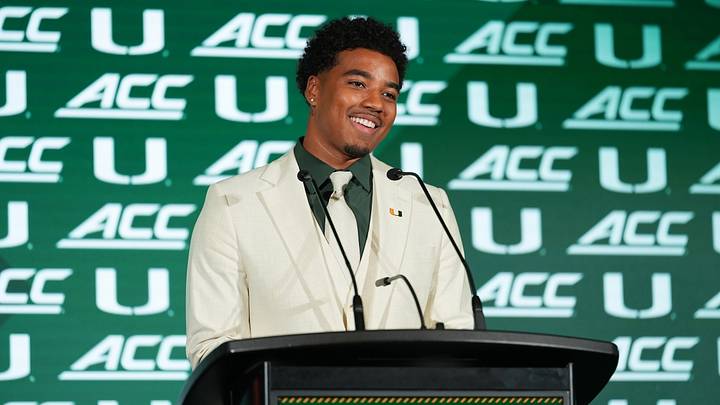
1. Darian Mensah, Miami
It’s now an annual tradition for the Hurricanes to make a splash portal move at quarterback—see: Cam Ward, Carson Beck. But this one had the biggest ripple effect. It was a late raid of an ACC rival (Duke) that thought it had its star QB locked up for 2026, and the resulting furor included the Blue Devils suing Mensah for breach of contract. They settled out of court a week later, as Miami remains on a winning streak in the realm of snatching players who are under questionably binding contracts elsewhere (Xavier Lucas last year from Wisconsin). Modestly regarded out of high school, Mensah put up spectacular numbers in his first two college seasons, with 56 touchdown passes, 12 interceptions and nearly 6,700 air yards at Tulane and Duke. He walks into a loaded offense at The U.
2. Arch Manning, Texas
Last year, the question was whether Manning could elevate the Longhorns to championship status. This year, the question is whether the Horns’ new offensive personnel can elevate Manning’s play to that level. Arguably the most ballyhooed recruit ever as a third-generation Manning QB, Arch was at times painfully unprepared to be a savior in 2025, which led to an eruption of overheated takes. But he got better as the season went along, and is now surrounded by a flush hand of skill players. “What he got put through probably would have melted or destroyed 99% of people in his shoes,” coach Steve Sarkisian said. Will the scar tissue facilitate growth into a true star? Answers start arriving in earnest Sept. 12 against Ohio State.
3. Trinidad Chambliss, Mississippi
Even Fernando Mendoza was not as profound a revelation last season as Chambliss, a Division II transfer who began the year as a backup and ended it slinging the Rebels into the College Football Playoff semifinals. Chambliss then made news in two major offseason developments—spurning a chance to follow former Ole Miss coach Lane Kiffin to LSU in the divorce of the century, and gaining an extra year of eligibility via the courts. With a guy who produced nearly 4,500 yards of total offense with a 0.7% interception rate back under center, the Rebels are a preseason top 10 team. The only looming question is how well Chambliss meshes with new offensive coordinator John David Baker, after a productive partnership with Charlie Weis Jr.
4. Josh Hoover, Indiana
The track record for new QBs coached by Curt Cignetti and offensive coordinator Mike Shanahan is that they have a career year. Mendoza and Kurtis Rourke did it at Indiana, and everyone they coached at James Madison did it, too. Hoover, who has already shown steady progress over three seasons at TCU, could really be something if the Cignetti pattern holds. The product of Heath, Texas, is the leading active passer in FBS, with more than 9,600 air yards and 79 total touchdowns. If Indiana is functioning well offensively, Hoover might be tasked with doing less and taking care of the ball more (33 career interceptions is not a Cig-friendly number). If so, his efficiency rating could take a Mendoza-esque leap forward from good to great.
5. Will Hammond, Texas Tech
The Brendan Sorsby Era That Never Was at Tech will apparently default to the Hammond era, provided his surgically repaired knee is ready to go. Hammond was a highly functional backup last year to Behren Morton on a Big 12 championship team, and was in position to fill the same role behind Sorsby until the Cincinnati transfer’s gambling scandal ended his college career. The well-bankrolled Red Raiders have assembled a roster with as much talent as almost anyone in college football—but the quarterback question looms large. Tech is hopeful that Hammond will be ready for the season opener, but if need be it could win with a backup for two weeks before hosting Houston on Sept. 18.

6. Bryce Underwood, Michigan
Much of what drew the No. 1 QB recruit in the class of 2025 to Ann Arbor is gone after one season, except the proximity to his Detroit home and the NIL money. But a reboot under a better head coach (Kyle Whittingham) and offensive coordinator (Jason Beck) could make for a quantum leap forward from a fairly cautious first year of college. Underwood averaged 24 pass attempts and six runs per game in the regular season, and was just 13th in the Big Ten in combined passes and runs during conference play. If training wheels were on, it’s time to take them off for ’26—especially with some key returnees at running back and receiver, plus Utah transfer JJ Buchanan at tight end. Time to let all his talent shine.
7. Alabama starter
In the portal era, there aren’t many intriguing preseason camp QB battles. The Crimson Tide have a rare one, and a good one, between two Ty Simpson backups—Austin Mack and Keelon Russell. Mack has been with Kalen DeBoer since Washington went to the 2023 national championship game, appearing in five college games. At 6'6" and 235 pounds, he’s the bigger of the two and the more experienced in the DeBoer/Ryan Grubb offense. Russell, who was the No. 2 QB nationally in the recruiting class of 2025, played in two games last season. At 6'3" and 194 pounds, he’s the more athletic of the two and probably has the higher upside. DeBoer may let the starter call go deep into camp before the program starts a high-pressure season.
8. Sam Leavitt, LSU
Leavitt had quite a tumultuous portal experience last winter. He was tagged as one of the top QBs in the market coming out of Arizona State when his name showed up in the portal in early January, with LSU a likely landing spot, but musical chairs and contract machinations had him looking at Miami, Tennessee and Kentucky. When Washington’s Demond Williams Jr. popped into the portal with an expected move to LSU while Leavitt was sitting courtside at a Tigers basketball game with Lane Kiffin, things reached peak awkwardness. But Williams stayed in Seattle and LSU eventually landed Leavitt. The brash, competitive QB is recovered from lisfranc surgery and now has to prove he can get back to 2024 efficiency.
9. Jaden Craig, TCU
Harvard grad ends up a Horned Frog—not a storyline you come across very often. Craig lit up the Ivy League the last two seasons, throwing 48 touchdowns in 21 games to lead the Crimson to the FCS playoffs for the first time. (Ivy League teams had historically declined postseason bids.) It’s a leap up to Power 4 FBS football, but Craig had the physical tools to win the starting job in Sonny Dykes’s always productive offense. But as would be expected for the son of a pediatrician and grandson of an anthropology professor, Craig’s biggest strength might be his mental game. If Bill Belichick is the prime story of the TCU–North Carolina opener in Dublin, Craig will be a strong second.
10. John Mateer, Oklahoma
No quarterback has had his muscles discussed this much since Tim Tebow. Pictures (inevitably shirtless) of a ripped Mateer popped up throughout the summer, testifying to hard work in the weight room while also spurring debate about whether a good QB should look like a linebacker. The dual-threat improvisor will need more than muscles to elevate his play this season. After arriving as a big portal catch last year, Mateer’s performance was up and down, diminished by an injury to the thumb on his throwing hand and some YOLO decision making. Oklahoma won games late in spite of its offense, not because of it. His 14-touchdown, 11-interception ratio has to improve this year.

11. Dante Moore, Oregon
His college career has been a study in patience, a rare modern commodity. After starting as a true freshman at UCLA, he transferred into a backup role at Oregon behind veteran Dillon Gabriel. Then, after starting last year and leading the Ducks to the CFP semifinals, Moore ignored a top-five draft grade to play one more season of college ball. He has room to grow in terms of pre-snap reads and pocket awareness—a pick-six and two strip sacks contributed heavily to Oregon’s blowout playoff loss to Indiana—but he’s still the most pro-ready prospect in college. Under a new coordinator, Moore will try to lead the Ducks to their first national title.
12. CJ Carr, Notre Dame
Appreciate what the grandson of Lloyd Carr did last season—he went from zero college pass attempts to the single-season efficiency record (168.06) at a school that has had a few capable quarterbacks. He’s a security blanket for head coach Marcus Freeman and offensive coordinator Mike Denbrock, who had first-year Fighting Irish starters in each of the previous three seasons. Carr will likely have to sling it around more this season after the departure of two first-round NFL running backs, which he’s capable of doing and should welcome. “Anything you do that’s competitive, if he doesn’t win, he’s going to tell you, ‘Let’s play again,’ ” says linebacker Drayk Bowen. “And he’s going to do it until he wins.”
13. Julian Sayin, Ohio State
He was polished and productive beyond expectations for a first-year starter, so much so that he became a Heisman Trophy finalist. Truth be told, there also wasn’t a lot of stress on Sayin for an 11-game stretch between the opener against Texas and postseason games against Indiana and Miami. Against those three opponents, all with high-level defenses, Sayin’s efficiency dropped to 138.41, compared to his full-season mark of 177.46. Some of that could be attributed to a running game that broke down late, but the Buckeyes also left some big plays on the table with elite wideouts Jeremiah Smith and Carnell Tate. “It’s going to be better than last year,” Smith says of his chemistry with Sayin. “It’s going to be pretty special.”
14. Alberto Mendoza, Georgia Tech
Mendoza the Younger was part of a compelling family story within Indiana’s larger epic season. The fact that Alberto was on the Indiana roster—after committing to Cignetti at James Madison—helped bring big brother Fernando to Bloomington, and the rest is history writ large. But there was no firm succession plan for Alberto at Indiana, with the Hoosiers grabbing Hoover in the portal from TCU. Mendoza relocated to Tech, where he beat out the competition in the spring to establish himself as the starter against a schedule that opens with two Power 4 opponents (Colorado and Tennessee). He’s three inches shorter than Fernando but possesses a similar high-level intellect.
15. Rocco Becht, Penn State
The winningest active QB in FBS starts? None other than Becht, with 26. The Iowa State transfer was at the controls of that super-steady operation for three seasons, finding ways to win where the margins are slim. (The Cyclones were 12–7 in one-score games with Becht, the son of former NFL tight end Anthony, as the starter.) He’s generously listed at 6'1", but has thrown for more than 9,200 yards and provides the leadership qualities Matt Campbell was looking for in getting his program started in State College. “He’s as tough and as competitive as any football player I’ve ever been around,” Campbell said.

16. Drew Mestemaker, Oklahoma State
The wholesale relocation of North Texas’s coach and top talent to Stillwater will be one of the most interesting storylines of the season in the Big 12. Eric Morris stole everything but the last speck of Who Hash from Denton, with Mestemaker the headliner. He had an explosive redshirt freshman season for the Mean Green, leading the nation in passing yards (4,379) while throwing for 34 touchdowns. His interceptions tended to come in bunches, with three each against South Florida and Tulane—the latter in the American Conference title game. But his personal ceiling is as high as the expectations for a Cowboys turnaround this season.
17. The freshmen in the Volunteer State
Vanderbilt and Tennessee landed the Nos. 2 and 3 quarterbacks in the class of 2026, respectively—and both might start from Day 1. Jared Curtis of Nashville decommitted from Georgia to stay home, an unprecedented recruiting coup for the rising Commodores. Meanwhile the Volunteers landed Faizon Brandon from North Carolina, beating out several other powers. From a talent perspective, Brandon faces the stronger competition in fellow five-star QB George MacIntyre, who played in two games last season. Curtis is competing against veterans who saw spot duty backing up Heisman runner-up Diego Pavia. If the Commodores and Vols go with the freshmen, it can be soft launched—they both open against FCS opponents and have star running backs to take the burden off the QBs.
18. Demond Williams Jr., Washington
He had a good sophomore year. He agreed to a new contract. Then he was leaving for LSU. Then he was in the crosshairs of a potential legal dispute. Then he was staying. Now all is well in Seattle, according to coach Jedd Fisch: “As good of a player as Demond is, his leadership is even better, the way he has commanded our locker room. He is now leading this group in a very special way.” He’s an elite athlete, capable of breaking ankles and making rushers miss, but he’s capable of making big-time throws as well. At a listed 5'11", his highest earning potential might be in college, so Williams might play two more years at that level before attempting an NFL career.
19. Byrum Brown, Auburn
He’s the dual-threat king of college football, leading the nation with 4,166 total yards last year and nearly 10,000 in his career despite missing half the 2024 season due to injury. And if you’ve watched the Tigers flail around in search of dynamic quarterback play the last few years, you know how welcome Brown’s productivity is on The Plains. He turned down overtures from several programs to come from South Florida with coach Alex Golesh, who expects Brown to transition smoothly to the SEC. “Byrum Brown represents everything that’s right about Auburn football and the identity that we’re building,” Golesh said.

20. The L.A. guys
Both UCLA amd USC have productive returning quarterbacks leading teams brimming with optimism—Nico Iamaleava of the Bruins and Jayden Maiava of the Trojans. Iamaleava was always expected to be a power-program star, going back to his big-dollar recruitment at Tennessee as the No. 2 QB in the 2023 class behind Manning, and is still in the process of living up to it. Maiava began his career at UNLV as a three-star 2022 recruit who quickly demonstrated an ability to move up a level. Maiava has the superior offensive line to play behind—but also much higher expectations. Iamaleava is trying to get the Bob Chesney era at UCLA off to a good start after the dismal DeShaun Foster tenure.
21. Noah Fifita, Arizona
This is your active career leader in touchdown passes with 73 and is third in passing yardage with 9,183. He’s the human bridge between the Fisch and Brent Brennan eras, and his play last season helped solidify Brennan and keep the Wildcats viable in the Big 12. Fifita proved himself as more than a product of star wide receiver Tetairoa McMillan’s prowess in 2025, throwing for more than 3,200 yards and 29 touchdowns. Brennan and Arizona have been banging the drum for Fifita as a Heisman candidate; he can justify that by putting the Wildcats in the league title chase. First major opportunity: at BYU on Sept. 12.
22. Jaron-Keawe Sagapolutele, California
The biggest Power 4 retention win in the portal might have been new coach Tosh Lupoi hanging on to Sagapolutele, whose verve as a freshman enlivened the post-Mendoza Cal offense. JKS had 300-yard passing games in ACC-altering upsets of Louisville and SMU, throwing six touchdowns and no interceptions in those games. The Hawaiian has considerable room to grow and improve, but it remains to be seen how good his supporting cast will be at the skill positions. (Offensive line looks solid.) A lot will be known quickly, with September games against former Pac-12 rival UCLA and ACC opponents Clemson and Syracuse.
23. Avery Johnson, Kansas State
Things started inauspiciously last season, when the Wildcats lost in Ireland to Iowa State and two of Johnson’s family members brawled in a puddle afterward. It did not get appreciably better from there, with the Wildcats finishing 6–6 and Johnson’s stats declining year over year. Maybe a coaching change will keep this from being a Cade Klubnik/Drew Allar/etc. cautionary tale of a promising QB whose career seems to diminish instead of progress. The arrival of a guy who knew how to run a dual-threat offense at K-State, Collin Klein, offers optimism—if Johnson can continue to progress in his reads and decisions.
24. Kamario Taylor, Mississippi State
Among all the college quarterbacks on hand, Manning Passing Academy visitors in June came away raving about Taylor—both his physical gifts and personality. The biggest recruiting coup of the thus-far-feeble Jeff Lebby era was a change-of-pace substitute as a true freshman most of the season for the Bulldogs, largely utilized as a running threat. Then he was unveiled as a secret weapon of sorts in the Egg Bowl and a bowl game against Wake Forest, with promising results. In those two games Taylor produced 565 yards total offense and four touchdowns, whetting the appetite for what he can do as a full-time starter.
25. Brad Jackson, Texas State
The biggest non–Power 4 portal win over the offseason was the Bobcats holding on to a quarterback with three years of eligibility remaining who finished seventh nationally in pass efficiency while producing 3,700 yards total offense and 34 touchdowns. Jackson (and some of his teammates) had options, but chose to remain in San Marcos, nurturing dreams of a new-look Pac-12 title and potential Group of 6 CFP bid. By all accounts Jackson is picking up where he left off. “He’s going through the reads faster than I am,” said head coach G.J. Kinne, a former quarterback. There is an immediate shock-the-world opportunity with the Bobcats opening at Texas.
Just missed the list: Kevin Jennings, SMU; Bear Bachmeier, BYU; LaNorris Sellers, South Carolina; DJ Lagway, Baylor; CJ Bailey, North Carolina State; Aaron Philo, Florida; Ethan Grunkemeyer, Virginia Tech; Gunner Stockton, Georgia; Julian Lewis, Colorado; Marcel Reed, Texas A&M; Conner Weigman, Houston; Lincoln Kienholz, Louisville; Devon Dampier, Utah; Billy Edwards Jr., North Carolina; Anthony Colandrea, Nebraska; Nick Minicucci, Delaware.
Listen to SI’s college sports podcast, Others Receiving Votes, below or on Apple and Spotify. Watch the show on SI’s College YouTube channel.
 Add us as a preferred source on Google
Pat Forde is a senior writer for Sports Illustrated who covers college football and college basketball as well as the Olympics and horse racing. He cohosts the Others Receiving Votes podcast for SI and is a regular contributor to the Tony Kornheiser Show podcast. He previously worked for Yahoo Sports, ESPN and The (Louisville) Courier-Journal. Forde has won 28 Associated Press Sports Editors writing contest awards, has been published three times in the Best American Sports Writing book series, and was nominated for the 1990 Pulitzer Prize. A past president of the U.S. Basketball Writers Association and member of the Football Writers Association of America, he lives in Louisville with his wife. They have three children, all of whom were collegiate swimmers.
Follow ByPatForde