%20%20--%3E%0A%3Csvg%20version%3D%221.1%22%20id%3D%22Layer_1%22%20xmlns%3D%22http%3A%2F%2Fwww.w3.org%2F2000%2Fsvg%22%20xmlns%3Axlink%3D%22http%3A%2F%2Fwww.w3.org%2F1999%2Fxlink%22%20x%3D%220px%22%20y%3D%220px%22%0A%09%20width%3D%2239px%22%20height%3D%2240px%22%20viewBox%3D%220%200%2039%2040%22%20enable-background%3D%22new%200%200%2039%2040%22%20xml%3Aspace%3D%22preserve%22%3E%0A%3Cpath%20fill%3D%22%23FFFFFF%22%20d%3D%22M38.5%2C7H28.2v26h10.3V7z%22%2F%3E%0A%3Cpath%20fill-rule%3D%22evenodd%22%20clip-rule%3D%22evenodd%22%20fill%3D%22%23FFFFFF%22%20d%3D%22M26.1%2C25.5c0%2C5.8-4.1%2C7.5-12.9%2C7.5C3.9%2C33%2C0%2C31.2%2C0%2C25.2v-1.1h11.6%0A%09v2.4c0%2C0.7%2C0.1%2C1.4%2C1.2%2C1.4c1%2C0%2C1.2-0.4%2C1.2-1.3v-0.9c0-1.6-0.9-1.6-3.5-2.2C2.2%2C21.7%2C0%2C19.7%2C0%2C15.3v-0.9C0%2C9.3%2C5.5%2C7%2C12.9%2C7%0A%09c10.2%2C0%2C12.8%2C2.6%2C12.8%2C7.4v1.8h-11v-2.9c0-0.6-0.4-1.1-1.2-1.1c-0.6%2C0-1.2%2C0.4-1.2%2C1.1v0.9c0%2C1.5%2C0.9%2C2%2C3.3%2C2.5%0A%09c8%2C1.6%2C10.5%2C3.3%2C10.5%2C7.5V25.5z%22%2F%3E%0A%3C%2Fsvg%3E%0A)
Welcome to College Football’s $50 Million Era: Inside the Roster Spending Explosion
In this story:
Coaches are saying it. Personnel staff members are saying it. Agents are saying it. Athletic directors are saying it.
If there’s one more thing you’ve learned about college football before the 2026 season starts, it’s the price to field a team is going up. Way up.
Just two years ago, Ohio State athletic director Ross Bjork disclosed the Buckeyes spent roughly $20 million through outside NIL deals on their football roster prior to winning the 2024 national championship. Indiana has not publicly disclosed how much it spent on last season’s title-winning squad, but industry sources believe it to be slightly higher than that—though nowhere near the $40 million mark, or even $30 million, thrown out by rivals to explain away the Hoosiers’ improbable success.

In 2026, however, the top competitors in the sport are spending two to three times more than the Buckeyes spent. And it’s multiple teams across multiple leagues.
“If you’re not spending at least $20 million,” says one power-conference coach, “you’re going to struggle to compete.”
Sports Illustrated spoke to more than 40 head coaches, athletic directors, general managers and agents this summer about what schools are spending for players in college football. Even in an opaque world where figures are not officially published and closely guarded, it’s clear top-line figures have become eye-opening and the overall investment being made into rosters is eye-watering.
Most coaches believe $20 million is roughly the average that even non–Power 2 leagues are spending on their football teams, with several casting that figure higher. Median figures in the Big Ten and SEC are thought to be well north of the cap set by the House settlement, which clocks in at more than $21 million for the upcoming athletics season total across all sports.
What is a notable contrast to even last year is that nearly every power-conference program (along with Notre Dame) is either at or near the maximum limit for revenue sharing in 2026–27 as an athletic department. That was not the case for some schools last season but has been one of the biggest areas of growth in fueling the overall numbers players and entire rosters receive. Even Group of 6 teams have increased the amount they’re spending on players, in some cases by several multiples, at both the high and low ends of the spectrum.
Assuming a conservative 75% of full revenue sharing is earmarked for football—a baseline many programs follow—that means more than $1 billion will be spent on players directly from schools across the FBS ranks. The actual overall number is likely to exceed double that when factoring in other sources.
Most programs have leaned heavily into outside NIL payments to go “above the cap.” While in the past this would have centered on collectives paying players, how cash is being distributed is far more varied than ever. This ranges from public national brand deals—think Texas quarterback Arch Manning’s ubiquitous Vuori and Warby Parker ads—to structuring new apparel or multimedia rights contracts that give players a cut of the money, to your standard college town small business paying for an Instagram post. There are still several collectives trying to make a membership or content model work as a way of distributing booster dollars, and the days of paying cash for autographs or faux community appearances is not something relegated to the past either.
“We’re just washing money,” one Power 4 athletic director says succinctly.
The numbers bear that out with compensation continuing to escalate. The College Sports Commission said in July that its clearinghouse has approved $228 million in NIL deals during the first six months of 2026, and multimedia-rights company Learfield said it more than doubled partnership revenue for schools involving NIL last year to over $300 million.
“We’ve lost that war. I don’t know if we can ever get back [to having a cap],” one ACC coach laments. “We’re supposed to be capped at $20.5 [million] or whatever, yet now it’s more like $30 million in terms of the new number to spend.”
Here’s what SI’s reporting revealed about how much the Power 4 leagues and Group of 6 are paying college football players this season.
ACC
Most expensive roster: Miami
Estimate for the median team: $17 million to $24 million
There’s an incredible consensus in the ACC about which team spends the most in the conference: Miami. The national runner-up from last season, the Hurricanes were ahead of the curve in the league when it came to player compensation in the NIL era and have shown no signs of slowing down as the private school has benefited from increased success on and off the field since coach Mario Cristobal arrived. Miami was singled out for its overall budget and how much it is paying at multiple positions that is well above most of its peers, including estimates of more than $6 million for quarterback Darian Mensah.
Behind the Canes, by a decent margin, is a group of Clemson, Florida State, Louisville and SMU.
“Miami is going to be in the $40-plus [million] range,” says one coach in the league. “But it’s a dramatic range—the ACC is like a blender. You can have six to eight schools, at $25 [million] to $35 million. I think you have another four to six schools in that $18 [million] to $20 million range. And I think you’re going to have another six to eight schools below that.”

Perhaps the most interesting thing about the ACC is just how quickly the spending has risen across the board, with some schools going from low single-digit millions being spent on players to double digits from last season to this one. Boston College is still among the laggards in the league but roughly doubled its investment in the roster, according to coach Bill O’Brien. Virginia Tech has gone from sitting in the bottom half of the league to approaching the upper third after hiring new coach James Franklin—exceeding more than $20 million not just this year, but for the future.
Even then, those toward the top are not slowing down and are starting to see competition for players less with their ACC rivals and more against well-heeled teams in the other power conferences.
“Everyone, at some point, runs out of money. Whether they’re spending $50 million, $10 million, $20 million or $30 million,” one high-ranking SMU official says. “But I don’t think there’s been one time, with the resources and the support we have, where we felt like we got outbid and we couldn’t compete. Sometimes we allow somebody to go after saying we’re not going to go any higher, but that’s more of a strategic choice than a limitation of funds.”
Big 12
Most expensive roster: Texas Tech
Estimate for the median team: $18 million to $25 million
It is no longer a novelty for the Red Raiders to be a disruptor in college football with the amounts they are spending on players, and most view the folks in Lubbock as swimming in a different pool than the rest of their conference.
“College fans, in general, there’s a, ‘Hey, Texas Tech’s not supposed to be doing this,’ type of thing. That’s O.K., we’re good with it,” Tech coach Joey McGuire says. “I thought there was a target on our back last year with what we did in the portal. There’s definitely a target on our back this year with the situation we had with [quarterback Brendan Sorsby]. It really is us against everybody.”

Even if you removed most of the roughly $5 million Tech was supposed to spend on Sorsby from its overall budget, the program is still expected to field the most expensive roster in the Big 12. That checks in at, or slightly under, the $40 million range, according to the survey, and is an overall figure that would be right at home in a Power 2 league. A handful of coaches and personnel staffers noted it is tough to fully understand just what the top-line figure is given the sums that the program is paying for talent out of the high school ranks (five-star tackle Felix Ojo committed last year and two more blue-chip top-30 players are committed for the coming 2027 class).
Interestingly, there is a palpable increase in acceptance of what Tech is doing than there was last offseason, particularly among coaches. At gatherings last year, there was plenty of grumbling in the background and a sense of overt jealousy at the sums the Red Raiders were throwing around to distort the prices needed to land players. Now? There’s plenty of acceptance, if not a begrudging admiration, because the Red Raiders are far from the only ones extending large offers in the current market.
It also helps that the front-runners have helped pull spending upwards wholesale in the conference, with the vast majority of schools spending millions more on retention year over year. One Big 12 coach said he thinks the top third of the league, which includes BYU, TCU and perhaps Houston, is closer to the $30 million range for the coming season than the $20 million or so they were estimated to have spent last year.
Mirroring results on the field, after Texas Tech, the Big 12 is closely bunched by roster spend. Less variance in spending from the bottom to the very top is the product of having a slew of new coaches and teams stepping up what they’re committing to pay.
“It’s become so transactional now at times. I don’t want to be the guy who sits here and wants to complain about things I don’t have because I’ve never been in a place with resources,” new Oklahoma State coach Eric Morris says. “When I got [to OSU], I was thankful for the amount of money I did have to spend and so my job now is to figure out how to build the culture and how to build a team that can go out there and have success on Saturdays.”
Big Ten
Most expensive rosters: Ohio State, Oregon
Estimate for the median team: $22 million to $28 million
The richest conference in the country is spending like it and it would be unsurprising if league commissioner Tony Pettiti is standing by a fourth College Football Playoff trophy next summer at Big Ten media days as a result.
“If anybody is $50-plus million, it’s got to be OSU and Oregon,” says one Big Ten coach.
Both internally and externally, there is probably an oversized amount of attention paid to the Big Ten’s elite group of schools at the top of the market.
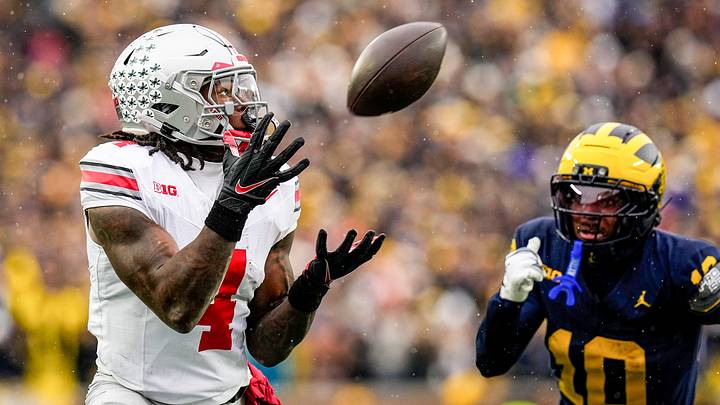
The Buckeyes have paced this subset of teams from the early days of paying players, but they are far from alone in sparing few expenses. Wide receiver Jeremiah Smith was identified by several respondents as one of the sport’s highest-paid players, with most estimates putting his total compensation north of $5 million and a handful pegging it closer to double that. That’s not all coming from Ohio State either, as he likely earns more than most—if not all—Power 4 quarterbacks thanks largely to his additional slate of national NIL deals.
The Ducks are in a similar position, not just luring back QB Dante Moore when he could have been a top-five NFL draft pick, but spending quite a bit on depth along their defensive line and having no issue accommodating expensive backups. Michigan and USC are not far behind the $40 million mark, while Indiana continues to net out closer to the top of the conference with each passing season. That doesn’t mean the absolute top end, but the reigning champions are still more than competitive in the $30 million to $35 million range.

There is a pretty healthy middle class in the Big Ten that continues to ramp up the amount of resources devoted to their rosters in both personnel and overall dollar figures. What might be more interesting to track is how teams near the bottom of the conference are opening up wallets in parallel. UCLA was brought up by several coaches and general managers inside and outside the conference as an example of a school throwing its weight around more than ever. Even Purdue and Rutgers have more money to play with compared to recent years and budgets around the $20 million mark.
“I think it’s been an evolution for a lot of donors, a lot of donor bases,” one Big Ten AD says. “Look at how far behind we all were with collectives [compared to the SEC]. There was some catchup that needed to be done.”
SEC
Most expensive rosters: LSU, Texas, Texas A&M
Estimate for the median team: $25 million to $33 million
It does just mean more in the SEC, with at least three quarters of the league featuring a roster north of $25 million—easily the highest percentage of any conference in college football this season.
Some is the result of fierce competition at the high end of the transfer portal, but much more can be attributed to the inherent league rivalry that has been supercharged by the arrival of new coaches.
“LSU is the most expensive [roster] in the country,” one Big 12 coach exclaimed. “It’s close to $50 million and well above $40 million for sure.”
Nearly every person surveyed brought up one, or all, of LSU, Texas and Texas A&M when discussing the most expensive rosters in the country and comfortably spending $40 million or more. The Longhorns notably paid handsomely for wideout Cam Coleman through the portal as part of an extensive bidding process that kept climbing past $3 million for the season and may have the most expensive backfield ever assembled when factoring in the seven figures devoted to bringing in Hollywood Smothers and Raleek Brown to line up next to Manning. Texas A&M may have as many as six players making more than $1 million this season just on offense. The Aggies have also assembled the No. 1-ranked recruiting class for next year and are expected to push the payroll out even further past $40 million in 2027.

“If you’re spending $15 million on a [incoming] high school class, your roster has to be near $50 million,” notes one head coach.
The floor also sets the SEC apart as no team is expected to field a roster costing less than $20 million this season. That includes Vanderbilt and South Carolina, and some opposing power-conference coaches would be jealous to have what Arkansas is able to spend. Even after paying for Mark Stoops’s $37 million buyout, one rival brought up that Kentucky is in the middle of the pack in the conference in roster spending now and tracking far ahead of last season.
That’s not even getting to Georgia, Ole Miss and Tennessee each spending upward of $35 million to drag figures even higher.
Notre Dame and the Group of 6
Football independence treats the Fighting Irish well on the field and their players well off it. The school has never really lacked for money given its deep-pocketed boosters, and that is increasingly showing up with a roster spend on par with many of their peers competing to win a national title in the $40-plus million club.
“They are no different from a high-end Big Ten team in terms of the overall number,” says one ACC coach. “To me, the thing that sticks out is they’ve done a hell of a job with retaining guys. They don’t lose somebody if they don’t want to.”
Much of that traces back to a renewed emphasis (and high-end spending) on players out of high school since coach Marcus Freeman took over.

Outside of Notre Dame, the rest of college football continues to stretch the bounds of what is possible despite some recognizable players in the sport making more than what entire Group of 6 teams are at the end of the day—ranging from six figures for low-end Sun Belt teams to the single-digit millions most are at. It helps to start from a low base, but some schools have more than doubled the amount they’re able to commit to their roster for 2026. Even programs you wouldn’t expect, like UTEP, are now fielding multimillion-dollar teams thanks to increases in revenue sharing.
There’s a general view that the high end of the newly formed Pac-12, along with a handful of teams in the upper echelon of the American, are pacing the pack in the Group of 6 when it comes to player expenses. Such schools like Boise State or Memphis are still a ways away from power-conference program expenditures on players in the $10 million range, but are moving in that direction faster than others. The rest of their leagues slot in behind—with a few aspirational outliers in the mix from other conferences—followed by your average Mountain West and Sun Belt team spending a few million on players. Most MAC and Conference USA teams occupy the bottom tier in college football after that and struggle to go into seven figures, but are seeing more and more programs hit such a mark.
Still, no matter what end of the scale a team may find itself on from the LSUs and Ohio States to the Ohios and Louisiana-Monroes of the world, all of college football has one certainty as attention turns to what the 2027 budget looks like: The price to play goes only one direction, and it’s certainly not being revised down anytime soon.
PODCAST: Listen to SI’s college sports podcast, Others Receiving Votes, hosted by Pat Forde, below or on Apple and Spotify. Watch the show on SI’s college YouTube channel or on SI TV.
 Add us as a preferred source on Google
Bryan Fischer is a staff writer at Sports Illustrated covering college sports. He joined the SI staff in October 2024 after spending nearly two decades at outlets such as FOX Sports, NBC Sports and CBS Sports. A member of the Football Writers Association of America’s All-America Selection Committee and a Heisman Trophy voter, Fischer has received awards for investigative journalism from the Associated Press Sports Editors and FWAA. He has a bachelor’s in communication from USC.
Follow bryandfischer