%20%20--%3E%0A%3Csvg%20version%3D%221.1%22%20id%3D%22Layer_1%22%20xmlns%3D%22http%3A%2F%2Fwww.w3.org%2F2000%2Fsvg%22%20xmlns%3Axlink%3D%22http%3A%2F%2Fwww.w3.org%2F1999%2Fxlink%22%20x%3D%220px%22%20y%3D%220px%22%0A%09%20width%3D%2239px%22%20height%3D%2240px%22%20viewBox%3D%220%200%2039%2040%22%20enable-background%3D%22new%200%200%2039%2040%22%20xml%3Aspace%3D%22preserve%22%3E%0A%3Cpath%20fill%3D%22%23FFFFFF%22%20d%3D%22M38.5%2C7H28.2v26h10.3V7z%22%2F%3E%0A%3Cpath%20fill-rule%3D%22evenodd%22%20clip-rule%3D%22evenodd%22%20fill%3D%22%23FFFFFF%22%20d%3D%22M26.1%2C25.5c0%2C5.8-4.1%2C7.5-12.9%2C7.5C3.9%2C33%2C0%2C31.2%2C0%2C25.2v-1.1h11.6%0A%09v2.4c0%2C0.7%2C0.1%2C1.4%2C1.2%2C1.4c1%2C0%2C1.2-0.4%2C1.2-1.3v-0.9c0-1.6-0.9-1.6-3.5-2.2C2.2%2C21.7%2C0%2C19.7%2C0%2C15.3v-0.9C0%2C9.3%2C5.5%2C7%2C12.9%2C7%0A%09c10.2%2C0%2C12.8%2C2.6%2C12.8%2C7.4v1.8h-11v-2.9c0-0.6-0.4-1.1-1.2-1.1c-0.6%2C0-1.2%2C0.4-1.2%2C1.1v0.9c0%2C1.5%2C0.9%2C2%2C3.3%2C2.5%0A%09c8%2C1.6%2C10.5%2C3.3%2C10.5%2C7.5V25.5z%22%2F%3E%0A%3C%2Fsvg%3E%0A)
Where the Big Ten Stands on College Sports’ Major Issues
In this story:
RANCHO PALOS VERDES, Calif. — The Big Ten’s four days of annual spring meetings had officials speak at length on a number of key topics ahead of the SEC’s meetings this week. It’s a welcome and needed change to see the Big Ten be proactive instead of reactive to external narratives. Here are a few items of note to keep in mind as the other Power 2 league plants its flag on issues in college sports.

Congressional action
It was fascinating to watch in real time all the optimism around the SCORE Act fade as the bill went from the verge of going to the House floor to being pulled entirely. Just about every Big Ten administrator has made at least one trip to Washington, D.C., in the past few months to meet with members of Congress in order to get something over the line. They are apparently back to square one after members of the Congressional Black Caucus and various others, such as Rep. Lori Trahan (D-Mass.), came out hard against its passage.
“I am a realist about the possibility, about the challenges, of trying to get legislation passed through Congress,” Washington athletic director Pat Chun says. “Can you get a majority of people to coalesce around something in a bill around college sports? If you study history, the answer is going to be no.”
Many of Chun’s peers are a little more hopeful, even if deep down they understand the window for getting something done on the hill is rapidly dwindling ahead of the summer recess and what figures to be an active election season. Sens. Ted Cruz (R-Texas) and Maria Cantwell (D-Wash.) are expected introduce their own version of a bill focused on college sports—possibly as soon as this week—but details have been scant as to the actual text of any legislation.
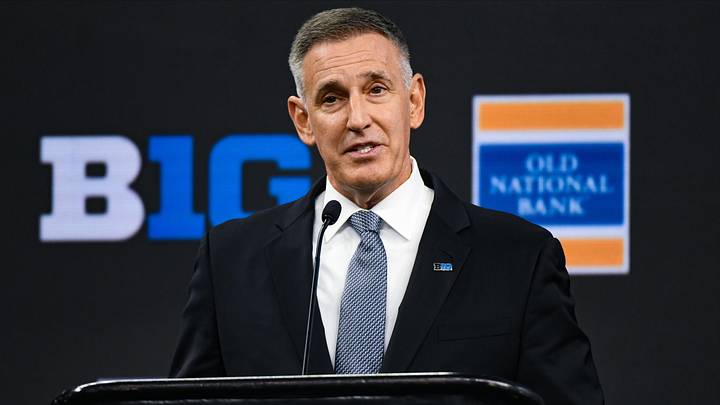
“Like everything else when something doesn’t work, you have to pivot and try to do something else,” Big Ten commissioner Tony Petitti said. “We’ll see the Senate piece of it, and then kind of go from there.”
24-team playoff
Naturally, there was a ton of talk about the College Football Playoff and quite the united front across the Big Ten in support of expansion to 24 teams.
The Big Ten was clearly trying to help prime the discussion around the playoff expanding before the SEC and Big 12 meetings this week. There was little formal support, or even talk, about moving to 14 or 16 teams with the CFP, but several Big Ten officials seemed to understand that the status quo of the playoff remaining at 12 appears the most likely outcome—even if it’s not the preferred path by the conference.
“I think we are focused on the fact that we believe 24 is the right number. It seems that many of the coaches in the SEC, and some of the ADs that I have read their comments, are also in agreement,” Michigan AD Warde Manuel said. “I think 24 stops it, it stops the conversation [about expansion]. There’s no way I can ever see us going past 24 teams. I promise.”
“I don’t know if there’s confidence [in expansion happening] because nothing’s changed,” said another athletic director. “It’s two votes and the SEC has one of them. We’re where we were last year.”
READ MORE: Inside College Football’s 24-Team CFP Debate Over Expansion, Access and Money
Media matters
All of the Big Ten’s media partners were in attendance, and it was good to catch up with CBS Sports’s Charles Davis, who will be taking over for Gary Danielson as the broadcast network’s primary analyst for the league’s 3:30 p.m. ET game.
Interestingly another new name who wasn’t around drew the most discussion. Seemingly every athletic director weighed in on Amazon’s broadcast deal with Duke men’s basketball and the larger repercussions from a carve-out that includes one game with reigning champion Michigan at Madison Square Garden next season. While some believed it was a good sign that the streamer was getting further into bed with college sports, others remained far more cautious over the unique arrangement—both for the ability for bigger brands to start cutting side deals that don’t involve sharing revenue with others and because of upsetting primary rights holder Fox.
Fox executives declined to talk openly about the deal. It’s clear they remained a bit miffed they were not more central to the initial discussions. The status of the game remains unsettled and Michigan’s athletic director noted his school was working through some of the concerns and still hopes to play it.
“My staff said they made sure that everybody understood that it needed to go through the Big Ten and they had our media rights and those kind of things in that market,” Manuel said. “What I didn’t know—and it’s fine and they didn’t necessarily need to disclose—but I was surprised when it became three games that they were putting together. I had good conversations with [Duke AD Nina King] since and we’re working through it. Hopefully it’ll be resolved. It’s a great college basketball game, given who we are, who they are in college basketball.”
It’s also clear Fox would be interested in potentially bidding for additional CFP games should they come to market beyond the two extra games that ESPN is contractually obligated for. Executives have not been shy about promoting a move to 24 teams recently. Though some see the conference’s push surrounding the playoff format as explicitly linked to Fox’s interests, that narrative got pushback.
“I would like to see the best media deal that we can get for the CFP. Fox is a great partner to us now. You know, I’ve read people, the comments from people, who say, ‘Well, we’re doing this because of Fox.’ I’m not doing it because of Fox,” Manuel says. “I want the best media deal for the Big Ten and for college football so that we can support our student-athletes and do the things we do with all our programs. I don’t hate ESPN because now we’re with Fox and NBC and CBS.”
“I don’t have any real feel about who’s the best to program it,” Petitti said. “They’re not our partner during the regular season, but we do have games that cross over on ESPN. Those games typically do very well, just like the ones we have on Fox and CBS and NBC. I think it’s about whether the commitment to scheduling it right and who’s going to bring the right resources. I don’t go in with any preconceived idea and no one league is driving that part of the process. That’s a collaborative piece that’ll be done by consultants and whatever else that we use, not me.”
CSC and spending stay in the spotlight
College Sports Commission CEO Bryan Seeley has been crisscrossing the country presenting to conferences this month and found a surprisingly receptive audience in the Big Ten despite some recent clashes. That includes an expensive arbitration with Nebraska involving numerous football players that just wrapped up and several million dollars worth of other deals from Big Ten athletes which remain in limbo after being put through the NIL Go clearinghouse.
“We’re committed to trying to get this thing right with our colleagues. I mean it is, for lack of a better word, a startup,” Petitti said. “We’ve got such a high volume of deals. I think I view that as a good sign. It means that people are trying to put deals in and follow the rules and live with the results. Look, do we always agree with Bryan and the CSC? Of course not. Do we think some deals could get through faster? Yeah. That’s where we are.”
A handful of coaches noted that managing expectations with players is becoming something their general managers are having to do more of as schools look for ever more creative ways to circumvent the revenue-sharing cap of roughly $22 million for next year.
One thing is certain regardless of how money gets from one source to the players: The overall amount schools are spending on their rosters is not slowing down or reversing any time soon.
“We don’t know what roster costs are. We don’t know where are things going to settle out in the landscape,” Ohio State AD Ross Bjork said. “There’s no transparency in the system to say, O.K., here’s what the market really is. You know, we front-loaded and that drove the market up. Now, we’re all moving [multimedia rights] money around. Because there’s no transparency in the system.”
That doesn’t mean some aren’t trying even if it feels like pushing a boulder up the hill in this current environment.
Punting is winning plus schedule power
Big Ten football coaches remained extremely miffed over recent changes to rules involving punts and kicks which restricts players on both sides of the snapper and alters the restrictions over what numbers some players who might be involved in such plays can wear. These were formally ratified by the NCAA in April.
“It just makes no sense,” says Iowa football coach Kirk Ferentz, shaking his head. “I’m not sure how we got to this point.”
Coaches did view several videos and discussed the changes at length during one of their meetings but those changes did not involve serious feedback from the conferences. The league has a representative on the football rules committee (Big Ten senior director for football operations A.J. Edds) and FBS oversight committee (Illinois coach Bret Bielema), but there was increased agitation from several prominent names that they should be more heavily consulted.
Men’s and women’s basketball coaches also spent plenty of time on recent NCAA tournament expansion, potential tweaks to regular-season schedules to mitigate travel concerns and, of course, the state of officiating across the conference.
“I’ve been going to these meetings for decades,” Oregon basketball coach Dana Altman joked. “It’s always the same, complaining about the officiating and the schedule and the rules.”
More College Football From Sports Illustrated
Listen to SI’s college sports podcast, Others Receiving Votes, below or on Apple and Spotify. Watch the show on SI’s College YouTube channel.
 Add us as a preferred source on Google
Bryan Fischer is a staff writer at Sports Illustrated covering college sports. He joined the SI staff in October 2024 after spending nearly two decades at outlets such as FOX Sports, NBC Sports and CBS Sports. A member of the Football Writers Association of America’s All-America Selection Committee and a Heisman Trophy voter, Fischer has received awards for investigative journalism from the Associated Press Sports Editors and FWAA. He has a bachelor’s in communication from USC.
Follow bryandfischer