%20%20--%3E%0A%3Csvg%20version%3D%221.1%22%20id%3D%22Layer_1%22%20xmlns%3D%22http%3A%2F%2Fwww.w3.org%2F2000%2Fsvg%22%20xmlns%3Axlink%3D%22http%3A%2F%2Fwww.w3.org%2F1999%2Fxlink%22%20x%3D%220px%22%20y%3D%220px%22%0A%09%20width%3D%2239px%22%20height%3D%2240px%22%20viewBox%3D%220%200%2039%2040%22%20enable-background%3D%22new%200%200%2039%2040%22%20xml%3Aspace%3D%22preserve%22%3E%0A%3Cpath%20fill%3D%22%23FFFFFF%22%20d%3D%22M38.5%2C7H28.2v26h10.3V7z%22%2F%3E%0A%3Cpath%20fill-rule%3D%22evenodd%22%20clip-rule%3D%22evenodd%22%20fill%3D%22%23FFFFFF%22%20d%3D%22M26.1%2C25.5c0%2C5.8-4.1%2C7.5-12.9%2C7.5C3.9%2C33%2C0%2C31.2%2C0%2C25.2v-1.1h11.6%0A%09v2.4c0%2C0.7%2C0.1%2C1.4%2C1.2%2C1.4c1%2C0%2C1.2-0.4%2C1.2-1.3v-0.9c0-1.6-0.9-1.6-3.5-2.2C2.2%2C21.7%2C0%2C19.7%2C0%2C15.3v-0.9C0%2C9.3%2C5.5%2C7%2C12.9%2C7%0A%09c10.2%2C0%2C12.8%2C2.6%2C12.8%2C7.4v1.8h-11v-2.9c0-0.6-0.4-1.1-1.2-1.1c-0.6%2C0-1.2%2C0.4-1.2%2C1.1v0.9c0%2C1.5%2C0.9%2C2%2C3.3%2C2.5%0A%09c8%2C1.6%2C10.5%2C3.3%2C10.5%2C7.5V25.5z%22%2F%3E%0A%3C%2Fsvg%3E%0A)
Inside College Football’s 24-Team CFP Debate Over Expansion, Access and Money
With turquoise water and sugary beaches as a backdrop, the Southeastern Conference will gather on the Florida panhandle this week for its annual spring meetings. At a poolside reception at the Sandestin Hilton on Tuesday evening, coaches, administrators, corporate sponsors and media members will converge on chilled shrimp, carving stations and open bars. The question hanging over this year’s feast: Will it be served with a side of defiance or acquiescence?
In practical terms, the SEC is the only thing standing in the way of an expansion of the College Football Playoff from 12 to 24 teams by the 2027 season. Due to a panicked and self-defeating move years ago by the rest of the Football Bowl Subdivision conferences to turn over primary decision-making power to two kingpin leagues, the Big Ten and the SEC, those are the only votes that matter. The Big Ten wants 24, and it has a lot of backup. (Although not formal unanimity, at least not yet. Reports to that effect don’t track with what multiple conference commissioners tell Sports Illustrated.)
To date, there is no evidence of widespread public support for doubling the size of the playoff so soon after tripling it, from four to 12, in 2024. If anything, fans have been vocally opposed to 24.
Yet the Big Ten’s vague-but-insistent stance—trust us, it’s going to be great—has somehow changed minds in the other Power 4 conferences, the Big 12 and Atlantic Coast. The commissioners of those leagues have publicly stated their support, just a few months after not backing that plan. SEC commissioner Greg Sankey is the holdout, preferring a move to 16 teams, although he’s chosen his words carefully and remains open to the wishes of his league membership (some of which favors 24).
“The number of teams being 16 is still our focus,” Sankey said earlier this month. “We are open to the conversation. There are a lot of ideas out there that would have to be supported by analysis and information, not speculation. And with something as important as the college football regular season, if you can build upon that as well as the postseason, awesome, let’s get to it. But let’s understand that if you look at professional leagues and the recent NCAA basketball tournament, it’s the small incremental expansions that are supported by information and analysis.”

Let’s dig into some information and analysis about what the 24-team playoff is advertised as providing, and where the promises might fall short:
Access, hope and return on investment
The primary selling point for 24 teams from the Big Ten—and those now riding its bandwagon—is that it casts a wider net of playoff participation and excitement nationwide. More teams in the bracket, more teams on the bubble, more fan bases invested for longer in the outcome of the regular season.
Big Ten chief operating officer Kerry Kenny said last week that if the 24-team format had been in place since 2014, when the four-teamer was implemented, 80 different schools would have made the field. The numbers bear out: Usual suspects Alabama and Ohio State would have made it all 12 years, all the way down to one-time appearances from the likes of San José State, Liberty and Appalachian State.
ACC commissioner Jim Phillips says a 24-team playoff sells “hope” to schools traditionally in the second and third tiers of power conferences. “There is so much investment going on in the sport of football—and I’m not necessarily concerned about schools that have traditionally found their way to the CFP. I’m talking about those that would have a chance, that right now don’t have a chance, to get into the playoff.”
This is where the Oklahoma States of the world (which would have had six playoff appearances in a 24-team field since 2014), the North Carolina States (five), the Mississippi States (four) and the Wisconsins (four) would get a participation trophy.
This also is where the word “hope” can be interchangeable with “spin.” A 24-team playoff would be a means of selling fans on a level of accomplishment that essentially is an accounting trick. The difference between an 8–4 season that ends in the ReliaQuest Bowl, Pop-Tarts Bowl or Mayo Bowl and an 8–4 season that ends in a first-round playoff loss is packaging and perception. The team itself isn’t any better, the postseason opponent might not be any better, and the postseason game location is likely worse—but the coach can collect a bonus, and a playoff appearance sign can be planted on the stadium facade.
To be sure, any team that makes it into the bracket has a chance to advance, turning an above-average season into something bigger—and earning increasingly bigger paychecks along the way. Miami proved that last season, going from a No. 10 seed to the national championship game. But underdogs are 2–6 in first-round playoff games in the 12-team format, with all six losses by double digits. If teams in the lower third of a 12-team playoff have struggled to compete, how about teams in the lower half of a 24-teamer?
As noted by Phillips, the increasing cost to compete at the high end of the sport increases the perceived reward of a playoff bid. Player compensation has escalated far beyond the House v. NCAA revenue-share salary cap of $21.3 million for 2026–27, more than doubling it at some schools. Bidding wars for the top coaches continue to drive up salaries, with LSU paying Lane Kiffin $13 million this season despite never having come close to winning a national title. Staff sizes are only increasing, not decreasing.
With that as a backdrop, upper-middle-class athletic programs like Louisville are locked in the arms race despite running up significant debt. The endgame strategy for those schools is a risky one: doubling down on investment in hopes that winning big covers the mounting deficits and cures everything. Playoff bids elevate a school’s profile, boost enrollment and become the carrot that keeps its fans—particularly the richest donors—engaged.
“In concept, I like the 24 [team CFP],” said Big 12 commissioner Brett Yormark. “More access, I think, is great. More access would be great for the Big 12. Aside from that, I think coaches and how rosters are being built, and the cost of rosters, were all based on what does it cost to be one of 12? I think going to 24 takes some heat out of the system.”

But there will be the same numbers of wins and same number of losses across FBS every year—even if schools are spending more money, half of them still are going to lose. A spiraling arms race doesn’t change that math. If fan bases were disappointed about being 8–4 in a 12-team era, they might be just as disappointed with that record even if it slides them into the lower echelon of a 24-team field.
“One of the unintended consequences of expansion of the playoff from four to 12 is the added pressure on teams at the upper end of the food chain,” says Mid-American Conference commissioner Jon Steinbrecher. “If those schools don’t get in the playoff, too often that fan base looks at the season as a disaster. I’m not sure expanding further from 12 changes that. I’m not sure it’s the pressure valve some people think it will be.”
Offering CFP consolation prizes to justify escalating expenses is voodoo economics—unless there is a pot of playoff gold waiting at the end of the 24-team rainbow. That remains to be demonstrated.
In terms of downstream effect, it should be noted that “hope” in a 24-team playoff would still be generally restricted to the Power 4 conferences, with a smidge of access available to the rest of FBS. Phillips noted that only about 9% of FBS teams make the playoff, but expansion wouldn’t happen for the benefit of teams outside the establishment structure. In 2027, the likely breakdown would be thus: 68 teams from six leagues competing for one bid (a 1.5% chance) and 68 teams from the Power 4 conferences plus Notre Dame competing for 23 bids (a 33.8% chance).
With the theoretical 80 schools that would have gotten playoff bids since 2014, 17 are in current non-power leagues, with a total number of 22 bids out of 288 spots—7.6% of the field. In the first two years of the 12-team playoff, non-power-conference schools got 12.5%. An expanded playoff would almost exclusively cater to teams finishing third, fourth, fifth and even sixth in the bloated power leagues.
Phillips is of the belief that a 12-team playoff runs the risk of leaving out a potential national championship, pointing to Notre Dame’s controversial exclusion last season. While he might be right in that specific instance, the Fighting Irish snub had more to do with procedural error than the size of the tournament—if Phillips’s own league had a more sensible tiebreaker system, Miami would have played for (and likely won) the ACC automatic bid. That would have knocked Sun Belt champ James Madison out and put Notre Dame in.

Furthermore, an argument for 13 championship-calber playoff participants last season hardly justifies advocating for the massive expansion to 24 teams. There certainly wasn’t a 14th capable team last year—the next program out after Notre Dame was BYU, which lost twice to Big 12 champion Texas Tech by an average margin of 24.5 points. The Red Raiders then lost in the playoff by 23 points at home to Oregon, which lost by 34 points to eventual national champ Indiana. BYU was light years removed from being capable of winning the national title.
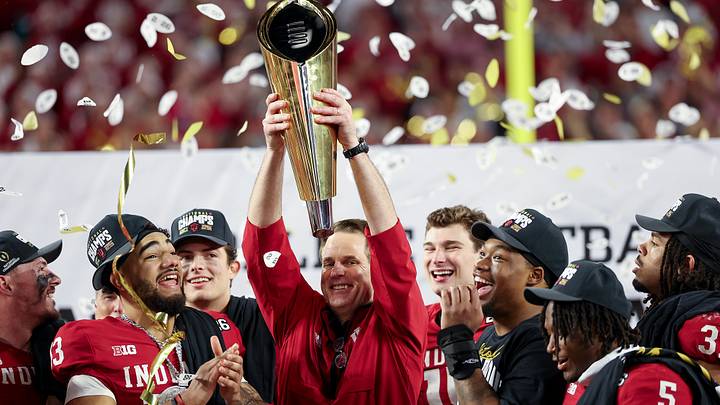
A final note on “hope”: No program in history was more hopeless than Indiana until it made the program-altering hire of Curt Cignetti as its coach. The Hoosiers morphed immediately into a playoff team in Year 1 under Cignetti, then into 16–0 champions in Year 2. They didn’t need a 24-team playoff to make that happen. Twelve was enough.
The regular season
The biggest area of disagreement between pro-24 and anti-24 camps is over the impact on the regular season. Big Ten commissioner Tony Petitti argues that a bigger playoff will actually help the regular season mean more, with positioning for bids, home field games and first-round byes adding layers of intrigue for an expanding pool of programs. Others assert that it’s impossible for the biggest games to still be as big when there is more latitude to lose them.
“When I was at [Major League Baseball], we never had to convince anybody that keeping more teams in the race is better for everybody in advance,” Petitti said at Big Ten spring meetings last week. “We never had to do that. I feel like in this [college football] space that we’re kind of being asked to do that.”
Baseball, of course, has a 162-game regular season that wallows through long stretches of tedium. It’s difficult to identify which games actually matter. Keeping fan bases engaged through that incremental journey is more challenging than the seismic weekly energy that comes with a 12-game football regular season. There is no need to manufacture drama.
“The football regular season is the most valuable college sports property there is,” Steinbrecher says. “Any [playoff] expansion needs to be fully, fully examined. Both what it means for the postseason, but also the regular season.”
Sankey says, “It’s incredibly important we maintain and continue to support the regular season.”
The most enticing nonconference games of the 2025 regular season had a direct impact on who made the playoff. Ohio State defeated Texas—the Buckeyes wound up in the field, the Longhorns wound up out. Oklahoma defeated Michigan—the Sooners wound up in, the Wolverines wound up out. Miami and Texas A&M defeated Notre Dame—the winners made the tourney, the loser did not. In a super-sized tournament, those results would not have resonated.

Would a 24-team playoff lead to more good nonconference games? The Big Ten and others say yes, thanks to the diminished potential penalty for losing games. But an ESPN source casts doubt on that, saying that the playoff expansion from four to 12 teams has not produced a corresponding willingness to take on more difficult opponents.
“I don’t think those two things are related,” the source says. “From four to 12, the opposite has happened.”
Regardless of what happens at the beginning of the season, the back end would feel dramatically different. Petitti argues that late-season jockeying for the last spots in the playoff will have increased urgency and attention. He touted a theoretical Iowa-Minnesota game with “real impact,” disregarding nearly a century of rivalry value placed on winning the Floyd of Rosedale trophy.
But is the potential flutter of interest gained from battles for the last spots in the playoff worth diminishing the stakes of, say, the annual November matchup of LSU and Alabama when both teams are comfortably in the bracket? The ESPN source says bubble drama in college basketball has not translated to higher ratings.
“I’m still waiting for the teams on the bubble of the NCAA tournament, for those games late in the season to generate high interest,” the source says. “This [expansion talk] is driven by valuing participation over premium competition. Schools invest more, they feel like they need a greater chance to make the playoff to justify it. They’re chasing something.”
The college football calendar
To make a five-round playoff work, something would have to go. Two somethings, actually: conference championship games and a week of summertime.
The latter is already being addressed.
An NCAA proposal is on the verge of approval which provides for a new, standardized start date for the season in what is essentially the present Week Zero—the Saturday prior to Labor Day weekend. Much of the reasoning behind this adjustment comes down to a set 14-week campaign that would provide two open dates for teams, no matter how the actual calendar shakes out (the 2025 season aligned as such, but the 2026 slate does not, for example). An unspoken consequence is that by shifting the college football calendar ahead, it would allow for additional rounds of the CFP to take place starting after Thanksgiving weekend—crucial not only with extra games to play in 16- or 24-team scenarios, but also to prevent fewer head-to-head matchups with NFL Saturday games that begin after the second weekend in December.
“I want to see the analysis behind it,” Mountain West commissioner Gloria Nevarez says. “I think there’s been a lot of talk about the value that expansion could bring and how it would fit in the calendar, but I haven’t really seen the analysis. I feel like, if we voted—which we haven’t really done—there would be support for 16 pretty easily. I think there’s still a lot of questions about the calendar and the value beyond that.”
Moving football deeper into August already comes with a number of issues schools will have to deal with—in many places students aren’t yet back on campus, and heat-related concerns would be more prevalent. But those might pale in comparison to even more jarring change on the back end, with conference title games going away in early December.
A 24-team playoff would consist of five rounds. The first round pits teams seeded Nos. 9 through 24 against each other in on-campus games, while the top eight seeds would have a bye. The second round would be at the campuses of those top eight. Then there would be quarterfinals and semifinals in traditional bowl settings and a national championship game.
With that schedule, conference title games would be gone, eliminating one of the core tenets of college athletics—declaring a league champion who won it on the field.
“How do you determine a conference champion?” Steinbrecher asks. “I think that’s still important.”
He is not alone in voicing support for a true league championship, particularly in the SEC. Coaches like Kirby Smart continually reference how much meaning there is for a season to include a trip to Atlanta to play for a trophy. The league has been playing its title game since 1992 and has annually been one of the most attended of the 10 games that weekend—acting as a pseudo SEC convention for fans, media and corporate partners.

It’s also long been one of the highest-rated games of the entire season, with the SEC championship averaging more than 16.6 million viewers each of the past two years in a 12-team playoff era. First-round CFP games averaged just 9.9 million viewers last season in comparison.
Petitti has spoken openly that these games would have to be eliminated if there was any expansion beyond the current format, but others believe a move to 16 could allow the games to remain. Would the SEC be willing to give up a contest which brings in an estimated $50 million to $100 million annually—revenue it doesn’t have to share with anyone else?
“I still think we’re stuck,” says one commissioner. “The SEC has no incentive to support [24]. It all hangs on whether the SEC is willing to give up their championship game.”
Money, money, money
There are plenty of skeptics who want to see the Big Ten finally show its work on the future of the playoff. Expansion proposals have rolled out piecemeal in meetings for much of the past two years and have also undergone numerous format revisions.
What hasn’t occurred is a full presentation, laying out clearly and concisely what changes would be in store. Some numbers have been discussed when it comes to additional revenue and payouts, but those have been more back-of-napkin estimates than anything concrete.
Petitti did lay out part of the case at Big Ten meetings last week. Citing that the Power 4 collectively make around $200 million from their conference championship games, he notes that 12 new, on-campus games in a 24-team playoff could generate roughly $72 million in ticket sales toward that overall figure. That would go on top of any additional corporate sponsorships and local advertising that could be sold even before media rights deals.
“I generally favor 16 as the next step for the College Football Playoff, but I am open to 24 or another format if the implications for playoff access, financial outcomes, viewership, the regular season and other key factors are clearly understood and can help guide the decision,” said Sun Belt commissioner Keith Gill.
“There is too much unwarranted speculation,” Steinbrecher says. “I’m open-minded to all of it—expansion to 16, 20, 24 could be magical. But there’s not been a lot of due diligence done yet.”
The MAC commissioner pointed to other touted playoff models in which the projected revenue bump turned out to be “significantly less” than had been advertised before media partners weighed in. A recent example from the basketball world: The NCAA tournament expansion from 68 to 76—unpopular with many fans—will generate an incremental $131 million over six years. That’s closer to a trickle of new revenue than a geyser.
“It’s all modeling until you actually figure out if there’s media interested in paying for expansion,” says another commissioner. “We’ve heard anecdotally, ‘Oh yeah, there’s value in other games.’ But is there?”
It appears there may be some in the coffers of Fox, which did not bid on the playoff when rights hit the market a few years ago and has lived to regret it given how popular the event has been. Executives at the company have publicly lobbied for a move to 24 teams, and privately believe they can put together an agreeable bid to land at least a package of games.
“I think it’s probably inevitable that [the playoff] expands, and hopefully, at least from the research we’ve done, the best model we’ve seen is 24,” said Fox Sports CEO Eric Shanks last month at the Sports Business Journal World Congress of Sports conference.
With Fox serving as the Big Ten’s primary broadcast partner, Petitti is widely interpreted as carrying the network’s water in the push for 24 teams. Last week he declined to publicly champion Fox as a playoff partner.
“I want to see whoever is committed to making it work,” Petitti says. “I don’t have any real feel about who’s the best to program it. [ESPN], they’re a great partner, they have a deep commitment to college football every week. I think it’s about what the commitment is to scheduling it right and who’s going to bring the right resources. I don’t go with any preconceived ideas. No one league is driving that part of the process. That’s a collaborative piece that’ll be done by consultants and whatever else we use. Not me.”

Some of his peers remain skeptical that’s the case. Many around the industry view playoff expansion as another front in the long-running college football Cold War between ESPN and Fox, with the Big Ten and SEC serving as their proxies.
Fox’s involvement in this latest salvo between networks and their proxy conferences is threefold. Its first hope is to gain access to more premium inventory in December through the playoff. The second is that it would create better value in some of its late-season Big Ten games. The third byproduct, which Petitti stressed last week, is the creation of more marquee nonconference matchups by lessening the postseason jeopardy of losses.
A significant transformation of nonconference schedules—and the regular season as a whole—is viewed with doubt in some circles.
“Expansion beyond 16, especially all the way to 24, threatens the value and brand of college football by watering it down,” a well-connected industry source says. “The argument is that expanding the number of teams also enlarges the fan bases interested later in the season. The deeper you go into 8–4 and 9–3 teams, I question how much benefit there is.”
The value of college football’s future regular-season inventory is a major factor for media executives as they look at the larger sports broadcasting picture. The CFP could be reentering the rights market at the same time the NFL is potentially looking for billions of dollars in increases.
When ESPN negotiated its sublicense playoff deal with Turner Sports in 2024, the network used $25 million as a midpoint for the value of each first-round game. Is anyone ready to pony up anything close to that for 10 games to make this entire endeavor worth the elimination of conference championship games? That might be the biggest question yet to be answered.
Timeline
Though there is a Dec. 1 deadline for the CFP to inform ESPN of potential format changes, the commissioners would ideally like to sort things out well in advance. Last year, there was a preference to decide any major items related to expansion before the start of conference media days in July; that timetable remains preferable—but perhaps not probable—for this summer.
The next CFP Board of Managers—the FBS commissioners plus Notre Dame athletic director Pete Bevacqua—is scheduled to meet in June. The hope from several commissioners is that some numbers will have been crunched and will be presented by then.
“At this time we are not supporting any specific model but are engaged and look forward to further analysis of all aspects before expressing our position,” Conference USA commissioner Judy MacLeod says.
Adds Pac-12 commissioner Teresa Gould: “The Pac-12 supports expanding the College Football Playoff. Regardless of the format, 16 or 24 teams, any expansion must feature continued access for conferences and programs across the country, add value and consider the experience of student-athletes.”
Ultimately, though, only two conference votes matter when it comes to the future of the playoff.
The decision remains solely the realm of the Big Ten and SEC, and in the hands of their two commissioners.
There is no line in the white Destin sand awaiting the SEC, but the Big Ten drew a proverbial one last week—Petitti said there has been “zero discussion” of a 16-team format. The league’s stance is 24 as soon as 2027, or the format defaults to 12. Sankey’s 16-team preference is a nonstarter with Petitti.
“We have to prove out that if you go to 24, you can actually generate the money I talked about before,” Petitti said. “Plan B is what we have now.”
SEC spring meetings have produced some fireworks before, including reversals of course after the voices of coaches, athletic directors and school presidents were heard. This year’s confab could be one of the most consequential in years—or the league can kick the can further down the road for a few more months. Sankey’s refusal to bail out on a pandemic football season helped turn the tide nationally toward playing six years ago; this year he holds the fate of the postseason in his hands.
More College Football From Sports Illustrated
Listen to SI’s college sports podcast, Others Receiving Votes, below or on Apple and Spotify. Watch the show on SI’s College YouTube channel.
 Add us as a preferred source on Google
Bryan Fischer is a staff writer at Sports Illustrated covering college sports. He joined the SI staff in October 2024 after spending nearly two decades at outlets such as FOX Sports, NBC Sports and CBS Sports. A member of the Football Writers Association of America’s All-America Selection Committee and a Heisman Trophy voter, Fischer has received awards for investigative journalism from the Associated Press Sports Editors and FWAA. He has a bachelor’s in communication from USC.
Follow bryandfischer
Pat Forde is a senior writer for Sports Illustrated who covers college football and college basketball as well as the Olympics and horse racing. He cohosts the Others Receiving Votes podcast for SI and is a regular contributor to the Tony Kornheiser Show podcast. He previously worked for Yahoo Sports, ESPN and The (Louisville) Courier-Journal. Forde has won 28 Associated Press Sports Editors writing contest awards, has been published three times in the Best American Sports Writing book series, and was nominated for the 1990 Pulitzer Prize. A past president of the U.S. Basketball Writers Association and member of the Football Writers Association of America, he lives in Louisville with his wife. They have three children, all of whom were collegiate swimmers.
Follow ByPatForde