%20%20--%3E%0A%3Csvg%20version%3D%221.1%22%20id%3D%22Layer_1%22%20xmlns%3D%22http%3A%2F%2Fwww.w3.org%2F2000%2Fsvg%22%20xmlns%3Axlink%3D%22http%3A%2F%2Fwww.w3.org%2F1999%2Fxlink%22%20x%3D%220px%22%20y%3D%220px%22%0A%09%20width%3D%2239px%22%20height%3D%2240px%22%20viewBox%3D%220%200%2039%2040%22%20enable-background%3D%22new%200%200%2039%2040%22%20xml%3Aspace%3D%22preserve%22%3E%0A%3Cpath%20fill%3D%22%23FFFFFF%22%20d%3D%22M38.5%2C7H28.2v26h10.3V7z%22%2F%3E%0A%3Cpath%20fill-rule%3D%22evenodd%22%20clip-rule%3D%22evenodd%22%20fill%3D%22%23FFFFFF%22%20d%3D%22M26.1%2C25.5c0%2C5.8-4.1%2C7.5-12.9%2C7.5C3.9%2C33%2C0%2C31.2%2C0%2C25.2v-1.1h11.6%0A%09v2.4c0%2C0.7%2C0.1%2C1.4%2C1.2%2C1.4c1%2C0%2C1.2-0.4%2C1.2-1.3v-0.9c0-1.6-0.9-1.6-3.5-2.2C2.2%2C21.7%2C0%2C19.7%2C0%2C15.3v-0.9C0%2C9.3%2C5.5%2C7%2C12.9%2C7%0A%09c10.2%2C0%2C12.8%2C2.6%2C12.8%2C7.4v1.8h-11v-2.9c0-0.6-0.4-1.1-1.2-1.1c-0.6%2C0-1.2%2C0.4-1.2%2C1.1v0.9c0%2C1.5%2C0.9%2C2%2C3.3%2C2.5%0A%09c8%2C1.6%2C10.5%2C3.3%2C10.5%2C7.5V25.5z%22%2F%3E%0A%3C%2Fsvg%3E%0A)
As a Fire Destroyed the Oakland Hills CC Clubhouse, Firefighters Rushed to Save Golf History
While there are no statistics citing how many first responders play golf, firefighters in hundreds of departments, organizations and charity events across the nation often flock to the course. With flexible 24-hour work schedules, they can play more often than almost anyone. Some even set up work areas within their stations to make golf clubs. Hoping for uneventful shifts as they report for duty between 7 and 8 a.m., they also prepare for the worst, confirming everything is in working order: trucks with proper fuel and water levels, safety equipment, hoses, medical supplies, personal gear and more. They must be ready at a moment’s notice.
One of those moments came on Feb. 17, 2022, on what dawned as a foggy and mild Michigan winter morning. Little did the golfing members of one Detroit area fire department know they were about to make golf history … by saving golf history.
Looking forward to a day off after a rough week, Oakland County’s Bloomfield Township fire chief John LeRoy normally hears alerts coming in 24/7. The one from 3951 Maple Road was especially troubling when the kitchen staff in the clubhouse at the legendary Oakland Hills Country Club smelled smoke. At 9:17 a.m.—which sounds more like a tee time—the first call rang in and as the radio calls intensified, the chief rushed to the scene.
“We get smoke calls all the time,” LeRoy says. “You can often tell by specific odors whether it’s electrical or something else and then discover its source; but the smell and location of this one was hard for anyone to define.”
The elegant 100-year-old wooden clubhouse was designed by Charles Howard Crane, an OHCC member and famous Detroit architect whose credits included the Fox Theatre, Detroit Opera House and the original Olympia Stadium, opened in 1922. Extensive renovations had been made since 1968, including a major project in 1999, adding numerous club amenities and a memory-laden galleria along the second-floor hallway with more than 200 pictures of the early clubhouse, grounds, and tournaments past. Oakland Hills has hosted six U.S. Opens, three PGA Championships and a Ryder Cup.
The membership continually remained committed to effective stewardship of such a national treasure and testament to golf history.
And its historic structural foundation was exactly what brought it down.
How the Oakland Hills clubhouse caught fire—and burned for days
Unlike today’s buildings, century-old structures weren’t designed to stop fires. In the 1920s, tall trees were plentiful and carpenters took pride in using them to fashion continuous planks to frame up multiple stories, or “balloon construction.” Extremely tall boards are stately and sound but create voids within the walls and act as chimneys, allowing fire and gases to spread upward and outward unimpeded, igniting combustible materials along the way.
“Big buildings have big fires,” Leroy explains, adding that at OHCC “no one could find it, even a shared police drone.”
After 30 minutes of frantic searching, thermal imaging cameras found the fire in the attic.

Simply punching holes and spraying water was not an option. Any structure opened and breached brings in oxygen, which fire hungrily consumes, plus multiple HVAC units were housed there. Collapsing floors and ceilings with disintegrating metal, boards, and equipment raining down can become a major threat equal to injuries from burns and smoke inhalation.
The blaze spread rapidly and the devastation escalated.
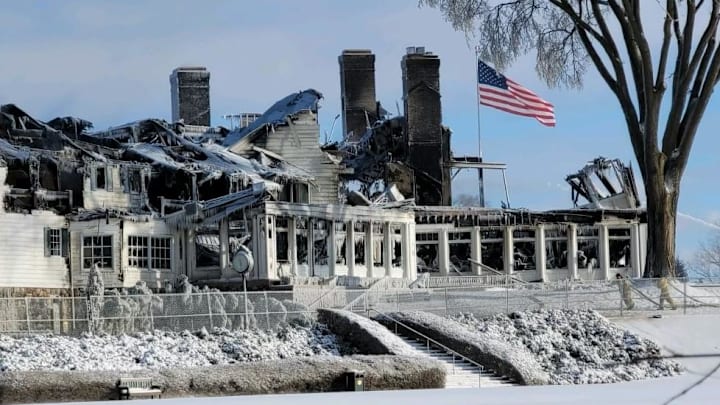
Freezing temperatures created other obstacles. That Thursday, Mother Nature unleashed it all on southeastern Michigan: warmer weather quickly evolved into rain, sleet, snow, and ice, with howling winds. Much like frigid waves crashing and freezing against seawalls, forming jagged bursts of natural ice sculptures, the pounding water from multiple ladder trucks spewing a combined total of 8,000 to 10,000 gallons per minute coated the building and parking lots. Water saturated the site for almost 24 hours and couldn’t be stopped, lest the flames reignite.
Miraculously, there were no injuries during the inferno and ultimate destruction, but another worry was slip-and-falls on piles of unfettered ice. With several emergency vehicles in the parking lot and hoses spider-webbing everywhere, salt trucks couldn’t get through.
Enter the unsung heroes: the staff at Oakland Hills.
“The staff used hand-held salt spreaders and kept going back and forth ‘til nightfall. They went home for a catnap and were back at 7 a.m. to do it all over again,” LeRoy says. “It was incredible.”
With everyone safely out of the building, concerns turned toward the fate of so many rare golf artifacts inside. Was anything left amidst the sodden and smoldering ruins?
Rushing in to save history
Much more survived than anyone originally thought due to the quick-thinking firefighters from the Southfield Fire Department. At 10:30 a.m., four members arrived and golf fan Lt. Zac McKee, knowing the valued history inside, immediately asked who was assigned to retrieve the memorabilia.
“You are,” LeRoy said, directing him to then-OHCC chief operating officer Christine Pooler and club president Rick Palmer.
McKee approached the club officials. “I have a crew of four and we’re going in to get your stuff … what do you need?”
The requests were the club’s PGA Championship and Ryder Cup trophies in the lobby’s main case, a bust of course architect Donald Ross mounted nearby and two valuable paintings in the basement. The firefighters entered the slightly smoky main lobby.
“At that point, the conditions weren’t bad and visibility was good,” says McKee, an instructor at the Southfield Fire Academy. “We broke the glass of the large main trophy case in the lobby and then my guys [paramedic Nate Herr, firefighters Mike Petrey and Patrick Kerr] started grabbing trophies and stacking pictures, carrying them to the entrance where OHCC staff had formed a ‘bucket brigade,’ taking everything to safety. We went back in and started on the walls and four other trophy cases, then opened the double doors to the dining room, but the back wall and windows were on fire, so we shut those.
“After we made multiple trips, the ceiling fell onto the chandelier and the staircase. Now it was too dangerous, and we cleared out from the main lobby and left wing.
“After the lobby, we were trying to get a ‘good job’ for my guys—an aggressive young crew—and the men’s second-floor locker room was next. We tried to get in from the inside and roof, but there was just too much fire.”
With the remaining first and second floor artifacts beyond reach, the crew was directed to the basement, just north and outside the main entrance, where many more treasures were also stored.

“We had no idea of the value of any of this artwork. By then, it was raining again, so we placed the paintings face-to-face to protect them and carried them upstairs to the staff. This went on for a while but eventually, embers fell on that exterior stairway, and the roof was looking bad,” McKee says. “I ordered my crew out, concerned the walls would collapse on us.”
There were some lighter moments of brevity during this long and arduous day. After the men’s locker room was engulfed, the club staff sent the freezing and ice-covered firefighters to the unscathed adjacent First Tee building, providing dry towels and hot coffee to warm them up.
“Walking into the First Tee house, it was pretty cool that the staff and members recognized us as the guys who carried things to them; they treated us great,” McKee says. “They left before us but we did leave a note thanking them for taking care of us on probably the worst day they could imagine for the club. Such gratitude was amazing.”
Head golf professional Steve Brady was also in the building and had assisted in the handoffs. He asked McKee if it was possible—and if no one was in danger of getting hurt—to go into the golf shop and retrieve two pieces: an irreplaceable photo of his wife and a framed letter from Arnold Palmer.

“Because we were very disappointed to abandon the men’s locker room, my crew was excited at the opportunity to go back in,” McKee says. “We noticed Steve had memorabilia all over his office and were able to bring those items out too … and meanwhile, he was giving us impromptu golf lessons every time we came in to swap out our wet and dirty fire gear!”
At this point Herr, a hockey player, pipes up. “There are flaws in my swing, but Steve taught me how to swing properly and not like a hockey player.”
Despite 14 fire departments battling the blaze, it was not totally extinguished until mid-morning Monday—four days later.
“When you have major debris crashing in upon itself, layers form, creating voids underneath and water cannot get in there,” LeRoy explains. “It’s like a campfire; you think it’s out, but the embers catch a wisp of air, and it re-ignites.”
Rebuilding, and remembering with gratitude
As the fire raged on, members watched, helpless. One member, who asked not to be named, observed everything from afar and expressed what everyone was no doubt thinking: “seeing our beautiful and historic clubhouse consumed by this horrific fire was a sad day for all of us who love Oakland Hills, golf, and the cherished memories associated with the club.”
Despite the devastation, there was never any question that the members wished to rebuild the Mt. Vernon-inspired architectural masterpiece, though it took months to sort through the losses, insurance issues, restoration information, legalities, budget and more. Commitments to host championships had to be honored (OHCC hosted the 2024 U.S. Junior Amateur) and having the clubhouse was vital. Through the rebuild, the club itself remained open with normal activities, albeit operating out of temporary facilities. Thankful employees breathed easier, knowing their jobs were still there.
After the fire, Michigan golf resorts took note of the Southfield Fire Department’s actions. Since the four firefighters all played golf, Boyne, Treetops, and Shanty Creek provided rounds of golf and other special items.
“Golf is grateful for the heroic efforts of the Southfield firefighters in battling the fire,” says Bernie Friedrich, Boyne Resorts director of golf course renovation and development. “Beyond those efforts, golfers in Michigan owe them a debt of gratitude for their efforts to save much of the rich golf history and artifacts housed at the club. Their appreciation of what these items meant is laudable!”
Construction on the new clubhouse began in December 2023. Anyone driving along 3951 Maple Road could see the meticulous reconstruction process developing.
Just three weeks ago, on April 5, the clubhouse officially opened, an Easter Sunday rebirth to be followed by grand-opening events later. The cost was estimated at $100 million, with new features that can come from the luxury of rebuilding from scratch, 100 years later.

Members and guests now pass through a similar entryway as before and are guided toward a driving range complete with Trackman stations and robotic golf ball pick-up. The bag drop-off is near a massive underground tunnel and storage area, constructed to accommodate cart and caddie operations and a more convenient setup for players who can traverse from the range, underground, and out toward the first tee of the South course. The tunnel ends near the golf shop, at the entrance bridge to the North course, over Maple Road.
The new clubhouse has an expanded second-floor ballroom, pub and additional amenities. The men’s locker room is now on two floors, with a more spacious veranda and balcony overlooking the South course. Rescued and restored artwork and memorabilia line the hallways throughout the club, including in the elegant ladies’ locker room above the Golf Shop.
Renowned and talented local artist Kim Fujiwara, whose realistic and lifelike paintings graced the walls of the clubhouse, recently added more portraits: Ricky Barnes (the 2002 U.S. Amateur champ), Donald Ross and Gil Hanse (who redesigned the South course in 2021). Oakland Hills customarily displays his likenesses of major contributors to the game, famous players who have won championships there, former head professionals and others who served the membership throughout its 110-year history.

In essence, what everyone initially feared for quite some time—that all had been lost—was not so. Because of the actions of the Southfield firefighters and the other 13 dedicated departments who fought the blaze for days, most of the historical treasures were saved.
As for the firefighters? That Thursday night, some 12 hours after arriving to the fire, McKee and company returned to their station for hot showers and pizza. The engine still needed prepping for the next emergency and there would be several medical calls and another fire alarm. Their shift didn’t end until 7 a.m. Sleep could wait.
But forget labeling them heroes. What they did at Oakland Hills, they were trained for.
“This is just what we all love to do; it’s the day-to-day job. Our main objective is to make the end result a bit less heartbreaking at all costs,” Petrey says. “I’m an avid golfer and have played since age 5. However, I didn’t know the historical significance of Oakland Hills. Walking in without knowing what artifacts we were going to save—and then realizing I was holding what I believe was the club’s Ryder Cup trophy, among others—was a truly surreal moment.”
“Honestly, what sticks out the most is just the opportunity to have been able to save so much,” Herr adds. “I truly didn’t understand what that meant to the golf community at the time.”
More Golf from Sports Illustrated
 Add us as a preferred source on Google
Janina Parrott Jacobs is a multi-media golf and travel consultant, writer and speaker and has played competitive amateur golf since age 8. She is active within several golf, military and veterans organizations, is a professional musician and performer and has owned a popular Detroit steakhouse since 1982.