%20%20--%3E%0A%3Csvg%20version%3D%221.1%22%20id%3D%22Layer_1%22%20xmlns%3D%22http%3A%2F%2Fwww.w3.org%2F2000%2Fsvg%22%20xmlns%3Axlink%3D%22http%3A%2F%2Fwww.w3.org%2F1999%2Fxlink%22%20x%3D%220px%22%20y%3D%220px%22%0A%09%20width%3D%2239px%22%20height%3D%2240px%22%20viewBox%3D%220%200%2039%2040%22%20enable-background%3D%22new%200%200%2039%2040%22%20xml%3Aspace%3D%22preserve%22%3E%0A%3Cpath%20fill%3D%22%23FFFFFF%22%20d%3D%22M38.5%2C7H28.2v26h10.3V7z%22%2F%3E%0A%3Cpath%20fill-rule%3D%22evenodd%22%20clip-rule%3D%22evenodd%22%20fill%3D%22%23FFFFFF%22%20d%3D%22M26.1%2C25.5c0%2C5.8-4.1%2C7.5-12.9%2C7.5C3.9%2C33%2C0%2C31.2%2C0%2C25.2v-1.1h11.6%0A%09v2.4c0%2C0.7%2C0.1%2C1.4%2C1.2%2C1.4c1%2C0%2C1.2-0.4%2C1.2-1.3v-0.9c0-1.6-0.9-1.6-3.5-2.2C2.2%2C21.7%2C0%2C19.7%2C0%2C15.3v-0.9C0%2C9.3%2C5.5%2C7%2C12.9%2C7%0A%09c10.2%2C0%2C12.8%2C2.6%2C12.8%2C7.4v1.8h-11v-2.9c0-0.6-0.4-1.1-1.2-1.1c-0.6%2C0-1.2%2C0.4-1.2%2C1.1v0.9c0%2C1.5%2C0.9%2C2%2C3.3%2C2.5%0A%09c8%2C1.6%2C10.5%2C3.3%2C10.5%2C7.5V25.5z%22%2F%3E%0A%3C%2Fsvg%3E%0A)
The History of Masters Traditions: From Honorary Starters and Phones to Gnomes
Veteran broadcaster Jim Nantz is so good at what he does that during his first Masters Tournament with CBS in 1986, he stuck the landing by saying, “A tradition unlike any other.”
The Masters rookie’s line eventually became a catchphrase with a life of its own. Augusta National, Inc., made it official in 2015 and trademarked it.
The Masters is all about honoring tradition and its half-brother, history. The Masters has an avalanche of both, from Bobby Jones to Gene Sarazen to Clifford Roberts and beyond.
Technically, the Masters is all about traditions, plural. There are many Masters traditions. Here are some you know, some you don’t and some that don’t exist anymore.
The ultimate weekend golfer
The Mastuhs Toonamint (surely you can translate that from Southern to English without an iPhone’s help) is played in threesomes the first two rounds and twosomes on the weekend. Whenever an odd number of players make the cut, the extra man at the bottom of the leaderboard has the option of playing by himself or adding a non-competing marker, usually a club member. Jeff Knox served in that role from 2002 until 2022, when, at 59 years of age, he was informed by the club that his services were no longer needed.

Knox became something of a legend (which the club wasn’t thrilled about) when he shot 70 to playing partner Rory McIlroy’s 71 in 2014. He also once outplayed Sergio Garcia, who allegedly didn’t shake his hand after the round. Knox’s pairings over two decades included Jason Day, Ernie Els, Bubba Watson and Keegan Bradley.
The new Knox is ANGC member Michael McDermott, a big-hitter (drives of 300-yards plus) who is also a Pine Valley member. McDermott, a financial planner from Wayne, Pa., was 50 last year when he was pressed into service to play with Tom Kim in the third round. The marker’s score is unofficial and yes, he often picks up instead of putting out to stay out of way. Nice work if you can get it … and you’re a serious stick.
The gnome-course advantage

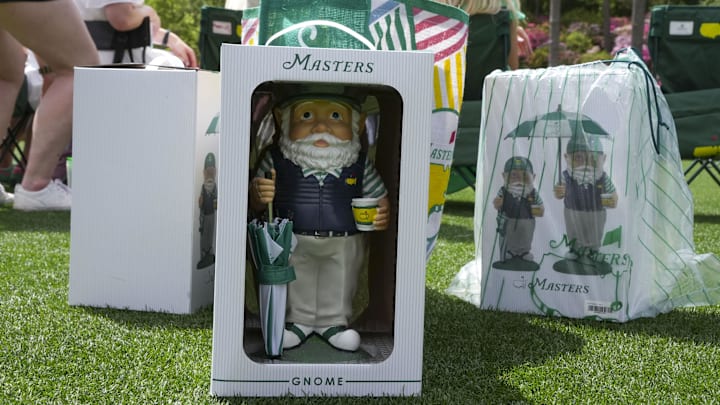
There’s no tradition like a new one. The Masters introduced a souvenir garden gnome statue, wearing a green and white argyle sweater, to its merchandise shop in 2016. It sold for $35. There’s no explaining the Cabbage Patch Doll-like frenzy that followed. Each year, a new model gnome is introduced and each year, it sells out rapidly. One of the 2016 gnomes sold at auction last summer for $10,195. As a buddy of mine said last year when he arrived to park Monday morning and saw spectators already leaving and carrying gnomes, “What do gnomes have to do with golf? I don’t get it.” Agreed.
You’ve gotta know when to hold ’em, when to fold ’em
It’s a tradition you can plop down your folding chair to reserve a prime viewing spot near any Masters green, leave and hike the rest of the course then return to sit down in your undisturbed A-plus spot. It’s an unspoken guaranteed reservation. The catch is that only one portable, foldable and arm-less chair per person (patrons in Masters-speak) is allowed. Rigid chairs or walking-stick chairs with points are prohibited. Don’t mess with the Chair Police.
Drive for show
Give the people what they want. The Masters used to hold a long-drive contest on Wednesday. The last one was in 1959. Sam Snead won in 1948 with a persimmon-wood blast of 290 yards, a bomb back then. How much fun would it be to bring that event back now? The winner would almost certainly be Bryson DeChambeau—sorry, Rory—because he stashed a few souped-up drivers from when he competed in the actual World Long Drive Championship a few years ago. Wednesday’s big event now is the Par-3 Contest, which features a lot of hit-and-giggle and wives and toddlers frolicking. It makes for good TV, apparently, but a Masters Long Drive Contest would be epic. Happy Gilmore could hit the ceremonial first tee shot.
A little nothing for the effort
The Masters membership includes some of the world’s richest (Bill Gates) captains of industry. Whether this qualifies as a rule or a tradition doesn’t really matter. But there is no tipping at Augusta National. Allegedly.
The Super Senior Division

No other sport honors its greats like the Masters. It is an emotional scene each year when the legends hit tee shots early Thursday morning off No. 1. Jack Nicklaus, Gary Player and Tom Watson perform the honors now. Arnold Palmer, Byron Nelson, Gene Sarazen and Sam Snead also took part for years. The tradition goes back to 1963 when old-timers Jock Hutchison and Fred McLeod were the first off. Back then, the twosome would play all 18 holes if they felt up to it, not just one tee shot. When Sarazen and Snead were the starters, they played 18 (in carts), then only 9 when Sarazen got too frail and eventually, just one tee shot. It was a thrill sometime in the ‘80s when I saw Sarazen hole a 60-foot putt to make par on the par-5 8th hole. Who’s next in line if any of the current legends retire? The contenders include Bernhard Langer, Fred Couples, Ben Crenshaw and Nick Faldo. Greg Norman? Not likely.
The Earl of Sandwich never authorized this
What does $1.50 buy you at any major American sporting venue? Maybe a cup of ice or a toothpick? It is a Masters tradition that food is affordable for fans—yeah, yeah, patrons—because as Bobby Jones noted, they spend the day at the course. Some long-time attendees swear the Masters isn’t official until they’ve spent $1.50 at the concession stand for their first pimento cheese sandwich, which comes in the traditional Masters green plastic wrapper. The sandwich is iconic item because of its creamy texture and slightly spicy taste. Or maybe its insanely low price. Pimento cheese is apparently a Southern thing. For some, it’s an acquired taste. For $1.50, sorry, I’d still take the toothpick.
The dinner before the dinner
Defending champion Scottie Scheffler got a lot of attention for hosting the annual Champions Dinner on Tuesday night, a gala event in which all past Masters champions who are able return for a swank dinner hosted—and paid for—by the defending champ, who also picks the menu. Scheffler drew praise for adding “Papa Scheff’s Ravioli” to the menu, a piece of self-deprecating humor referencing the incident in December when he tried to roll homemade ravioli with a wine glass. The glass shattered, slicing his hand and sidelining him for the first two months of 2025.
The 2026 Champions Dinner portrait. #themasters pic.twitter.com/wn6XTykQU5
— The Masters (@TheMasters) April 8, 2026
Augusta National also hosts the lesser-known Masters Amateur Dinner on Monday night for the amateurs who qualified to play in the tournament. It’s a way to welcome them and improve their comfort level … if that’s possible. Last year, that was Evan Beck, Jose Luis Ballester, Noah Kent, Justin Hastings and Hiroshi Tai. Ballester apparently got pretty comfortable because when he couldn’t find an on-course restroom during his round, he ended up using the woods left of the 13th fairway, leaving no doubt in the minds of spectators (located on the fairway’s other side) what he was doing. The Associated Press called him “The Masters Whiz Kid” in a headline.
Skip this hole

It is a practice round tradition for many contestants to try to hit a low shot and make it skip across the pond and up onto the 16th green. The man credited with starting this unusual tradition is Canadian Gary Cowan, a two-time U.S. Amateur champ. He did it in 1972 while playing with Ben Crenshaw. When Cowan pulled it off on the first try, Crenshaw wanted to see him do it again. Cowan did it twice more. Crenshaw tried it unsuccessfully twice but with a few tips from Cowan, got a third shot on dry land. The king of the skippers may be 2023 Masters champ Jon Rahm, who skipped a shot onto the green in 2016 and watched the ball trundle to the back of the green, catch the slope and make a sharp left turn, then coast into the hole for ace. Nobody tries this trick shot during the competition, obviously.
Heavy metal

The Masters champion gets the club’s traditional green jacket, of course. But that’s not all. It is also a tradition that he receives a stunning sterling silver replica of the Augusta National clubhouse, a gold medal and a gold locket. Only two of those fit in a pocket of the green jacket.
Second place doesn’t suck as much as you thought
Few notice that the Masters Tournament runner-up is rewarded with a silver medal, as is the U.S. Open runner-up. The British Open second-place finisher gets a silver salver, a polished tray. The Masters runner-up also pocketed $2.16 million last year, by the way.
How to eat like a Masters patron in your own home
A relatively recent tradition is the Taste of the Masters, a kit shipped to your home during tournament week made up of some of the concession stands’ finest foods. Pimento cheese sandwich? Check. Egg salad sandwich? Check. Pork bar-B-que sandwich? Check. Cookies and Masters logo cups and coasters? Check. Prices range from $99.95 to $184.95, depending upon how much pimento cheese you think you and your guests can keep down. Believe it or not, this spread usually sells out quickly.
That’s Ms. Golf to you

One short-lived tradition was a beauty pageant hosted by the city of Augusta during Masters week from 1957 to 1967. The winner was crowned Miss Golf and celebrated with a Tuesday afternoon parade of honor and, if she was really lucky, a flyover by a blimp squadron. Old photos of the event show one Miss Golf and her pageant sash planting a kiss on the cheek of a grinning Arnold Palmer.
From the Masters gift collection
The Masters champ isn’t the only one going home with prizes from Masters week. It’s been a tradition since 1954 to award crystal for outstanding performances. The player who shoots the low round each day scores a crystal vase. An eagle earns a pair of crystal highball glasses. A hole-in-one is worth a large crystal bowl. The Par-3 Contest champ wins a crystal pedestal bowl. The prizes used to be a big deal and get more attention than they do now but that’s probably due to the $21 million purse and the $4.2 million first prize that makes crystal gifts seem puny.
Rory McIlroy is No. 1 … this year

You may have noticed that each Masters contestant is assigned a number that is also displayed on his caddie’s bib. It’s a tradition that the defending champion gets No. 1. After that, the numbers are passed out in the order of check-in. Fans can use the caddie bib number to identify a player. Another tradition is that each player wears a small personal Masters badge that gives him course and clubhouse access since not every security guard may recognize the likes of Ben Griffin or Chris Gotterup.
On top of the world
Amateur contestants are allowed to spend the week in the Crow’s Nest, a small living space just below the clubhouse lookout. They don’t have to stay there, it’s optional and it’s also pretty Spartan. Even a Spartan might ask, “Is this it?”
There are four small cubicles with beds, one of which has bunk beds. There is only one bathroom for the group. The players share a common room with a couch, a coffee table, a TV and a card table. The players have access to the dining room, by the way, where filet mignon and peach cobbler are always on the menu.
The most famous Crow’s Nest tale was when amateurs Jack Nicklaus and Phil Rodgers stayed there in 1959 and neither was known for a slim profile. Since the ams were paying only $2 for dinner, they would order two steaks apiece. They soon got a warning about their avarice and were told they’d have to ante up another $2 for the second steak, which didn’t dissuade either one. Nicklaus recalled that they told the club to “keep the steaks coming.”
Dial M for Masters

Only about 100,000 pay phones are thought to exist in the U.S. (down from a peak of 2.6 million) and who would guess that Augusta National still has them. The club needs them because cell phones aren’t allowed on the grounds. There are several banks of phones, including ones near the first fairway (where the media center used to be) and the eighth green. The phones provide free calls across the globe and if the call recipient has caller ID, “Masters” appears on that screen. It’s a great opportunity to call your friends and rub it in.
The major cause of Hat Hair
When players come to the palatial media building (which is actually on the other side of where Berckmans Road used to be, off Augusta National’s original grounds), they are requested to remove their hats for the televised media interviews. Old-school decorum? No, it’s the Masters downplaying commercialism, since every player’s hat has a product logo on it. How seriously do Masters officials take commercialism? In the media concession area, the soft-drink taps that used to be labeled with Coca-Cola or Diet Coke logos, now simply say Cola or Diet Cola.
Summertime, when the livin’ is easy
In what may be the most unusual and ironic tradition of all, Augusta National closes its doors for play during the summer, when it’s golf season everywhere else. Now that’s a tradition truly unlike any other.
More Masters Coverage from Sports Illustrated
 Add us as a preferred source on Google
Van Sickle has covered golf since 1980, following the tours to 125 men’s major championships, 14 Ryder Cups and one sweet roundtrip flight on the late Concorde. He is likely the only active golf writer who covered Tiger Woods during his first pro victory, in Las Vegas in 1996, and his 81st, in Augusta. Van Sickle’s work appeared, in order, in The Milwaukee Journal, Golf World magazine, Sports Illustrated (20 years) and Golf.com. He is a former president of the Golf Writers Association of America. His knees are shot, but he used to be a half-decent player. He competed in two national championships (U.S. Senior Amateur, most recently in 2014); made it to U.S. Open sectional qualifying once and narrowly missed the Open by a scant 17 shots (mostly due to poor officiating); won 10 club championships; and made seven holes-in-one (though none lately). Van Sickle’s golf equipment stories usually are based on personal field-testing, not press-release rewrites. His nickname is Van Cynical. Yeah, he earned it.
Follow GaryVanSickle