%20%20--%3E%0A%3Csvg%20version%3D%221.1%22%20id%3D%22Layer_1%22%20xmlns%3D%22http%3A%2F%2Fwww.w3.org%2F2000%2Fsvg%22%20xmlns%3Axlink%3D%22http%3A%2F%2Fwww.w3.org%2F1999%2Fxlink%22%20x%3D%220px%22%20y%3D%220px%22%0A%09%20width%3D%2239px%22%20height%3D%2240px%22%20viewBox%3D%220%200%2039%2040%22%20enable-background%3D%22new%200%200%2039%2040%22%20xml%3Aspace%3D%22preserve%22%3E%0A%3Cpath%20fill%3D%22%23FFFFFF%22%20d%3D%22M38.5%2C7H28.2v26h10.3V7z%22%2F%3E%0A%3Cpath%20fill-rule%3D%22evenodd%22%20clip-rule%3D%22evenodd%22%20fill%3D%22%23FFFFFF%22%20d%3D%22M26.1%2C25.5c0%2C5.8-4.1%2C7.5-12.9%2C7.5C3.9%2C33%2C0%2C31.2%2C0%2C25.2v-1.1h11.6%0A%09v2.4c0%2C0.7%2C0.1%2C1.4%2C1.2%2C1.4c1%2C0%2C1.2-0.4%2C1.2-1.3v-0.9c0-1.6-0.9-1.6-3.5-2.2C2.2%2C21.7%2C0%2C19.7%2C0%2C15.3v-0.9C0%2C9.3%2C5.5%2C7%2C12.9%2C7%0A%09c10.2%2C0%2C12.8%2C2.6%2C12.8%2C7.4v1.8h-11v-2.9c0-0.6-0.4-1.1-1.2-1.1c-0.6%2C0-1.2%2C0.4-1.2%2C1.1v0.9c0%2C1.5%2C0.9%2C2%2C3.3%2C2.5%0A%09c8%2C1.6%2C10.5%2C3.3%2C10.5%2C7.5V25.5z%22%2F%3E%0A%3C%2Fsvg%3E%0A)
How a Decision Three Decades Ago Is Pushing Japan Toward a Kentucky Derby Win
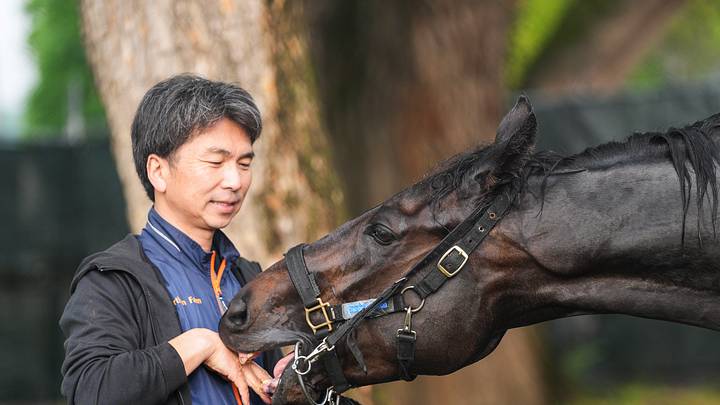
LOUISVILLE — Japanese racing has become a consistent presence at the Kentucky Derby over the last decade, but the visitors remain shrouded in mystery. Their horses are kept in detention barns at Churchill Downs for health reasons, surrounded by a forbidding chain-link fence that bears a USDA sign reading “ISOLATION” in bold letters. They bring their own language, own jockeys, own trainers and own way of doing things to Louisville.
They’ve been lost in translation, and have lost all attempts to win the Derby. Eight Japan-based horses have run the race, seven of them in the last 10 years, with none finishing better than third. (A notable third, which we’ll get to.) The average finish has been 10th.
But the racing world is largely in agreement that a Japanese Derby victory is inevitable. The country’s racing industry has invested too much, too wisely, for too long to be denied. Racing consultant and liaison Kate Hunter—a Nashville native and resident of Chiba, Japan—is here to underscore that in plain, brassy English.
“My goal in life is to be some American trainer’s worst nightmare,” Hunter said. “To bring over a Japanese horse that’s going to ruin Kentucky Derby day. So I apologize in advance for bringing over the Japanese.”
She laughed, but the intent was clear. They’re coming for the Derby.
This year, Hunter is serving as the point person for Danon Bourbon (20–1 in the morning-line odds) and Wonder Dean (30–1). Long odds, but legit horses. Danon Bourbon, undefeated in three races, has become a wise guy tout among the morning workout watchers at Churchill. Expect his odds to come down before post time Saturday.
Hunter fired that warning shot to the American racing establishment Tuesday outside Barn 17. She was wearing a jacket that backs up the confidence: “Forever Young” read the white letters on the red coat.
Forever Young could have been the first Japanese Derby winner two years ago, if not for horrific racing luck. Slow out of the gate and bumping with fellow Japanese import TO Password, he overcame that to loom in contention in the stretch. Forever Young and Sierra Leone chased Mystik Dan to the wire, with Sierra Leone lugging in and crowding (arguably impeding) Forever Young to the inside. Mystik Dan prevailed in a three-horse photo finish.
Forever Young has gone on to international greatness thereafter. He’s won races in Japan, the Middle East and the United States, capturing the Breeders’ Cup Classic last fall. His lifetime earnings exceed $31 million.
“The success of Forever Young has inspired a lot of Japanese trainers that, yeah, we can do this,” said NBC racing analyst Randy Moss. “Whether this year is the year they can break through is questionable. But it’s just a matter of time before they win the Kentucky Derby and other Triple Crown races.”
The rise of the Rising Sun as a racing force dates to a fateful breeding decision in 1990.
Despite winning the 1989 Kentucky Derby, Preakness and Breeders’ Cup Classic, Sunday Silence was not highly valued as a stallion prospect upon retirement. His conformation was widely criticized—“inward-turning hocks” loosely translated to being awkwardly knock-kneed, which was viewed as a recipe for injury. His stature was unimpressive. Sunday Silence ran fast but looked flawed, and the breeding industry was not enthusiastic about passing along his traits to future offspring.
In the inimitable words of Los Angeles Times columnist Jim Murray: “He was so ugly he was almost two years old before they were sure he wasn’t going to be a camel.”
Owner Arthur Hancock III had already sold 25% interest in Sunday Silence to Japan’s Zenya Yoshida near the end of the colt’s 3-year-old season. Sensing a lack of a market in the breeding shed upon the horse’s retirement from racing, Hancock went ahead and sold full rights to Yoshida before he’d ever covered a mare in the U.S. Sunday Silence moved across the world and—seemingly—into obscurity.
Yet while North American breeding and racing moved on without giving it much thought, Sunday Silence became the foundation stallion of Japanese racing. He was the leading stallion in Japan annually from 1995 to 2007, siring more than 1,500 foals and producing multiple champions.
Among Sunday Silence’s final progeny was the colt Deep Impact, who won 12 out of 14 races, including the Japan Triple Crown. He followed his father in becoming the dominant sire in the nation’s breeding industry. Deep Impact is the grandsire of Forever Young and Wonder Dean.
(It should be noted that Danon Bourbon is a Kentucky-bred, sired by Maxfield, who was undefeated in five races at Churchill Downs. Danon Bourbon was purchased by Japanese interests as a yearling for $450,000 and has raced exclusively in Japan until now.)
“They have produced a fantastic thoroughbred breeding and racing product,” says Chauncey Morris of the Kentucky Thoroughbred Association. “They have created their own breed over there that is hyper-competitive.”
With the sire lines established in Japan, a second crucial decision was made. The nation’s top breeders went international in search of the best broodmares. They were a presence at the big bloodstock sales at Keeneland in Lexington, in Ocala, Fla., in Saratoga, N.Y., and in Europe—and they were buying up well-bred female horses.
“A lot of emphasis on the mares,” said Hunter, who majored in Japanese Studies at Earlham College in Richmond, Ind., before moving to Japan. “They really played a heavy role in creating the modern Japanese thoroughbreds. One of the things they’ve been doing for the past few decades, coming to Keeneland, going all over the world to buy the absolutely best mares and then breed those best mares to their homegrown best Japanese stallions and then getting something from there.
“It’s been a winning combination, breed the best to the best. They’re not hoping for the best. They’re getting the best.”

The nation’s best 3-year-olds earned their Run for the Roses automatic berths by capturing the Japan Road to the Kentucky Derby (Danon Bourbon) and the Euro/Middle East Road to the Kentucky Derby (Wonder Dean, who won the UAE Derby). Upon arrival in Louisville, they commenced their usual unique training regimen.
American racehorses usually spend a couple of minutes on the track every morning—they show up, they run a few furlongs, they return to the barn to cool down. The Japanese horses have an extensive pre-workout routine—walking the shed row at the barn for quite a while and then turning slow, jogging circles in the Churchill mile chute before proceeding to a full gallop around the oval. Their track time can stretch to 10 minutes per morning.
The reasoning is sensible: like any athlete, the horses need time to warm up before exerting themselves. It’s just different from the way American trainers work their animals.
When it’s time for full-on exertion—a timed workout over a distance of anywhere from three to eight furlongs—the Japanese have tended to be more restrained here than their American counterparts. Danon Bourbon and Wonder Dean worked four furlongs Tuesday morning in 52 4/5 seconds and 54 3/5, respectively—glacial times compared to the American horses, but the works also came closer to the race.
But being fit and ready for the race is only part of the equation. The greater challenge might be jumping from the fairly orderly environment of international racing to the sensory overload of the Kentucky Derby. In football terms, it’s like going from a controlled scrimmage on your home practice field to Saturday night in Death Valley.
All hell is going to break loose, and the horses have to handle it. This is where Hunter’s experience across previous Derbies comes into play. She doesn’t just translate the language for the Japanese horsemen; she translates the Derby tumult and how to prepare for it.
“America,” she said, “is just a whole new ball of wax.”
From the time the horses leave their barns to walk over to the grandstand for the race Saturday evening, noise and crowds will be constants. There are 150,000 people in attendance, many of whom have been drinking all day.
The new Churchill paddock, where the horses are saddled, is its own mini-coliseum, surrounded by fans on two levels. Most trainers will “school” their horses in the paddock in preparation—bringing them through the area during the races in the days leading up to the Derby, to gain some acclimation.
“It’s not typically done in Japan,” Hunter said. “Last year was the first year I managed to convince them to do it, and the trainers who did it were very glad they did it. They thought it was good for the horses and good for the people. Ultimately it’s up to the trainer and how he thinks his horse will handle it because it can be a very stressful schooling experience. It might take too much out of a horse.
“The Japanese crowds are usually pretty big, they’ve experienced decent crowds. But I keep trying to explain to them, you’ve never experienced a crowd until you’ve experienced a Kentucky Derby crowd.”
It’s a road game for the Japanese imports. The 90-minute buildup to the race can be bewildering. The two-minute race will be fast and furious, with carefully laid plans often evaporating the second the gates open and 20 horses burst forth—many of them not in a straight line. Racing luck will collide with talent and tenacity.
“May the best horse win,” says Morris.
Sooner or later, the best Kentucky Derby horse will be from Japan. It’s not a matter of if; it’s a matter of when.
More Horse Racing From Sports Illustrated
 Add us as a preferred source on Google
Pat Forde is a senior writer for Sports Illustrated who covers college football and college basketball as well as the Olympics and horse racing. He cohosts the Others Receiving Votes podcast for SI and is a regular contributor to the Tony Kornheiser Show podcast. He previously worked for Yahoo Sports, ESPN and The (Louisville) Courier-Journal. Forde has won 28 Associated Press Sports Editors writing contest awards, has been published three times in the Best American Sports Writing book series, and was nominated for the 1990 Pulitzer Prize. A past president of the U.S. Basketball Writers Association and member of the Football Writers Association of America, he lives in Louisville with his wife. They have three children, all of whom were collegiate swimmers.
Follow ByPatForde