%20%20--%3E%0A%3Csvg%20version%3D%221.1%22%20id%3D%22Layer_1%22%20xmlns%3D%22http%3A%2F%2Fwww.w3.org%2F2000%2Fsvg%22%20xmlns%3Axlink%3D%22http%3A%2F%2Fwww.w3.org%2F1999%2Fxlink%22%20x%3D%220px%22%20y%3D%220px%22%0A%09%20width%3D%2239px%22%20height%3D%2240px%22%20viewBox%3D%220%200%2039%2040%22%20enable-background%3D%22new%200%200%2039%2040%22%20xml%3Aspace%3D%22preserve%22%3E%0A%3Cpath%20fill%3D%22%23FFFFFF%22%20d%3D%22M38.5%2C7H28.2v26h10.3V7z%22%2F%3E%0A%3Cpath%20fill-rule%3D%22evenodd%22%20clip-rule%3D%22evenodd%22%20fill%3D%22%23FFFFFF%22%20d%3D%22M26.1%2C25.5c0%2C5.8-4.1%2C7.5-12.9%2C7.5C3.9%2C33%2C0%2C31.2%2C0%2C25.2v-1.1h11.6%0A%09v2.4c0%2C0.7%2C0.1%2C1.4%2C1.2%2C1.4c1%2C0%2C1.2-0.4%2C1.2-1.3v-0.9c0-1.6-0.9-1.6-3.5-2.2C2.2%2C21.7%2C0%2C19.7%2C0%2C15.3v-0.9C0%2C9.3%2C5.5%2C7%2C12.9%2C7%0A%09c10.2%2C0%2C12.8%2C2.6%2C12.8%2C7.4v1.8h-11v-2.9c0-0.6-0.4-1.1-1.2-1.1c-0.6%2C0-1.2%2C0.4-1.2%2C1.1v0.9c0%2C1.5%2C0.9%2C2%2C3.3%2C2.5%0A%09c8%2C1.6%2C10.5%2C3.3%2C10.5%2C7.5V25.5z%22%2F%3E%0A%3C%2Fsvg%3E%0A)
Yordan Alvarez Didn’t Need Defense to Prove He Was the AL MVP
In this story:
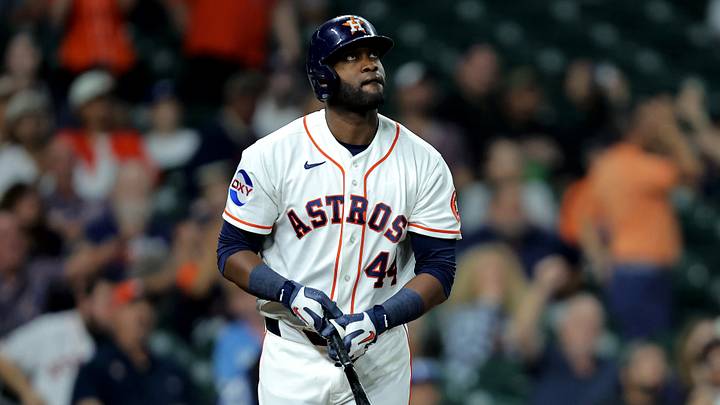
Yordan Alvarez was named the 2026 American League’s Most Valuable Player on Thursday night, becoming the second player to ever be named a league’s MVP while serving as his team’s designated hitter. The only other player to achieve that feat was Shohei Ohtani, who did it four times with the Angels and Dodgers, though he also pitched in some of those campaigns.
The MVP award isn’t distributed to MLB’s best all-around player. If it were, Alvarez would be completely out of the picture given his lackluster abilities in the outfield on the rare occasion he does play there (-5 defensive runs saved in 25 appearances this season). But that’s not his job for the Astros. His job is to elevate the offense and create run-scoring opportunities, or be on the delivering end of said opportunities, not track down fly balls. And that’s exactly what he did all throughout 2026––at a level higher than anyone else in the sport, at that.
Alvarez was far and away the American League’s most productive offensive player. The 29-year-old flirted with the AL Triple Crown, but ultimately narrowly missed out after Pete Alonso ended the year with seven more RBIs and one more home run than Alvarez. Still, perhaps even more impressive, he did become just the ninth player in MLB history to win the Slash Triple Crown, leading the majors in batting average (.316), on base percentage (.432) and slugging percentage (.601).
That also means the Astros slugger led MLB with a 1.033 OPS, and there was a comfortable gap of 91 points separating him from the next best player in that category (Pete Crow-Armstrong, .942). In fact, only three qualified players finished the season with an OPS above .900––Alvarez, Crow-Armstrong and Willson Contreras. And it’s not just his power at the plate that makes the 29-year-old such an elite offensive player. Among the eight players with 40 or more home runs, Alvarez also struck out the fewest times (120).
Among all qualified hitters, Alvarez’s 181 wRC+ was easily the best in MLB, far outpacing Crow-Armstrong’s mark of 157. That stat essentially means Alvarez was 81 percent better than the average MLB hitter. Additionally, his 6.8 fWAR was the second-best in the American League, narrowly trailing Bobby Witt (7.0), who is largely propped up by defensive metrics and finished xxxxx in the voting. Yankees slugger Ben Rice was the next-closest primary designated hitter at 4.2, followed by the Royals’ Carter Jensen (3.7).
In league history, there have been only two seasons in which a primary DH registered a higher fWAR than Alvarez’s 6.8––Edgar Martinez in 1995 (7.0) and Shohei Ohtani in 2024 (9.0). Ohtani won the NL MVP in ‘24, while Martinez was overlooked for the ‘95 AL MVP, as voters favored Red Sox first baseman Mo Vaughn in one of the closest three-way votes in league history. (Martinez ultimately finished third in voting that year behind Albert Belle, too.) Modern metrics indicate they miscalculated.
Alvarez’s advanced metrics, meanwhile, were simply jaw-dropping to be ignored. The slugger ranked in the 97th percentile or better in the following categories; xwOBA, xBA, xSLG, average exit velocity, barrel rate, hard-hit rate, launch-angle sweet spot rate, and walk rate. He was also in the 74th percentile in terms of strikeout rate (17.2%). All that to say, Alvarez hits the ball extremely hard, extremely consistently and doesn’t strikeout often. And when he’s not hitting the ball extremely hard, he’s frequently showcasing his patience at the plate by drawing walks. Regardless of what approach pitchers take to combat him in the batter’s box, Alvarez didn’t falter.
Houston was a below-average team this year and snuck into the playoffs thanks to the dreadful seasons endured by their division rivals. They were the first team in MLB history to reach the playoffs with a record of .500 or worse. Making the postseason would’ve been nothing more than a pipe dream for the Astros if it weren’t for Alvarez’s heroics at the plate. He led the club in virtually every hitting category, including home runs, RBIs, runs, walks, OPS, doubles and total bases.
Keep in mind, Alvarez played in just 45 games last season while navigating injuries (leading to him being named the AL Comeback Player of the Year on Wednesday). Houston’s offense suffered as a result of that, and finished 21st in MLB with 686 runs. It was clear how much they missed Alvarez in the lineup. Compare that to this season, when the Astros ranked seventh in OPS, led the league in home runs (226) and were 13th in runs scored (734). It’s not difficult to see the degree to which Alvarez elevates this offense and the impact he has on a nightly basis.

The other finalists
Alvarez got the edge from MVP voters over Royals shortstop Bobby Witt Jr. and Rays third baseman Junior Caminero. Of the three, Witt had the highest fWAR (7.0), though his offensive numbers pale in comparison to the other finalists.
Witt ranked third in MLB with 24 outs above average and 18 runs prevented, per Statcast, to highlight his defense-oriented case. On offense, he logged a .800 OPS with 18 home runs, 54 RBIs, 45 stolen bases and 94 runs scored. Witt’s top-tier speed and outstanding defense make him a viable MVP candidate, but Alvarez’s elite offensive production was simply too great to ignore. His OPS was 233 points higher than Witt’s and he had more than twice as many home runs. In this instance, Alvarez’s lack of defense aptitude wasn’t enough to sway MVP voters away from him.
As for Caminero, he was a challenger to Alvarez in most offensive categories. Defense isn’t much of a factor of the Rays third baseman’s game. While he’s not a DH, he’s one of the worst defenders in the league, registering -14 outs above average at the hot corner this year. Only three players in all of MLB registered worse defensive ratings than Caminero––Willy Adames, CJ Abrams (who switched positions to second base amid his prolonged struggles at shortstop) and Andruw Monasterio. Caminero hit 42 home runs, the same amount as Alvarez, and registered 101 RBIs, but he struck out more, walked less often and had fewer extra-base hits. As a result, his OPS was .884––eighth best in MLB but still 149 points lower than that of Alvarez.
This was Alvarez’s best season, and after never previously finishing higher than third in AL MVP voting, the Astros star was finally, and rightfully, able to claim the award as his own.
 Add us as a preferred source on Google

Karl Rasmussen is a staff writer for Sports Illustrated. A University of Oregon alum who joined SI in February 2023, his work has appeared on 12up and ClutchPoints. Rasmussen is a loyal Tottenham, Jets, Yankees and Ducks fan.
Follow Karlras920