
Jeffrey Springs or Aaron Civale: What the Data Says About Their Hot Starts
In this story:
The A's are coming off of a 5-1 week in which they led all of MLB in ERA, posting a 2.21 in six games against the Yankees and Mets. The week also consisted of three shutouts, including in three of the past four games. The pitching staff has been tremendous the past week, and ranks 22nd in baseball for the season, putting up a 4.20 ERA (4.64 FIP).
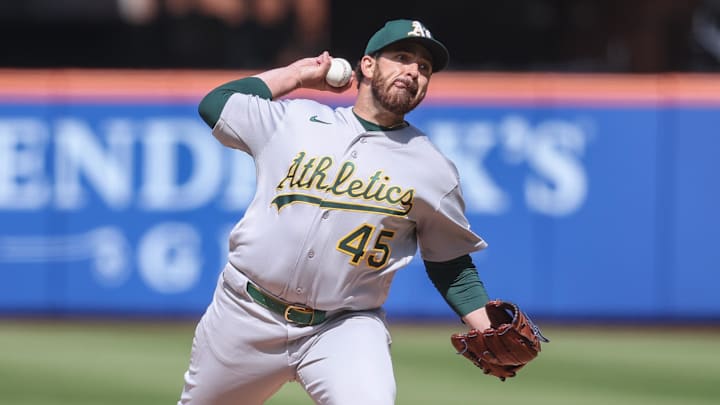
The two early standouts this season have been lefty Jeffrey Springs in his second year with the club, and free agent addition Aaron Civale.
The left-hander is holding onto a 1.47 ERA after three starts spanning 18 1/3 innings of work, while Civale is holding a 1.72 ERA across 15 2/3 innings. With these two standouts, we decided to look into their advanced stats a bit, and discovered that the data is suggesting troubling times ahead for one of them.
Jeffrey Springs hitting the ground running

At the end of last season, Jeffrey Springs talked about some of the early season struggles he had adjusting to Sutter Health Park in Sacramento, and getting his pitches where he wanted them to be in his first full season back from injury. You got the sense that he would be in a much better spot to begin this season, and early on, he's been tremendous.
The first thing you notice when looking at his Baseball Savant page is the amount of red that litters it in key areas. The two most noticeable spots are his expected ERA (xERA), which sits at 2.19 (89th percentile) and his average exit velocity of 84.6 miles per hour, which ranks in the 90th percentile. Limiting hard contact generally leads to a lower ERA.
He's also looking good in barrel% (74th) and hard-hit% (81st), which are all right in that same vein of limiting hard contact, and these all show similar outcomes, which is encouraging.
The stats on his pitch mix are also encouraging.
Four-seamer: .136 batting average, .181 xBA
Changeup: .059 batting average, .108 xBA
Slider: .250 batting average, .250 xBA
Sweeper: .000 batting average, .072 xBA
Cutter: .000 batting average, .108 xBA
That all goes back to Springs limiting hard contact. The highest expected slugging percentage he has is on the four-seamer at .332, which is also solid. League average this season for slugging percentage sits at .375, while his .332 on the heater is right around the offensive production of the Reds or Royals, who rank 27th and 28th in MLB in slugging.
So his "worst" pitch is also limiting opposing offenses to one of the worst in the game.
While his BABIP sits at .170, meaning there is some luck involved in his stats, the contact that he's been giving up suggests that he's earning a fair amount of that luck. He also has a left-on-base rate of 78.6%, which is a little better than league average (72%), but not in another realm completely.
On top of the mentality he has this season, his stuff has been grading out better and his location has been among the best in baseball. While holding a 1.47 ERA may not be the expectation for Springs all season, these numbers suggest he could be a huge part of the A's rotation throughout the campaign if he's throwing the ball like this.
Aaron Civale's metrics convey a different story

While this isn't the biggest point of contention, we should point out up top that Civale hasn't made a start at Sutter Health Park yet, and will be the last member of the Opening Day rotation to do so with Luis Severino crossing his name off the list on Monday night. Given his unfamiliarity with the ballpark, that could play a role in his outcomes reversing.
That said, his advanced metrics are also pointing the wrong way.
While Springs' Savant page was littered with read, Civale's best ranking is his 8.1% walk rate, which ranks in the 63rd percentile. Otherwise, there is a lot of rankings at or below league average, even while he has been off to a solid start.
His xERA sits at 3.70 (55th percentile), and his xBA of .235 ranks in the 54th. The biggest red flag for us is that his LOB% sits at 98.4%, which is top-10 in baseball. The reason it's so high is because of the small sample size we're operating with.
Last year, Freddy Peralta held the best LOB% at 85.5%, with Garrett Crochet right behind him at 84.3%. Civale isn't quite that same level of pitcher, and there should be a decent amount of regression here.
His pitch mix also provides a similar sign:
Cutter: .154 batting average, .278 xBA
Sinker: .333 batting average, .306 xBA
Curveball: .067 batting average, .136 xBA
Four-seamer: .167 batting average, .160 xBA
Split-finger: .250 batting average, .261 xBA
Slider: .000 batting average, .323 xBA
His slugging percentages (and xSLG) are much higher, especially with the sinker (.539 expected) and four-seamer (.597 expected), while his launch angle nearly across the board is between 11 and 16 degrees for his most-used pitches. Those are line drives, especially with his average exit velocity of 91.8 mph (16th percentile).
This all said, the role he is providing is exactly what he was brought in to do. The expectation is for him to provide roughly five innings every fifth day and to be a stabilizing presence in the rotation. If he can provide the innings the A's are after while giving his team a chance to win ball games each time out, then he'll be doing just fine.
For more A's insight and analysis, make sure to follow Jason on X @ByJasonB or BlueSky @JasonBurke and the site's Facebook page!
 Add us as a preferred source on Google
Jason has been covering the A’s at various sites for over a decade, and was the original host of the Locked on A’s podcast. Mason Miller once said he likes Jason's content.
Follow byjasonb