
Braves Face Difficult Choice as Starting Pitching Market Takes Shape
In this story:
The Braves won 94 games last season without making a major starting-pitching addition, and the rotation they'll carry into 2027 still has plenty of question marks.
Many debate which pitcher, but that could be the wrong question being asked. It's what kind of pitcher, and how many. Should Atlanta spend big on one premium starter or spread its money across two dependable mid-tier arms? That choice will shape the rest of the offseason, and the calendar isn't doing the Braves any favors.
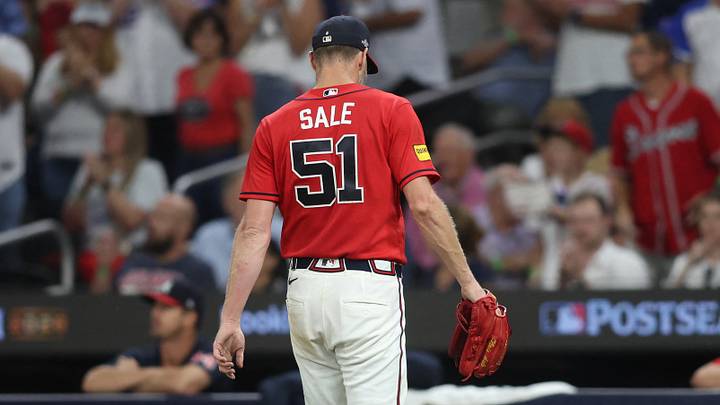
Start with the anchor. Chris Sale is signed through 2027 on a one-year, $27 million extension, with a $30 million club option for 2028. He'll pitch next season at 38, so managing his workload is going to matter, and he can't be asked to carry the staff by himself.
Behind him, the picture gets murkier. The list of pitchers who have missed and/or are expected to miss significant time in the last couple of years is a long one: Spencer Strider, Spencer Schwellenbach, Hurston Waldrep and Reynaldo López are all either going to be huge question marks in 2027 or absent altogether. On top of that, it's not clear yet what the roles of Grant Holmes, Ray Kerr and Didier Fuentes might be. All of those questions loom over the team.
Alex Anthopoulos has been fairly blunt about the first two and his expectations for them. He said Strider and Schwellenbach could return in 2027, but that it wouldn't be responsible to count on either of them for a full workload given their injury histories. That's the sentence I'd build the entire offseason around. Atlanta doesn't just need good pitchers. It needs innings, and a lot of them.
If the Braves want a true No. 2 behind Sale, the top of the market is where you look. Michael King and Freddy Peralta are both expected to land sizable multiyear deals. Trevor Rogers is projected to get somewhere between $75 and $100 million.
Tarik Skubal is projected at more than $300 million and will likely command at least $45 million a year, so he's a reference point more than a realistic target. The Braves reportedly explored acquiring him at the deadline, but I wouldn't expect them to revisit it this winter, given Anthopoulos' propensity to avoid massive free agent contracts.
The upside is obvious. A true No. 2 gives you a playoff-caliber arm, and if he's young enough, a successor for when Sale's contract runs out. The downside is just as clear. Put the whole budget on one pitcher and one injury wipes out the plan. There's also less left over for left field and shortstop, which is a problem when the team still needs both.
And there's an extra wrinkle with Rogers specifically. He's expected to decline the Orioles' qualifying offer, and the decision is due Nov. 17. Because Atlanta exceeded the luxury tax in 2026, signing him would also cost the Braves draft picks and international bonus money, on top of the contract. That's a cost this front office may not want to pay.
The other path is quantity and balance. There are plenty of names for the Braves to work with. Nick Martinez, an All-Star in 2026, could get around $40 million over two years. Clay Holmes is likely to get multiple years after declining his $12 million option, and his ground-ball tendencies would suit Atlanta.
Kevin Gausman is a candidate for a large one- or two-year deal, and while his ERA was 4.51 last season, the underlying numbers suggest he was unlucky. I've already made the case for Gausman, so I won't repeat it here.
Then there's the familiar name that I've also already brought up as a smart choice. Tyler Mahle went 7-10 with a 3.99 ERA in 149 innings between San Francisco and Atlanta, including a 1.99 ERA in nine appearances after the trade, and both he and the Braves have expressed a desire for him to return.
The benefits of this route are real. You get more total innings, protection against injuries, a lighter load for Sale and a lower risk on each contract. The drawbacks are real too.
Every dollar the Braves spend on the rotation is a dollar they can't spend on left field, where Randy Arozarena, Seiya Suzuki and Luis Robert Jr. are all in the mix, or at shortstop, where Mauricio Dubón is the obvious choice. This is where my recent pieces meet in the middle.
The clock is a factor, too. The collective bargaining agreement expires December 1, and a lockout looks increasingly likely. That would freeze transactions, which means executives expect a flood of deals before then. That leaves the Braves with less time to settle on an approach.
As I've pointed out, if history is any guide, Anthopoulos has tended to prefer shorter deals and trades over massive, long-term contracts. Sale's one-year extension fits that pattern. That's not a prediction, only a tendency worth keeping in mind.
Ultimately, this comes down to a simple choice. One star gives you upside, a playoff-caliber arm and a potential successor to Sale, but at the cost of depth and flexibility. Two solid veterans give you innings and insurance, but probably no pitcher you'd call a true ace. Neither answer is wrong. The Braves just have to decide which risk they'd rather live with.
Sign up for our free Atlanta Braves on SI newsletter for the latest news
 Add us as a preferred source on Google

Roman is the founder of Empire Sports Talk with a focus on producing written and digital content focused on MLB news, analysis and commentary.
Follow EmpireSportsPod