%20%20--%3E%0A%3Csvg%20version%3D%221.1%22%20id%3D%22Layer_1%22%20xmlns%3D%22http%3A%2F%2Fwww.w3.org%2F2000%2Fsvg%22%20xmlns%3Axlink%3D%22http%3A%2F%2Fwww.w3.org%2F1999%2Fxlink%22%20x%3D%220px%22%20y%3D%220px%22%0A%09%20width%3D%2239px%22%20height%3D%2240px%22%20viewBox%3D%220%200%2039%2040%22%20enable-background%3D%22new%200%200%2039%2040%22%20xml%3Aspace%3D%22preserve%22%3E%0A%3Cpath%20fill%3D%22%23FFFFFF%22%20d%3D%22M38.5%2C7H28.2v26h10.3V7z%22%2F%3E%0A%3Cpath%20fill-rule%3D%22evenodd%22%20clip-rule%3D%22evenodd%22%20fill%3D%22%23FFFFFF%22%20d%3D%22M26.1%2C25.5c0%2C5.8-4.1%2C7.5-12.9%2C7.5C3.9%2C33%2C0%2C31.2%2C0%2C25.2v-1.1h11.6%0A%09v2.4c0%2C0.7%2C0.1%2C1.4%2C1.2%2C1.4c1%2C0%2C1.2-0.4%2C1.2-1.3v-0.9c0-1.6-0.9-1.6-3.5-2.2C2.2%2C21.7%2C0%2C19.7%2C0%2C15.3v-0.9C0%2C9.3%2C5.5%2C7%2C12.9%2C7%0A%09c10.2%2C0%2C12.8%2C2.6%2C12.8%2C7.4v1.8h-11v-2.9c0-0.6-0.4-1.1-1.2-1.1c-0.6%2C0-1.2%2C0.4-1.2%2C1.1v0.9c0%2C1.5%2C0.9%2C2%2C3.3%2C2.5%0A%09c8%2C1.6%2C10.5%2C3.3%2C10.5%2C7.5V25.5z%22%2F%3E%0A%3C%2Fsvg%3E%0A)
How Don Mattingly Became the Phillies' New Interim Manager
In this story:
Welcome to Verducci’s View, a new weekly baseball newsletter from Sports Illustrated senior writer Tom Verducci. Every Monday, Tom will empty out his notebook over email and cover MLB’s hottest topics, provide in-depth analysis through both text and video breakdowns, look forward to what’s worth watching during the week and more. This week, we’re focusing on new Phillies interim manager Don Mattingly, what's bugging Rafael Devers and more.
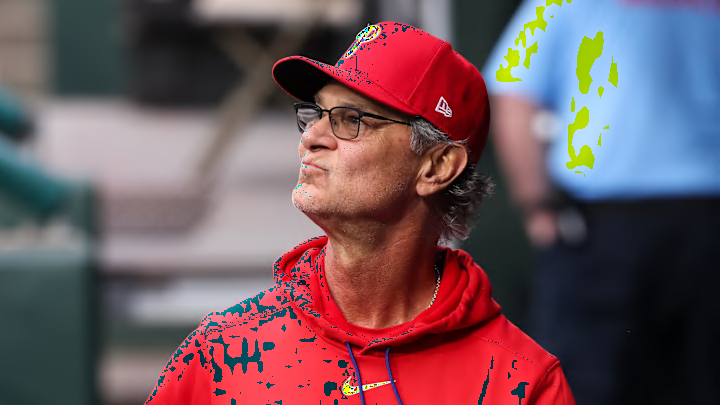
Don Mattingly was washing clothes and restocking his apartment with groceries, the banalities of a rare off day in the baseball season, when his phone rang. He saw the caller was Dave Dombrowski, the Phillies’ president of baseball operations. It was last Monday. The Phillies were 9–19. This was two days after the Red Sox broke the managerial ice by firing Alex Cora. He had a feeling what was about to go down.
“I’ve been around long enough to know the vibe in a city like New York or Boston or wherever,” Mattingly says. “And the Boston thing had just gone down. You could feel something like this has a chance to happen. And so, it wasn’t a huge surprise.”
Dombrowski asked Mattingly, his bench coach, to manage the team, replacing Rob Thomson, whom Dombrowski fired. Dombrowski called Mattingly only after Cora, his first choice, turned him down.
“Obviously the talk is that we wanted Alex and Alex didn’t want to do it,” Mattingly says. “So, when he called, I’m like, Yeah, I’ll do it. And it’s kinda as simple as that.”
As with Thomson in 2022, the Phillies stumbled upon an accidental manager who has the gift of having to prove nothing, who doesn’t need the job. Just as Thomson was prepared to end his days in baseball, Mattingly had a foot out the door after he left his job as the Blue Jays' bench coach after Toronto lost Game 7 of the World Series, the first World Series Mattingly reached.
“I honestly thought all year long last year thinking, this is it for me,” he says. “I love Toronto. I like the people over there, the organization. I felt like my time had kind of ran out there. It was just time.
“I felt like I knew going into the season it was going to be time for that. So yeah, as the season ended, I thought, O.K., that’s it.”
Then, about two weeks after the World Series, Dombrowski called him. He told him how well he would fit in with the Phillies. He didn’t have to remind him that Preston Mattingly, Don’s kid, is the general manager. He gave Don all the time he needed to think about it.
Meanwhile, Don’s youngest son, Louie, 11, who had such fun enjoying the World Series run, told his father, “You know, Dad, you can’t quit.”
“Oh, I don’t know, Louie,” Don said.
Don’s wife heard that and said, “Oh, we’re going to do this again?”
Ultimately, the answer was yes. It was too good to pass up, working with Preston, seeing his granddaughter and making Louie happy.
Twenty-eight games into the season, Mattingly, a second choice, became the accidental manager. He admits he won’t do much differently than Thomson.
“I feel comfortable,” he says. “I’ve been basically trying to think like Thomson all year long. That’s the role of the bench coach, trying to be with him.”
It’s a blessing to have the manager’s job and not need it. No score to settle from your former team. No proving ground. No fear of being fired. No eggshells on which to walk to keep your job. It served Joe Torre well in 1996 under George Steinbrenner. (Torre’s famous line was, “What’s the worst thing that could happen to me? I get fired? That’s happened three times already.”) Joe Morgan in 1988. Jack McKeon in 2003. Thomson in 2022.
The Phillies won their first four games under Mattingly before a one-hit shutout loss to Miami on Saturday reminded everyone this team has deep flaws. It has no cleanup hitter (29th in OPS). The back half of the lineup is weak. Their hitters chase too much (fifth most in MLB). The defense is poor (27th in Outs Above Average, worst in batting average allowed on balls in play).
Changing the manager won’t fix those issues. Mattingly is there for the same reason Thomson succeeded Joe Girardi: The team was underachieving and needed the quickest fix, a new voice, before the season slipped away early. In Mattingly, they have a voice of strength and rectitude who has the freedom of playing with house money.
“I really feel like I’m a lot like Thomps,” he says, “but I’m not Thomps. I’ve got to be myself. I let them know the things that I see, the areas that I feel where we have to get better. Pressing on the details, pressing on playing better, pressing on us sticking together and fighting. I know the talent is there. It’s not a hard sell. It’s not a sell at all. It’s like, Play better. We play better; we’re going to win. And there’s plenty of time.”
The Pirates’ Power Plant

Nobody throws fastballs like the Pirates. In an era of declining fastball use, Pittsburgh throws the most fastballs (53.1%, not including cutters), has the highest four-seam average velocity (95.9 mph) and allows the lowest slugging percentage on heaters (.353).
Yes, the Pirates have elite arms such as Paul Skenes and Bubba Chander. And Jared Jones is back to 99 mph on his rehab outings and could rejoin the team soon. There is also the emergence of reliever Isaac Mattson, who throws 82% fastballs, and the additions of Mason Montgomery and Wilber Dotel, who have hit 100 mph. And there is the new pitching coach, Bill Murphy, who spent a decade in the Astros’ system. Under Murphy, the Pirates have increased their fastball usage from 50.4% to 53.1%.
“It’s having the elite stuff and using that stuff to get ahead,” manager Don Kelly says. “I think it’s just the way they’ve looked to attack guys. I don’t know how much of it is based on what kind of fastball they have. I’m sure that Evan Sisk isn’t throwing as many fastballs as Mason Montgomery.
“What stands out to me is guys like Mitch [Keller], who has been able to manipulate the fastball. He was throwing 95, 96 again [Friday] with the four-seamer but the sinker is what has been really impressive for him this year. It’s like two different pitches.”
Pirates' Pitching Profile | Statistic | MLB Rank |
|---|---|---|
Fastball Use | 53.1% | First |
Four-seam velocity | 95.9 mph | First |
Fastball SLG | .353 | First |
Fastball BA | .230 | Second |
Four-seam use | 36.5% | Third |
First-pitch four-seamers | 475 | Third |
Devers’s Fastball Problem

In 123 games since his trade from the Red Sox to Giants, Rafael Devers has slashed .229/.322/.415, a steep fall from his .279/.349/.510 production with Boston. The most obvious decline in his game is that pitchers are pounding him with fastballs, and he is doing almost nothing with them.
Devers is seeing 58.2% fastballs (not including cutters), up from 55.6% last year. The Padres last month threw him 71% fastballs, against which he hit .222 with no extra base hits. His whiff rate on fastballs is 36.7%, third worst in MLB.
Fastballs with a bit more velocity especially flummox him. Devers is hitting a career low .147 against fastballs at 95+ mph. He has not hit a home run off a pitch 95 mph or faster since last Sept. 28.
What’s going on? Even in his best days Devers never had a textbook swing. His front shoulder lifts and opens as he brings the barrel through with strong hands. His stride gets long. It’s a long swing that since 2023 has grown slower (from 73.4 mph to 71.3) with even more tilt (from 27° to 31°). He has tried compensating by moving back in the box each year, buying six inches more “time” to get his swing off over the past four years.
The Astros in 2021 once threw Devers more than 50 straight fastballs, which was more gamesmanship than exploiting a weakness. He hit .275 and slugged .521 against heaters that year—good numbers.
The more serious problem started last year, when Devers hit .222 and slugged just .363 against fastballs. It has worsened this year. His bat is slowing.
“I think it started out mechanical,” says Giants manager Tony Vitello. “In spring training, he never got in a rhythm. He had two breaks in the action there.”
Then, Vitello says, the ugly season-opening sweep at the hands of the Yankees prompted the team, including Devers, to press.
“He started to get his body really involved in his swing,” Vitello said. “And you’ve seen it; it is a gorgeous swing when he drives a ball to left-center. It’s a very handsy swing, but he’s involved his body so much it’s kind of hard to have hand speed and it’s hard to have that handsy swing that manipulates the ball all over the park.”
A weak-hitting, fastball-prone Devers creates a huge hole in a lineup that lacks power. Vitello admits his lineup gets pitched differently if Devers is a name to be circled by opponents to treat with care. Teams go right after San Francisco hitters without fear; no team sees a higher rate of pitches in the zone.
Most fastballs seen in 2026 (min. 400 pitches) | Percentage | Batting Average |
|---|---|---|
Luis Arraez, Padres | 62.6% | .321 |
Isaac Collins, Royals | 62.2% | .241 |
Rafael Devers, Giants | 58.2% | .235 |
Cedric Mullins, Rays | 57.6% | .136 |
Jake Cronenworth, Padres | 57.2% | .220 |
Devers vs. 95-plus mph | BA | SLG | Home Runs |
|---|---|---|---|
2024 | .300 | .722 | 9 |
2025 | .222 | .363 | 5 |
2026 | ,147 | .176 | 0 |
The Giants lack power and don’t draw walks, a brutal combination. They became only the third team in the past 91 years with less than 20 homers and 70 walks in their first 33 games.
Less Than 20 HR and 70 BB Through 33 Games, Since 1935
Team | HR | BB | Final Record |
|---|---|---|---|
1964 Mets | 15 | 68 | 53-109-1 |
2010 Astros | 16 | 61 | 76–86 |
2026 Giants | 19 | 67 |
Seen and Heard
I’m not sure how much I buy ABS is harming pitchers like Logan Webb and catchers like Patrick Bailey who grew accustomed to stealing strikes on pitches out of the zone, especially at the bottom. In April last year the Giants’ staff benefited from 87 called strikes on pitches out of the zone. This April? Eighty-six. Webb, saddled with a 4.30 ERA, is throwing his sinker and changeup lower in the zone than last year. The Giants should consider throwing him more on the fifth day, the way the Braves do with Bryce Elder. Webb has been better in his career on four days rest (3.24) than with more (3.57). He’s made only one start on four days of rest this year. Last year he made 15 starts and threw 89.1 innings on four days of rest—only Carlos Rodon had more—and posted a 2.92 ERA in those starts ... At 20 years and nine days, Pirates shortstop Konnor Griffin on Saturday became the youngest player in 52 years to reach base five times and pile up seven total bases in a nine-inning game. Only two players ever did it at a younger age: 19-year-olds Jimmy Sheckard in 1898 and Claudell Washington in 1974 ... Kyle Schwarber reached 350 homers in his age-33 season. Of the 39 retired players who hit 350 homers through age 33, 24 of them went on to hit .500, a 62% rate ... Runners zigzagging to get into the path of an infielder’s throw are getting so brazen and common that MLB is gathering feedback on whether a rule is needed to reign them in. Rule changes almost never happen during a season. As it stands now, it’s a perfectly legal play (the runner’s path is not determined until a fielder attempts a play on the runner) that because of viral video has been elevated to “smart baseball.” ... Weird start for Mariners catcher Cal Raleigh: despite his usual elite bat speed, he is hitting .080 against 95+ mph. Only Ezequiel Tovar of the Rockies is worse against at least 100 elite velo pitches (.045) ... About the Marlins calling pitches from the dugout: Miami is throwing 54.1% off-speed and breaking pitches (not including cutters), the most in MLB this year and the third highest rate in the Statcast era (2020 Twins and 2023 Giants) ... The Mets have enough problems of their own making. The schedule makers didn’t help. New York will have crossed a time zone 20 times in its first 40 games ... This generation of power hitters makes an instant impact like never before. Nick Kurtz of the Athletics plays in career game No. 150 Sunday. He entered with 41 homers. Until 2017, only three players hit 41 homers in their first 150 games: Rudy York (48), Mark McGwire (46) and Ryan Braun (43). In just the past 10 seasons, seven players have reached the threshold: Pete Alonso (48), Gary Sanchez (47) and Cody Bellinger, Aaron Judge, Matt Olson, Fernando Tatis Jr. and Kurtz (41).
Breakdown of the Week
Look out, baseball world. Elly De La Cruz is getting nearer to the extremely high ceiling to his game. The Reds’ shortstop is hitting the ball harder (94.7 mph exit velocity), slugging better (.547) and chasing less (25%, better than MLB average) than ever before. He also is playing more consistent defense than ever.
“He’s just maturing as a player,” says Reds manager Terry Francona. “He’s moving his feet better. He’s worked hard with [coach] Freddy [Benavides]. He’s throwing the ball immensely better this year.”
Until this season, Reggie Jackson (1974), Barry Bonds (1996) and Larry Walker (1997) had the most stolen bases, seven, among players who hit 10 home runs before May. De La Cruz just became the first player with 10 homers and eight stolen bases in the first month of a season.
Progress is rarely linear in baseball. But De La Cruz has managed to shorten his swing from both side of the plate with each successive year. That’s a rarity. If you want to know how he pulled it off, with a nod to Barry Bonds and Babe Ruth, check it out here:
TV on TV This Week
Saturday, May 9, Astros @ Reds, 4 p.m. ET (FS1)
The Reds under Francona are finding ways to win games when they are close. They joined the 1987 Brewers as the only teams to start 12–0 in games decided by one or two runs. The flip side of that trait is that Cincinnati was 8–13 when the margin was more than two runs.
More MLB from Sports Illustrated
 Add us as a preferred source on Google
Tom Verducci is a senior writer for Sports Illustrated who has covered Major League Baseball since 1981. He also serves as an analyst for FOX Sports and the MLB Network; is a New York Times best-selling author; and cohosts The Book of Joe podcast with Joe Maddon. A five-time Emmy Award winner across three categories (studio analyst, reporter, short form writing) and nominated in a fourth (game analyst), he is a three-time National Sportswriter of the Year winner, two-time National Magazine Award finalist, and a Penn State Distinguished Alumnus Award recipient. Verducci is a member of the National Sports Media Hall of Fame, Baseball Writers Association of America (including past New York chapter chairman) and a Baseball Hall of Fame voter since 1993. He also is the only writer to be a game analyst for World Series telecasts. He lives in New Jersey with his wife, with whom he has two children.