%20%20--%3E%0A%3Csvg%20version%3D%221.1%22%20id%3D%22Layer_1%22%20xmlns%3D%22http%3A%2F%2Fwww.w3.org%2F2000%2Fsvg%22%20xmlns%3Axlink%3D%22http%3A%2F%2Fwww.w3.org%2F1999%2Fxlink%22%20x%3D%220px%22%20y%3D%220px%22%0A%09%20width%3D%2239px%22%20height%3D%2240px%22%20viewBox%3D%220%200%2039%2040%22%20enable-background%3D%22new%200%200%2039%2040%22%20xml%3Aspace%3D%22preserve%22%3E%0A%3Cpath%20fill%3D%22%23FFFFFF%22%20d%3D%22M38.5%2C7H28.2v26h10.3V7z%22%2F%3E%0A%3Cpath%20fill-rule%3D%22evenodd%22%20clip-rule%3D%22evenodd%22%20fill%3D%22%23FFFFFF%22%20d%3D%22M26.1%2C25.5c0%2C5.8-4.1%2C7.5-12.9%2C7.5C3.9%2C33%2C0%2C31.2%2C0%2C25.2v-1.1h11.6%0A%09v2.4c0%2C0.7%2C0.1%2C1.4%2C1.2%2C1.4c1%2C0%2C1.2-0.4%2C1.2-1.3v-0.9c0-1.6-0.9-1.6-3.5-2.2C2.2%2C21.7%2C0%2C19.7%2C0%2C15.3v-0.9C0%2C9.3%2C5.5%2C7%2C12.9%2C7%0A%09c10.2%2C0%2C12.8%2C2.6%2C12.8%2C7.4v1.8h-11v-2.9c0-0.6-0.4-1.1-1.2-1.1c-0.6%2C0-1.2%2C0.4-1.2%2C1.1v0.9c0%2C1.5%2C0.9%2C2%2C3.3%2C2.5%0A%09c8%2C1.6%2C10.5%2C3.3%2C10.5%2C7.5V25.5z%22%2F%3E%0A%3C%2Fsvg%3E%0A)
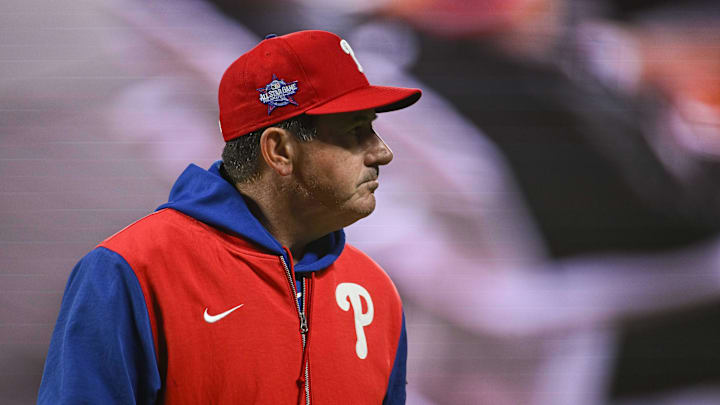
Rob Thomson Had to Go in Philadelphia
In this story:
The firing of Alex Cora made the firing of Rob Thomson easier, if not a necessity. The Boston Red Sox and Philadelphia Phillies are cut from the same cloth: high-payroll teams off to disastrous starts facing April urgency with no avenues to change personnel. The Phillies are in worse shape than even the Red Sox. So, the manager must go.
Managers are fired in bunches. Like paper towels and pet food, scapegoats come in bulk. General managers like the cover of company when it comes to change.
Thomson was fired three days after Cora, just as last year Baltimore fired Brandon Hyde nine days after Pittsburgh fired Derek Shelton, which preceded the firing of Dave Martinez in Washington 49 days later. When poor roster construction leads to poor performance, blame goes to the manager and coaches, not the front office decision makers who put the team together, who have far more job security.
There was a time when general managers were reluctant to fire managers, because that moved them closer to having their own job on the line. As the saying went, GMs got two manager hires, in rare cases three. Times have changed. A.J. Preller of the Padres has fired seven full-time managers in 12 years. The body count around MLB dugouts rises:
- Eleven teams have changed managers in the past 12 months.
- More than half the teams in MLB, 16, have changed managers in the past 20 months.
- Dave Roberts is the only World Series winning manager who still has a managing job with the same organization.
Thomson led the Phillies to four straight playoff seasons with an average of 92 wins per year. Last year they gave the mighty Dodgers all they could handle in the NLDS, suffering all three losses with the tying run at the plate upon the last out.
All that success earned him no more than 28 games of grace. At 9-19, the Phillies are tied with the Mets as the worst teams in baseball (which should make Carlos Mendoza the most nervous man in baseball, especially with Cora out there as an easy choice).
Twenty-eight games seem quick, until you realize that good teams almost never play this badly. Nine and nineteen is a commentary on the Phillies’ problems, not some “unlucky” small sample size that precedes a great recovery. The numbers are staggering in their bluntness of how dire their situation is.
Seventy-five teams in the wild card era have started no better than 9-19. One of them—one!—made the playoffs: the 2024 Astros, who won the AL West with 88 wins because the division was so weak. Seattle finished second with 85 wins.
It’s hard to get your head around how bad the Phillies are in every aspect of the game, a depth for which any manager must bear great responsibility. The offense is shallower than the Schuylkill. The Phillies have dropped from eighth in runs per game last year to 28th this year. The 7-8-9 hitters are batting .209.

Alec Bohm looks as lost as any major league hitter I can remember seeing. He has barreled one ball this season, is hitting .100 against fastballs and has not pulled a hit beyond shortstop. Adolis Garcia, DFA’d by the Rangers, still chases too much and has trouble with spin (.193 last year, .190 this year). Bryson Stott hasn’t hit for three years (OPS+ of 89, fifth worst in MLB among players with 1,000 at-bats). Justin Crawford is a rookie who chases too much. The team has the fifth highest chase rate.
Get past Trea Turner (who is having a down year, which is unsurprising for a shortstop at age 33), Kyle Schwarber and Bryce Harper, and a pitcher can fairly cruise. Those three players have combined for 1.1 WAR. Brandon Marsh is the team leader at 0.6 WAR. All others beyond those four have combined for -1.8 WAR.
The offensive problems are obvious; the defensive shortcomings are a bit less apparent but nearly as corrosive. The Phillies are ranked 23rd by Outs Above Average. Worse, they are allowing a sky-high .354 batting average on balls in play, the highest in baseball. Poor Cristopher Sanchez, the lefthanded sinker specialist, has the highest BABIP in MLB at .423. The average batting average in MLB on groundballs is .246. The Phillies are allowing a .295 average on grounders, worst in baseball.
Philadelphia needs to overhaul its personnel, but there are almost no trades this time of year and top prospect Aiden Miller has been bothered by a recurring back injury since last fall.
The worst thing for a manager on the hot seat is an off day. It causes rumination to replace hope that luck will change in the game that night. The Phillies’ front office had time to ruminate on how bad this team really is. A team with the fifth highest payroll has the worst record in baseball while failing at all phases of the game.
Don Mattingly is a fine and obvious choice to replace Thomson. He has 12 years of managing experience and as Thomson’s bench coach knows the personnel on hand. But it’s not as if he can play a different hand than Thomson. He still has no cleanup hitter and a defense without range.
The most fascinating part of the hire is that the Phillies’ general manager is Mattingly’s son, Preston Mattingly. Don left Toronto, where as bench coach he reached the World Series for the first time, to work with his son. Dave Dombrowski is the Phillies’ president of baseball operations who makes the final calls. His record on managers has some huge hits (Jim Leyland in Florida, Cora in Boston and Thomson in Philadelphia all won pennants or World Series) and misses (he fired Phil Garner in Detroit six games into a season).
But you would think the father-son dynamic between GM and manager gives Don Mattingly more runway than most mid-season hires should expect. Then again, the 1985 Yankees had a father-son manager-player dynamic in Yogi and Dale Berra. Yogi was fired after 26 games.
More MLB from Sports Illustrated
 Add us as a preferred source on Google
Tom Verducci is a senior writer for Sports Illustrated who has covered Major League Baseball since 1981. He also serves as an analyst for FOX Sports and the MLB Network; is a New York Times best-selling author; and cohosts The Book of Joe podcast with Joe Maddon. A five-time Emmy Award winner across three categories (studio analyst, reporter, short form writing) and nominated in a fourth (game analyst), he is a three-time National Sportswriter of the Year winner, two-time National Magazine Award finalist, and a Penn State Distinguished Alumnus Award recipient. Verducci is a member of the National Sports Media Hall of Fame, Baseball Writers Association of America (including past New York chapter chairman) and a Baseball Hall of Fame voter since 1993. He also is the only writer to be a game analyst for World Series telecasts. He lives in New Jersey with his wife, with whom he has two children.