
Marlins Ace Took Run Support Into His Own Hands 30 Years Ago
In this story:
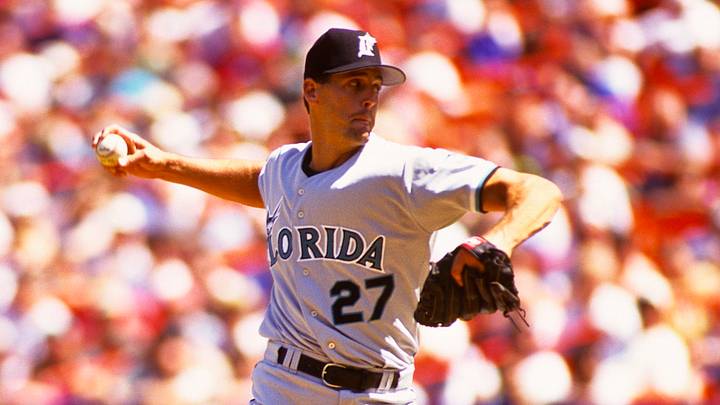
On Aug. 14, 1996, Kevin Brown threw eight innings of one-run ball, allowing only three hits while striking out 10 and walking nobody in Florida's 2–1 victory over the Colorado Rockies. Brown also drove in the Marlins' first run himself, beating out a two-out infield single to bring home a runner.
The Shohei Ohtani impression came at an especially useful time. Brown entered the game receiving the worst run support of any pitcher in the Major Leagues, forcing him to operate with little margin for error throughout one of the best seasons of his career.
Brown's performance that afternoon was another dominant showcase in a season chock-full of them. He eventually finished 1996 with a 17–11 record and an MLB-best 1.89 ERA across 233 innings. An ERA that low, paired with 11 losses, provides a pretty good indication of how little help Brown sometimes received.
Brown's Season Looks Different Through Modern Lens

Brown received just 3.15 runs of support per game that season. This wasn't some curse preventing Brown specifically from receiving help, either. Florida scored 688 runs to finish 27th among MLB's 28 teams.
The lack of offensive support undoubtedly suppressed Brown's win total, and that may have mattered when voters decided who would add the National League Cy Young Award to his trophy case.
Atlanta Braves ace John Smoltz won the 1996 National League Cy Young Award after going 24–8 with a 2.94 ERA and 276 strikeouts across 253 2/3 innings. Brown finished second despite allowing more than a full run fewer per nine innings, receiving only two of the 28 first-place votes.
That does not necessarily mean voters got it wrong. Smoltz pitched more innings, fanned 117 more batters, and led the Majors in both wins and strikeouts during a spectacular season of his own. Still, the comparison provides useful historical perspective on how pitching evaluation has changed.
Wins once occupied a much larger place in conversations surrounding pitching excellence. Modern analysis places greater emphasis on the things a pitcher can control while accounting for factors such as defense and run support. Brown's 17 victories look much different when placed next to the limited offensive help he received.
Had Brown and Smoltz produced the same seasons a decade or two later, the voting likely would have sparked a much closer debate.
Pitchers such as Félix Hernández and Jacob deGrom later demonstrated that voters could look beyond an unimpressive win-loss record when the individual performance was dominant enough.
Brown was evaluated in a very different pitching landscape in 1996. Whether it would have been enough to push him past Smoltz is impossible to know, but his season remains an interesting reminder of how differently baseball has learned to measure dominance.
 Add us as a preferred source on Google
Wesley Dixon is a sports writer focused on thoughtful analysis, roster-building angles, player development and feature-style storytelling. He has covered the Philadelphia 76ers and the NBA, with work centered on breaking down team direction, player fit and the larger stories behind the game. Wesley is a lifelong MLB fan, following multiple teams throughout the league. He is excited to bring that same detail-oriented approach to On SI.