%20%20--%3E%0A%3Csvg%20version%3D%221.1%22%20id%3D%22Layer_1%22%20xmlns%3D%22http%3A%2F%2Fwww.w3.org%2F2000%2Fsvg%22%20xmlns%3Axlink%3D%22http%3A%2F%2Fwww.w3.org%2F1999%2Fxlink%22%20x%3D%220px%22%20y%3D%220px%22%0A%09%20width%3D%2239px%22%20height%3D%2240px%22%20viewBox%3D%220%200%2039%2040%22%20enable-background%3D%22new%200%200%2039%2040%22%20xml%3Aspace%3D%22preserve%22%3E%0A%3Cpath%20fill%3D%22%23FFFFFF%22%20d%3D%22M38.5%2C7H28.2v26h10.3V7z%22%2F%3E%0A%3Cpath%20fill-rule%3D%22evenodd%22%20clip-rule%3D%22evenodd%22%20fill%3D%22%23FFFFFF%22%20d%3D%22M26.1%2C25.5c0%2C5.8-4.1%2C7.5-12.9%2C7.5C3.9%2C33%2C0%2C31.2%2C0%2C25.2v-1.1h11.6%0A%09v2.4c0%2C0.7%2C0.1%2C1.4%2C1.2%2C1.4c1%2C0%2C1.2-0.4%2C1.2-1.3v-0.9c0-1.6-0.9-1.6-3.5-2.2C2.2%2C21.7%2C0%2C19.7%2C0%2C15.3v-0.9C0%2C9.3%2C5.5%2C7%2C12.9%2C7%0A%09c10.2%2C0%2C12.8%2C2.6%2C12.8%2C7.4v1.8h-11v-2.9c0-0.6-0.4-1.1-1.2-1.1c-0.6%2C0-1.2%2C0.4-1.2%2C1.1v0.9c0%2C1.5%2C0.9%2C2%2C3.3%2C2.5%0A%09c8%2C1.6%2C10.5%2C3.3%2C10.5%2C7.5V25.5z%22%2F%3E%0A%3C%2Fsvg%3E%0A)
David Stearns’s Six Biggest Mistakes That Have Sunk the Mets
In this story:
Carlos Mendoza got the axe on Friday, and David Stearns might be next.
The Mets finally dumped their manager after a 34–47 start to the season. After the collapse that kept New York out of the playoffs in 2025, the team’s performance this year has been unacceptable. If it continues, Mendoza likely won’t be the last to go.
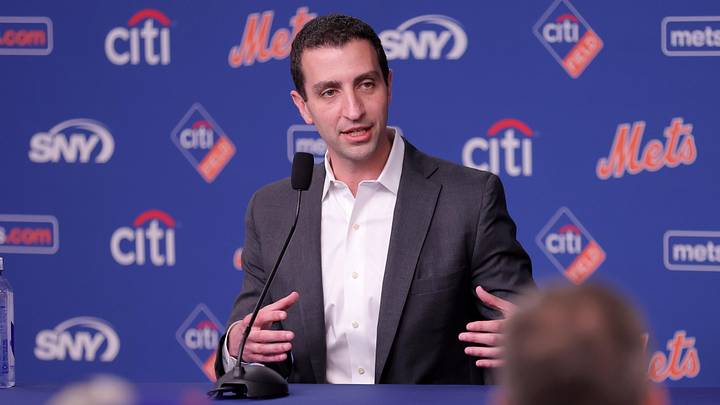
Stearns, the Mets’ president of baseball operations, has been in his position since Oct. 1, 2023. Despite a massive payroll and all the resources he could ask for, New York has been a disappointment in that time. The team reached the postseason in ’24, but fell apart in ’25 and has been worse this season.
While there has been some bad luck, Stearns has made a series of decisions that have put the team in this position. The Manhattan native grew up rooting for the Mets. His hiring after nearly a decade with the Brewers felt like a feel-good homecoming story. It has turned into a mess, and it’s hard to see a way out. The Mets are a $329 million disaster, and his decisions are at the heart of the franchise's problems.
Here’s a look at the six worst moves and decisions Stearns has made during his tenure with the Mets. If he winds up being relieved of his duties, we can point to these as the main issues.
Signing Frankie Montas

Frankie Montas has always been a “what if” guy. He has struggled with injuries and instability throughout his career, but when he has been on, the 33-year-old righty can be dominant. Stearns bet heavily on that ability in December 2024 when he signed Montas to a two-year, $34 million contract that carried a player option for the second season. It has been one of the worst decisions he's made since arriving in Queens.
In 10 MLB seasons, Montas has only made 30 or more starts twice, so it was no surprise when he opened his first season with the Mets on the IL with a lat strain. He wasn’t activated until June 24, and in less than six weeks, he was removed from the starting rotation on August 12 after posting a 6.68 ERA in seven starts. Two weeks and two bullpen appearances later, the Mets announced Montas would need Tommy John surgery to repair an injured UCL in his pitching arm.
Just after the season concluded, Montas exercised his player option for 2026 and was designated for assignment and released by the Mets. They’re paying him $17 million not to pitch this season. He ended his tenure Queens tenure with a 6.28 ERA and a 1.60 WHIP in 38 2/3 innings over nine appearances. Just a disaster of a signing.
Trading for Marcus Semien

The Mets were horrid on defense last season, and that directly contributed to the collapse that left them home during the playoffs. Stearns decided to aggressively address that deficiency this offseason. The first big move he made to improve his team’s defense came on November 24, 2025, when he traded Brandon Nimmo to the Rangers for Gold Glove second baseman Marcus Semien.
Semien helped lead the Rangers to a World Series title in 2023, and he won a Silver Slugger that year, but showed signs of decline thereafter. In his final two seasons in Texas, he slashed .234/.307/.379 with a wRC+ of 96. He remained an excellent defender, but was below average with the bat. Nimmo, a career-long Met, was coming off a season in which he posted a .760 OPS and 25 home runs. He was a below-average defender, but a reliable lefty bat in the lineup.
So far, the Rangers have won this deal. Semien has been awful at the plate, hitting .214 with a .613 OPS. He gets on base just 27.1% of the time, and his bat speed sits in the ninth percentile league-wide. To make matters worse, the 35-year-old’s defense has also taken a massive step back. He has produced -5 outs above average. Semien’s wRC+ of 73 ranks 146th out of 154 qualified MLB hitters, and he’s been worth -0.2 fWAR on the year.
Nimmo has hit .265 with a .757 OPS, eight home runs and a 112 wRC+. He has topped Semien with 1.2 fWAR, but hasn’t exactly lit things up in Texas. Still, he has been a much more productive player while the Mets are starved for offense.
The contracts involved make this deal fascinating. Semien is making $26 million this year and in 2027, before that number drops to $20 million in ’28. There’s a decent chance he gets released long before then despite those lofty numbers. The 33-year-old Nimmo also has a contract likely to age poorly. He’s making $15.25 million this season but is scheduled to make $20.5 million in each of the next four seasons.
Both contracts are bad, but it looks like Stearns and the Mets got the worst of this swap. Especially because they likely could have dumped Nimmo’s contract on several teams in need of a lefty bat over the winter. Instead, they were so single-minded on fixing the team’s defense that they brought in an expensive, aging player who was already on an extreme downward trend.
All six Mets errors tonight pic.twitter.com/gdPw2hH1OA
— Talkin' Baseball (@TalkinBaseball_) June 25, 2026
Allowing Pete Alonso to walk without a replacement

When Pete Alonso hit free agency over the winter, there was a legitimate debate across baseball as to whether he was worth a big, long-term deal. He was coming off an excellent contract year in 2025, in which he slashed .272/.347/.524 with 38 home runs, 126 RBIs, a wRC+ of 141 and 3.6 fWAR. But he was over 30, a righty and provided no defensive value. Teams have shied away from handing big deals to players with that profile.
The Mets opted not to move quickly on Alonso, and the Orioles swooped in with a five-year, $155 million deal that the veteran first baseman gladly signed. The problem isn’t that Stearns didn’t re-sign Alonso; it’s that he didn’t have a replacement for his production lined up.
After a slow start, Alonso has resumed mashing baseballs in Baltimore. Through 82 games, he is slashing .253/.341/.474 with 18 home runs, 55 RBIs, a wRC+ of 126 and 1.8 fWAR. He would currently lead the Mets in home runs and RBIs, and would be second among qualified hitters in fWAR, wRC+ and slugging.
Following Alonso's departure, Stearns needed to pivot for a big bat. He failed to do so. Instead, he inked Jorge Polanco to a two-year, $40 million contract that has been a disaster. Polanco has only played in 14 games this season due to wrist and Achilles injuries. He’s currently on the 60-day IL, and has produced a .532 OPS, one home run and two RBIs.
Another massive miscalculation that has served to really hurt New York’s offense.
Signing Devin Williams coming off of his worst season
Devin Williams was one of baseball’s best relievers at the end of the 2024 season. The Brewers capitalized on his value by sending him to the Yankees in December of that offseason in exchange for Nestor Cortes, Caleb Durbin and cash. He proceeded to have the worst season of his career in '25. Somehow, Stearns saw that and decided to buy.
In 67 appearances for the Yankees last season, Williams went 4–6 with a 4.79 ERA, 1.13 WHIP, and 90 strikeouts against 25 walks in 62 innings. His numbers were worse across the board as he produced 1.4 fWAR. Despite those issues, when the 31-year-old hit free agency this winter, the Mets handed him a three-year, $51 million deal. Stearns was banking on a big bounce-back. It hasn’t happened.
Williams has made 29 appearances this season and has a 3–2 record with a 4.44 ERA, 1.52 WHIP, and 40 strikeouts against 15 walks in 26 1/3 innings. His strikeout rate has dropped from a career-best of 43.2% in 2024 to 33.6%, while his walk rate is up to a career-worst 12.6%. Opponents are hitting .240 against him, which is nearly double the mark of .129 they produced during his last All-Star season in 2023. Williams's 0.6 fWAR has him on pace to top the mark he had with the Yankees last year, but he is far from being the elite pitcher who won NL Reliever of the Year in 2020 and ‘23.
The fact that Stearns watched Williams fall apart in the Bronx during the 2025 season and decided a raise and a move to Queens in ’26 would fix him was overly optimistic at best.
Luis Robert Jr. Trade

As part of the push to improve the team’s defense, Stearns made a January trade for former Gold Glove center fielder Luis Robert Jr. He sent Luisangel Acuña and Truman Pauley to the White Sox to add Robert, who was an All-Star in 2023. The 28-year-old had played more than 110 games one time in his six-year career and, not surprisingly, ended up on the IL with a back injury after only playing 24 games to open the season.
During his All-Star season in 2023, Robert blasted a career-high 38 home runs, while slugging .542 in 145 games. He has been a shell of himself since. Over the last two seasons, he combined to slash .223/.288/.372 with 28 home runs and a wRC+ of 84 in 210 games. It’s a small sample size, but he’s been the same guy with the Mets. In those 24 games, he has slashed .224/.327/.329 with a 92 wRC+ and produced 0.1 fWAR.
Robert is playing the 2026 campaign on a $20 million contract that has a club option for another $20 million next season. It’s highly unlikely it gets exercised.
Continuing this winter's theme, Stearns bet on a former All-Star who was rapidly diminishing and expected a bounce back.
Failing to fully address the starting rotation
In 2025, the Mets’ starting rotation ranked 18th in baseball with a 4.13 ERA. That needed to improve if the team wanted to contend in ’26.
Stearns entered the offseason needing to fix that broken rotation. Kodai Senga fell apart last year while Clay Holmes was solid but not spectacular in his first full season as a starter. Rookie Nolan McLean had the makings of an ace, but between David Peterson, Sean Manaea and prospects Jonah Tong and Brandon Sproat, there wasn’t much else promising in a rotation that needed frontline help to compete for a postseason berth. Addressing that deficiency had to be a priority. It wasn’t.
Yes, Stearns swung a deal to land Freddy Peralta from the Brewers in a deal that included Sproat—which was the kind of big move he needed to make—but he didn’t add enough around Peralta and McLean to create the kind of scary starting staff contenders need. The results have been as you’d expect.
Holmes fractured his right fibula in mid-May and is on the 60-day IL. McLean (4–5, 4.03 ERA) has been up and down despite showing incredible stuff. Peralta has flopped. The reigning NL wins leader is 5–6 with a 4.53 ERA and a 1.37 WHIP. Peterson started the season 3–6 with a 6.09 ERA and a 1.65 WHIP before being traded to the Cubs. Senga made seven starts and posted a—shield your eyes—10.08 ERA, while Manaea has mostly pitched out of the bullpen, and his fastball velocity has dropped a full tick from 2025.
The Mets’ starting rotation currently ranks 28th in baseball with a 4.90 ERA. Only the A’s (4.99) and Rockies (5.92) are worse, and both teams play in extreme hitters' parks. Citi Field is decidedly not that.
Stearns’s tenure has been a mix of poor decisions and bad luck. He has been fully aware of his team’s issues, and most of his big decisions have actually made the Mets worse.
With Mendoza gone, Stearns is firmly in the crosshairs because if the franchise can’t turn things around or show life soon, there will be no one left to blame but the guy in charge.
More MLB from Sports Illustrated
 Add us as a preferred source on Google
Ryan Phillips is a senior writer on the Breaking and Trending News team at Sports Illustrated. He has worked in digital media since 2009, spending eight years at The Big Lead before joining SI in 2024. Phillips also co-hosts The Assembly Call Podcast about Indiana Hoosiers basketball and previously worked at Bleacher Report. He is a proud San Diego native and a graduate of Indiana University’s journalism program.
Follow rumorsandrants