%20%20--%3E%0A%3Csvg%20version%3D%221.1%22%20id%3D%22Layer_1%22%20xmlns%3D%22http%3A%2F%2Fwww.w3.org%2F2000%2Fsvg%22%20xmlns%3Axlink%3D%22http%3A%2F%2Fwww.w3.org%2F1999%2Fxlink%22%20x%3D%220px%22%20y%3D%220px%22%0A%09%20width%3D%2239px%22%20height%3D%2240px%22%20viewBox%3D%220%200%2039%2040%22%20enable-background%3D%22new%200%200%2039%2040%22%20xml%3Aspace%3D%22preserve%22%3E%0A%3Cpath%20fill%3D%22%23FFFFFF%22%20d%3D%22M38.5%2C7H28.2v26h10.3V7z%22%2F%3E%0A%3Cpath%20fill-rule%3D%22evenodd%22%20clip-rule%3D%22evenodd%22%20fill%3D%22%23FFFFFF%22%20d%3D%22M26.1%2C25.5c0%2C5.8-4.1%2C7.5-12.9%2C7.5C3.9%2C33%2C0%2C31.2%2C0%2C25.2v-1.1h11.6%0A%09v2.4c0%2C0.7%2C0.1%2C1.4%2C1.2%2C1.4c1%2C0%2C1.2-0.4%2C1.2-1.3v-0.9c0-1.6-0.9-1.6-3.5-2.2C2.2%2C21.7%2C0%2C19.7%2C0%2C15.3v-0.9C0%2C9.3%2C5.5%2C7%2C12.9%2C7%0A%09c10.2%2C0%2C12.8%2C2.6%2C12.8%2C7.4v1.8h-11v-2.9c0-0.6-0.4-1.1-1.2-1.1c-0.6%2C0-1.2%2C0.4-1.2%2C1.1v0.9c0%2C1.5%2C0.9%2C2%2C3.3%2C2.5%0A%09c8%2C1.6%2C10.5%2C3.3%2C10.5%2C7.5V25.5z%22%2F%3E%0A%3C%2Fsvg%3E%0A)
The Paul Skenes Dilemma (Continued)
In this story:
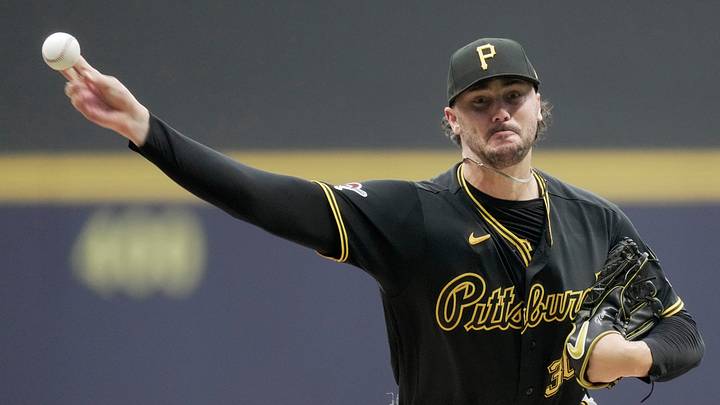
Paul Skenes of the Pirates is not right, both in mechanics and confidence, and Pittsburgh manager Don Kelly knows it. So, when Skenes arrived at PNC Park Saturday, after throwing a full bullpen session Friday in anticipation of his regular turn Sunday, Kelly told him he was delaying his start until Wednesday, giving him three more days of “recovery.”
The concern is obvious. Kelly pulled Skenes from his last start after five innings and only 65 pitches because Skenes was spraying his fastball and the life on his pitches was clearly missing. Skenes averaged just 95.7 mph on his four-seamer in that game in Miami, easily a career low. It was a new bottom to a two-month slump in which Skenes is 3-6 with a 5.01 ERA, the worst stretch of pitching in his life.
“They have been diving into everything,” Kelly said about the pitching staff and Skenes trying to address what has gone wrong. Kelly mentioned one theory about Skenes possibly being too “counter-rotational,” a flaw in his whipsaw, unorthodox delivery in which he pulls his arm too far behind him.
But the big problem has been Skenes’s stride direction. I detailed last week here how Skenes’s slump began immediately when he changed his stride direction to be less crossfire and more directional to the plate. By stepping more to the plate and less toward the third base side of the mound, Skenes reduced the offset angle of his delivery by as many as eight inches. He lost one of his superpowers, his harsh horizontal attack angle, especially against righthanded hitters. The move may have been an attempt to be less counter-rotational.
Then, just as suddenly, Skenes returned to his usual offset form in the start in Miami. With a readjusted stride direction, he was back to releasing the ball 30 inches offset from mid-rubber, rather than the 24 inches from his previous start. That is no small change.
Look at the seesaw nature of his horizontal release point:
Skenes Horizontal Release Point
Games Started | Average | |
|---|---|---|
Through June 8 | 13 | -2.54 |
June 9-Aug. 5 | 11 | -2.16 |
Aug. 11 | 1 | -2.54 |
The batting average by righthanded hitters during the slump shot up to .301, as compared to .193 before the stride direction change.
And here is the update on the chart I created last week. Note the abrupt and drastic correction in his last start:

Skenes looked more like himself mechanically in Miami, but the bigger concern now is that the ball is not coming out of his hand the way that it should. Kelly knows this. Skenes is not hurt. He simply looks exhausted. The mechanical tweaks and the burden of not pitching well as Pittsburgh fell out of the race have worn him down. He needs a break.
In part, Skenes is a victim of the phenomenal nature of his arrival in the big leagues in 2024. He was a freakish nightmare for hitters. It wasn’t just that he was the hardest-throwing starter in MLB with an average four-seam velocity of 98.8. The metrics of his fastball were never great — below average spin and below average induced vertical break. But the pitch was dominant for two reasons: elite velocity and an unconventional attack angle.
As the hardest-throwing starter in 2024, for instance, Skenes threw from a below-average release height with an above-average offset point. The only other such low-slot, offset power pitchers (averaging at least 96+ MPH) were Grayson Rodriguez, Michael Kopech, Luis Gil (all of whom broke down) and Cade Smith, a reliever.
This year, Skenes lost the two factors that made his fastball great: the elite velocity and the unconventional attack angle. His low-spin, low-vert fastball is too conventional to work well without those signature superpowers.
How important is velocity to Skenes? He’s no different than any pitcher. Velo matters. A drop from 98.8 mph in 2024 to 95.7 in his last start is huge and alarming. Losing two to three miles per hour makes every fastball more hittable, including his, as you can see here:
Skenes Fastball by Velocity Range, 2026
Number | Spin | H. Rel | Average | SLG | |
|---|---|---|---|---|---|
96 MPH and Slower | 142 | 2,096 | 2.24 | .259 | .630 |
96.1 MPH to 97 MPH | 331 | 2,164 | 2.25 | .213 | .360 |
97.1 MPH+ | 402 | 2,212 | 2.32 | .188 | .306 |
Skenes has a solid work ethic and has been grinding to get right. That grind is catching up to him as the results remain elusive. Kelly is doing the right thing to give him more time for mental and physical recovery. And it may not be a one-time fix. It may be smart for Pittsburgh to continue to give Skenes extra rest between starts the rest of the season.
 Add us as a preferred source on Google
Tom Verducci is a senior writer for Sports Illustrated who has covered Major League Baseball since 1981. He also serves as an analyst for FOX Sports and the MLB Network; is a New York Times best-selling author; and cohosts The Book of Joe podcast with Joe Maddon. A five-time Emmy Award winner across three categories (studio analyst, reporter, short form writing) and nominated in a fourth (game analyst), he is a three-time National Sportswriter of the Year winner, two-time National Magazine Award finalist, and a Penn State Distinguished Alumnus Award recipient. Verducci is a member of the National Sports Media Hall of Fame, Baseball Writers Association of America (including past New York chapter chairman) and a Baseball Hall of Fame voter since 1993. He also is the only writer to be a game analyst for World Series telecasts. He lives in New Jersey with his wife, with whom he has two children.