
Colt Keith Must Rediscover Key Strength to Secure His Place With the Tigers
In this story:
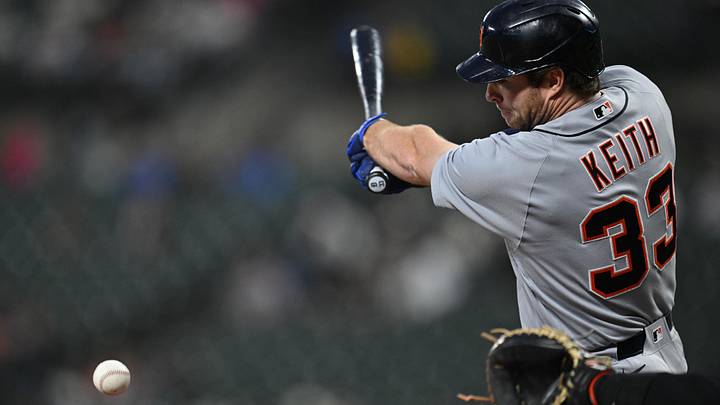
Since his debut in 2024, Colt Keith has had the third-most plate appearances for the Detroit Tigers, accumulating 1,447, only behind Riley Greene (1,831) and Spencer Torkelson (1,642), who lead the team.
During that span, Keith has accumulated 4.6 fWAR, the fifth-highest on the team, trailing only two other infielders, 2026 American League Rookie of the Year Kevin McGonigle (5.4 fWAR) and Zach McKinstry (5.0). That impact clearly makes Keith one of the team's most impactful players, with sustained performance that, although it hasn't been first-rate, has offered the Tigers some offensive stability.
However, I think we should analyze the aspect that generates the most uncertainty about Keith's future, as he will remain under team control through 2029 after signing a six-year extension in January 2024 worth $28,642,500 guaranteed, which includes club options for 2030 ($10 million), 2031 ($13 million), and 2032 ($15 million). The total value of the deal could reach $82 million if all three options are exercised and the corresponding incentives are applied.
Will He Be Able to Repeat His 2025 Offensive Version?

The decline from 7.4 to 4.7 in his Off (the statistic FanGraphs uses to illustrate a player's offensive value compared to the league average) may not seem as alarming as its repercussions, which were mostly reflected in Keith's walk rate, which, after improving from 6.5% in his 2024 debut to 10.3% in 2025, declined again, finishing at 7.6% this year.
That caused Keith to regress from the 73rd percentile in BB% to the 27th, much closer to his 26th percentile in 2024. It is worth noting that Keith improved his strikeouts, reducing his rate from 21.8% last year to 19.9% and, at the same time, his BABIP was not affected, although his .305 average has been the lowest after recording .306 and .307 in his first two years, respectively.
As expected, when we see a decline of this magnitude, like the one Keith had in his walk rate, we almost always think about the possibility that he was a more aggressive hitter, but that was not the case. In fact, in 2026, his O-Swing% rate was the lowest of his career, at 24.6%, as was his Z-Swing%, which was 62.8% and has dropped 5.0 percentage points since he recorded 67.8% in his debut. So, once again, all this leads us back to his plate discipline, and I think the turning point was the regression of his walk rate against right-handed pitchers, which fell in 2026 to 8.0% after reaching the highest point of his career at 10.7% in 2025.

Although Keith's on-base percentage was not directly affected and he finished with the same .316 BABIP, his final impact, with a 112 wRC+, fell short of last year's 118. To this, of course, we must add his big problem against left-handed pitchers, who have limited Keith to a batting line of just .235/.283/.275, with only one home run and a puzzling 60 wRC+. Unlike his ability to draw walks against right-handers, Keith has seen his ability limited, with a rate of just 5.7%, while striking out in 25.2% of his plate appearances.

That problem, of course, has led Detroit to use Keith less and less when facing left-handed starting pitchers, limiting his plate appearances from 88 in 2024 to just 25 throughout 2026, when his wRC+ dropped from 13 to -24. That said, we cannot forget that when Keith made his Major League debut, the first thing that sparked interest in Detroit was how he hit left-handed pitchers, producing a batting line of .305/.352/.366, without much power (he produced a .718 OPS), but with a 108 wRC+ that exceeded the league average.
Since then, that impact has disappeared and, although he will still be a player to keep in mind in the team's future, Keith will have to work to change that negative story of the last two seasons or, otherwise, he could be increasingly displaced from his role as a starter.
 Add us as a preferred source on Google

Yirsandy is a baseball writer specializing in MLB coverage with experience across multiple teams and storylines. He currently writes for Diamond Centric, where he covers the New York Mets, San Diego Padres, Chicago Cubs, Milwaukee Brewers, and Kansas City Royals. My work focuses on game coverage, player analysis, and storytelling that connects performance with context. My Substack has also been an important part of my writing development, where I’ve built much of my baseball coverage and storytelling voice over time. I’m passionate about combining reporting, research, and thoughtful analysis to produce engaging baseball content for readers.
Follow Yirsandy