
The Left-Handed Gamble That Could Give Tigers More Value Than It Costs
In this story:
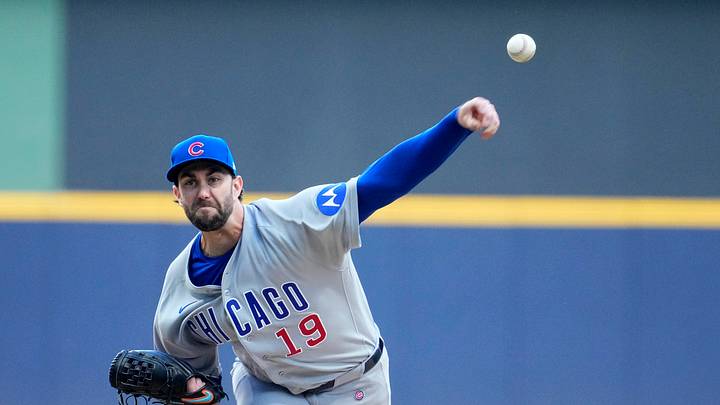
If I had to choose a pitcher who is not very expensive in free agency and could fit into the Detroit Tigers’ rotation, one of my selections would be left-hander David Peterson for several reasons that project interesting value.
Peterson, 31, is among just 15 left-handed starting pitchers who have accumulated at least 400 innings pitched over the last three seasons, and I think his impact has been a little undervalued. Although he has gone through injuries and complicated situations due to his command problems, he is in the middle of the list with 23.7 batters faced per game and stands out as the third pitcher with the highest GB/FB rate (2.01) —among only three who exceed 2.00—, in addition to recording the fourth-lowest Soft% (14.1) and HR/9 (0.67) rates.
What has been his biggest problem? Yes, he has the highest walk rate in the entire group, with a 9.4 BB%. After Peterson went from the New York Mets to the Chicago Cubs in late June, much of his control problems showed an interesting improvement. His walk rate of 4.04 had a slight drop to 3.82 during the second half of the season.
That small step forward led to a much more significant adjustment because it allowed him to pitch with less pressure in the counts and, following his adjustments with the four-seam fastball and sinker, he finished by raising his K-BB% from 8.6 to 13.9.
With more strikeouts, fewer walks and his usual home run prevention, Peterson improved his xFIP from 4.34 to 3.44 after the All-Star break and finished in great form, unlike other additions who arrived at the Cubs at the trade deadline, such as Kevin Gausman and Clay Holmes, who were unable to offer the sufficient depth the team needed.
Advantages and Disadvantages if the Tigers bet on Peterson

Peterson improved from the 35th to the 54th percentile in reducing his opponents’ contact when he pitched in the strike zone and reduced his Hard Hit% rate from 46.2% to 37.2% when he went from the Mets to the Cubs. This showed that he can still have an impact as a left-handed pitcher when his control is in optimal shape.
An interesting point for Detroit is that Peterson should not be an expensive pitcher, since he could be attainable for around $13 million if the idea is to offer him a one-year contract. His improvements at the end of 2026 and the projections that place him as a starter capable of pitching more than 140 innings, with a 4.02 xFIP, support that possibility. This last figure is quite close to the version we saw with Chicago, where he finished the year with a 3.84 xFIP in 15 starts.
Now, looking ahead, his biggest questions lie in the uncertainty that has followed his repertoire over the last few seasons, with a regression in the Run Value of three of his main pitches, starting with the sinker, curveball and changeup. Between 2024 and 2025, Peterson recorded an average RV of 8.8 with his three main weapons, but in his 23 outings in 2026 he dropped to -3.1 because of the inconsistency he went through with his curveball (-4.6) and changeup (-5.5).

The good news is that his slider improved considerably when he arrived in Chicago: its RV increased from -7.7 in the stretch between 2024 and 2025 to 3.8. Added to those advances was the impact of his four-seam fastball (3.5) and sinker (2.9).
For Detroit, the duo of Framber Valdez and Peterson is not exactly a combination with a high potential to avoid contact, but both have been two of the left-handed pitchers with the greatest ability to generate weak contact, get a lot of ground balls and avoid home runs. These are several of the most interesting aspects of his profile, whose value could increase as the Tigers’ defense also manages to take a step forward in quality next season.
 Add us as a preferred source on Google

Yirsandy is a baseball writer specializing in MLB coverage with experience across multiple teams and storylines. He currently writes for Diamond Centric, where he covers the New York Mets, San Diego Padres, Chicago Cubs, Milwaukee Brewers, and Kansas City Royals. My work focuses on game coverage, player analysis, and storytelling that connects performance with context. My Substack has also been an important part of my writing development, where I’ve built much of my baseball coverage and storytelling voice over time. I’m passionate about combining reporting, research, and thoughtful analysis to produce engaging baseball content for readers.
Follow Yirsandy