%20%20--%3E%0A%3Csvg%20version%3D%221.1%22%20id%3D%22Layer_1%22%20xmlns%3D%22http%3A%2F%2Fwww.w3.org%2F2000%2Fsvg%22%20xmlns%3Axlink%3D%22http%3A%2F%2Fwww.w3.org%2F1999%2Fxlink%22%20x%3D%220px%22%20y%3D%220px%22%0A%09%20width%3D%2239px%22%20height%3D%2240px%22%20viewBox%3D%220%200%2039%2040%22%20enable-background%3D%22new%200%200%2039%2040%22%20xml%3Aspace%3D%22preserve%22%3E%0A%3Cpath%20fill%3D%22%23FFFFFF%22%20d%3D%22M38.5%2C7H28.2v26h10.3V7z%22%2F%3E%0A%3Cpath%20fill-rule%3D%22evenodd%22%20clip-rule%3D%22evenodd%22%20fill%3D%22%23FFFFFF%22%20d%3D%22M26.1%2C25.5c0%2C5.8-4.1%2C7.5-12.9%2C7.5C3.9%2C33%2C0%2C31.2%2C0%2C25.2v-1.1h11.6%0A%09v2.4c0%2C0.7%2C0.1%2C1.4%2C1.2%2C1.4c1%2C0%2C1.2-0.4%2C1.2-1.3v-0.9c0-1.6-0.9-1.6-3.5-2.2C2.2%2C21.7%2C0%2C19.7%2C0%2C15.3v-0.9C0%2C9.3%2C5.5%2C7%2C12.9%2C7%0A%09c10.2%2C0%2C12.8%2C2.6%2C12.8%2C7.4v1.8h-11v-2.9c0-0.6-0.4-1.1-1.2-1.1c-0.6%2C0-1.2%2C0.4-1.2%2C1.1v0.9c0%2C1.5%2C0.9%2C2%2C3.3%2C2.5%0A%09c8%2C1.6%2C10.5%2C3.3%2C10.5%2C7.5V25.5z%22%2F%3E%0A%3C%2Fsvg%3E%0A)
Dustin May’s Deal With the White Sox Is Music to the Ears of His Peers
In this story:
Following an impressive showing in the 2026 postseason, the White Sox are addressing one of their most pressing needs in free agency.
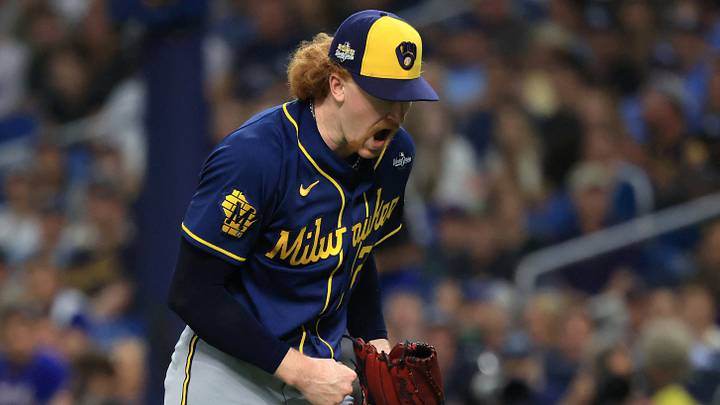
Chicago and free agent starting pitcher Dustin May agreed to a three-year deal worth $52.5 million on Tuesday. May is fresh off a World Series title with the Brewers, whom he often served as an opener of sorts, logging 11 innings in five playoff appearances.
May started the season with the Cardinals before landing with the Brewers at the trade deadline. He made 31 starts throughout the campaign, including 10 with Milwaukee, and had a 4.70 ERA (3.63 FIP) with 144 strikeouts against 50 walks in 145 2/3 innings. For the Brewers, he had a 5.65 ERA (5.06 FIP) in the regular season and a 5.73 ERA (3.37 FIP) across 11 postseason innings. Those aren’t very impressive numbers on the surface, and though there’s reason to believe he can outperform them with Chicago, May’s deal will certainly delight his mid-rotation peers on the open market.
Why this deal makes sense
The White Sox were desperate to add to their starting rotation this offseason. Last year, Chicago’s starters threw the fewest innings in MLB (674 2/3). They were one of two teams (along with the Nationals) whose relievers pitched more innings than their starters. Their lack of a stalwart rotation was clear in the postseason, too, when they didn’t have a single starting pitcher throw more than five innings in a game. In fact, Chicago’s bullpen covered 44 1/3 innings in the postseason while its starters lasted just 17 2/3 innings across their seven games.
It’s clear the team needs its rotation to cover more innings on a nightly basis, and May can certainly help in that regard. He will provide some needed stability to the White Sox’ rotation and help the team be less reliant on its bullpen in 2027. May pitched five or more innings in 18 of his 31 starts last season, and though his numbers weren’t great, he’s a clear upgrade for the middle or back end of the rotation.
Furthermore, despite having four World Series titles under his belt, May is only 29 years old. He has plenty of postseason experience, which was likely a factor after the White Sox’ playoff run last year. May has appeared in 14 postseason games, which is comfortably more than any other member of Chicago’s pitching staff (though Luis Castillo has pitched 28 postseason innings to May’s 25).
1st major addition of the #WhiteSox offseason
— Adrian White (@AdrianWhiteSox) November 17, 2026
Dustin May gets 3 years, $52.5M, per @JRFegan. @ByRobertMurray had the agreement 1st.
4.70 ERA in 26’, but a 3.63 FIP across 145.2 IP (career-high). pic.twitter.com/pWQAit4pQF https://t.co/Fu8Ecluxg8
Dustin May (signed with CWS) is a hard-throwing righty with incredible spin capacity. He was a sought after arm each of the last two trade deadlines and now lands a multi-year deal. His underlying metrics were much stronger than his near-5 ERA would indicate and he adds firepower… https://t.co/bs0DnxvDpg pic.twitter.com/rIChBAetx2
— Thomas Nestico (@TJStats) November 17, 2026
Biggest risk factors
May’s production on the mound hasn’t matched the hype that once accompanied him as a top Dodgers prospect, particularly over the last few years, but he’s now in line to make $17.5 million annually for the next three seasons. That’s quite a bit of money to tie up in a pitcher who has recorded negative bWAR in each of the last two seasons and has a 4.82 ERA across his last 56 appearances. May doesn’t rack up a ton of strikeouts, and his go-to breaking ball, his sweeper, wasn’t very effective in this year, registering -6 run value, according to Statcast.
The May deal seems like an overpay on the side of the White Sox at first glance. My colleagues Will Laws and Nick Selbe projected him to garner a two-year contract worth between $32–34 million. May immediately becomes the team’s second-highest paid player behind only Castillo, who is in the final year of the five-year, $108 million deal he signed with the Mariners after the 2022 season.

Roster implications for the White Sox
The White Sox have a handful of pitchers competing for a spot in their starting rotation, and now one of those spots will be occupied by May. Martin and Burke figure to be mainstays, and Chicago is expected to transition Grant Taylor into a starter role, too. That leaves just one vacancy in the rotation for the likes of Anthony Kay, Noah Schultz, Hagen Smith, David Sandlin and Castillo to compete for.
The rotation now also consists of four right-handed pitchers, meaning the last spot will more likely be handed to a lefty like Kay, Smith or Schultz, as both Sandlin and Castillo are righthanders.
Market impacts
May’s deal is a great sign for other starting pitchers looking to secure a paycheck this offseason. The $52.5 million deal will see him earn $17.5 million per season, which is more than most projections had him in line to make. If May, with his lackluster numbers, can secure that kind of deal, the floor for a deal for pitchers in a higher tier, such as Trevor Rogers, Michael King and Freddy Peralta, among others, may also be elevated.
As for middle-of-the-rotation free agents, such as Shota Imanaga, Michael Soroka and Foster Griffin, they now have a blueprint to follow in their own negotiations this offseason. May’s deal could result in a handful of mid-tier starters getting bigger deals than previously anticipated.
Dustin May (signed with CWS) is a hard-throwing righty with incredible spin capacity. He was a sought after arm each of the last two trade deadlines and now lands a multi-year deal. His underlying metrics were much stronger than his near-5 ERA would indicate and he adds firepower… https://t.co/bs0DnxvDpg pic.twitter.com/rIChBAetx2
— Thomas Nestico (@TJStats) November 17, 2026
Winners and losers
May’s decision to decline the $20 million mutual option in his deal with the Brewers makes Milwaukee a winner of this signing. The Brewers likely weren’t too keen on bringing him back at such a tall price tag, and his decision to reach the open market triggered a $500,000 buyout. Essentially, the Brewers saved $19.5 million by May opting for free agency.
But May himself is also a big winner here. Rather than play out next season on a one-year, $20 million deal, he landed himself some security and longevity with his new contract in Chicago. It’s a minor AAV decrease, but he’s now locked in to make $52.5 million over the next three years. Had he returned to Milwaukee and struggled, his market next offseason wouldn’t have been so fruitful.
Other winners of the deal are the remaning free agent pitchers, who can now use May’s deal as a starting point in their own negotiations. The White Sox set the market for starting pitching with May’s contract, and other starters will refer back to this deal as they negotiate their own pay days.
It’s difficult to find an obvious loser in this deal unless May tanks out of the gate next year and proves to be unreliable even as an innings eater. But he seems capable of fulfilling at least that role.
 Add us as a preferred source on Google

Karl Rasmussen is a staff writer for Sports Illustrated. A University of Oregon alum who joined SI in February 2023, his work has appeared on 12up and ClutchPoints. Rasmussen is a loyal Tottenham, Jets, Yankees and Ducks fan.
Follow Karlras920